


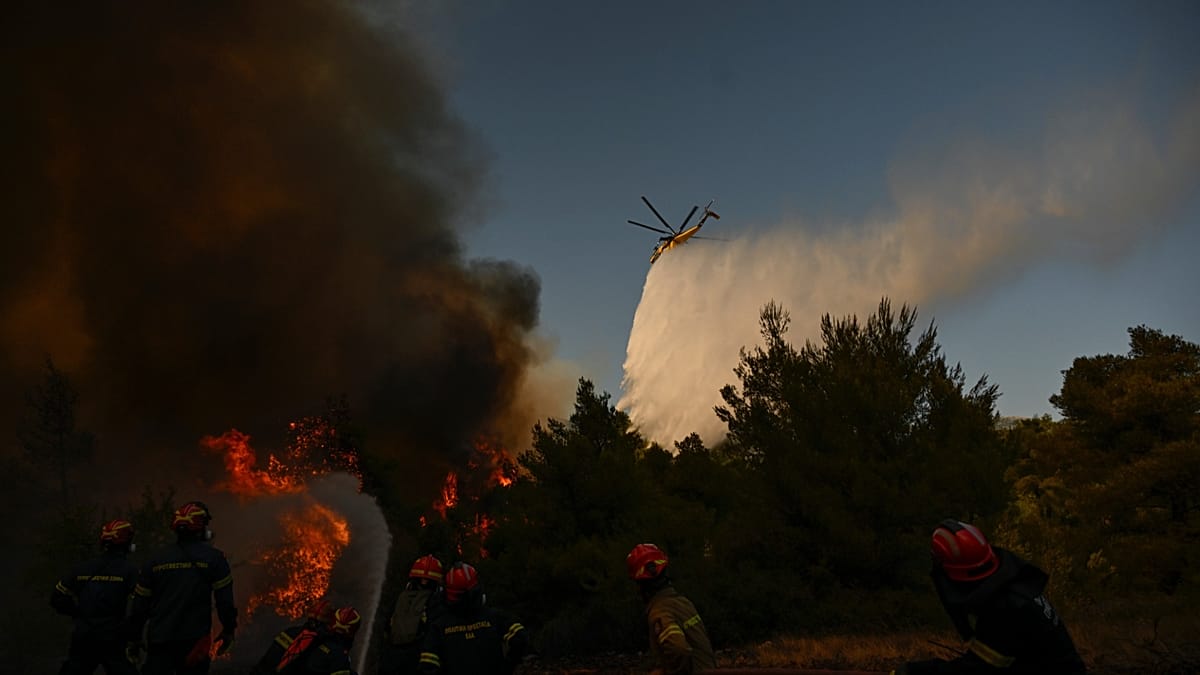
Five water-dropping planes and another five helicopters took off at first light on Monday to help hundreds of firefighters battling a major wildfire west of Athens, a day after a mid-air collision between two firefighting helicopters killed two crew members.
ADVERTISEMENT


ADVERTISEMENT
The collision laid bare the danger at the most volatile front of Europe’s wildfire emergency.
The two crew members, one Greek and one Danish national, died when their helicopter collided with another near the seaside area of Psatha while tackling the fire that started Friday morning.
The blaze raged through pine forests and scrubland through the weekend, whipped by gale force winds that often prevented water-dropping planes from operating.
The crew of the second helicopter, a Greek and a British national, were taken to a hospital, where their injuries were reported to be light. Foreign firefighting and helicopter crews are often deployed in Greece to help tackle wildfires during the country’s hot, dry summers.
Greek Prime Minister Kyriakos Mitsotakis expressed his sorrow after the crash.
“The loss of the Greek coordinator and the Danish pilot as they were fighting the major blaze at Porto Germeno fills us all with grief. My sincere condolences to their families,” he said.
Easing winds raise hopes of halting the advance of the flames
Flames bore down deeper into the region of the Greek capital, forcing fresh evacuations in the early hours of Monday.
But strong winds were dying down, raising hopes that the nearly 500 firefighters battling the blaze could manage to halt its advance.
Authorities warned the broader Athens region of Attica remained at a high risk for wildfires due to a forecast increase in temperatures.
More than 1,000 people have been evacuated from the region, including more than 250 rescued by boats from beaches in the area.
Evacuation orders were issued in the early hours of Monday for three more areas, while crews worked to create firebreaks in a forest to help halt the advance of the blaze.
Greece’s firefighting department said on Sunday the fire apparently began from sparks emitted by a faulty power line transporting electricity from a private wind generator facility to the main electricity network.
Two people were arrested, an electrical engineer responsible for designing and overseeing the power project and a contractor involved in constructing the electricity transmission network. Both face felony arson charges, while authorities had also issued an arrest warrant for the owner of the wind generator company.
Greece has devastating wildfires every summer, with hot, dry conditions and frequently strong winds making it easy for small sparks to trigger major blazes.
Measures to limit fire risks, such as bans on barbecues and certain outdoor work such as welding and use of electrical power saws are often ignored. The vast majority of the hundreds of wildfires the country has each year are caused by negligence.
But some fires are deliberately set. On Sunday, authorities said one man was arrested on Kefalonia on suspicion of having started a fire that spread quickly in the southeastern part of the island, triggering the evacuation of nearby villages.
Major blaze in France contained but hotspots remain
Farther west, France’s largest wildfire remained held within its perimeter on Sunday night after forcing 224,000 people to flee in what may have been the country’s largest civilian evacuation outside wartime.
Hot spots still burned within a 420-square-kilometre scar, thousands remained unable to return home and nearly 3,000 firefighters were deployed against the Gironde megafire and a second blaze in Provence.
Together, fires in France and Spain have driven roughly a third of a million people from homes and vacation sites, emptied communities at the height of the European summer and stretched emergency services across simultaneous disasters.
Additional sources • AFP