

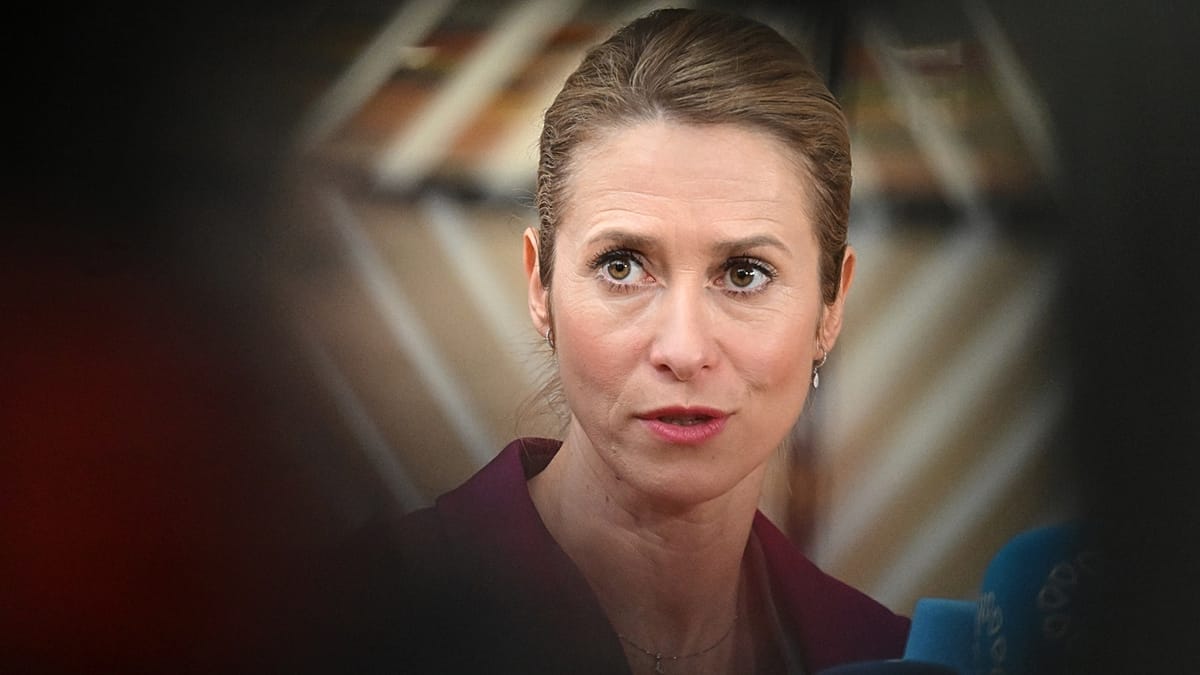
Kaja Kallas has been caught in a political whirlwind after an informal document linked to the French government floated several ideas to drastically revamp her position of High Representative, the European Union’s foreign policy chief.
ADVERTISEMENT


ADVERTISEMENT
The paper pitches three options, one of which would strengthen her portfolio and expand her competencies into trade and economic development. The other two options, however, would severely weaken her role by shifting powers either to the European Commission, led by Ursula von der Leyen, or to the member states.
Amid the damaging headlines, Kallas opened the door for a fresh debate but made it clear that, at the end of the day, the EU treaties, which establish the substance of the High Representative’s mandate, will have the final say.
“It is important to recall that the roles and responsibilities of the EU institutions are clearly defined in the treaties. That framework remains unchanged,” Kallas said in an internal email sent to staff and seen by Euronews.
The French paper landed at a time when the critics of Kallas were becoming increasingly vocal about their dissatisfaction with her performance. The High Representative has ruffled feathers for her comments on China, for insisting on using Russia’s immbolised assetsto support Ukraine, for her strained ties with the US administration, and for tabling ambitious plans without prior consultation with capitals.
Overall, her critics argue that she still behaves like the outspoken prime minister of Estonia she once was, advancing positions that go beyond the consensus endorsed by the EU’s 27 member states and at times veer into personal opinion.
Slovak Prime Minister Robert Fico, a frequent critic of Brussels known for his contrarian stance, has called for her dismissal several times.
Speaking on condition of anonymity, multiple diplomats from different countries acknowledged that the backlash against Kallas has intensified in recent weeks. However, they disagreed with the French paper, which only a few appear to have actually read.
“She does, unfortunately, a lot to lose support. She is not very good at building alliances in the Council,” a senior diplomat said.
“But France is currently in all-attack mode against all institutions.”
France has since toned down the document, saying it was an exploratory note that had not been validated by the government.
Mission impossible
The real problems, diplomats say, go beyond Kallas.
They stem from a complex and outdated institutional setting that places the High Representative between the European Commission, the independent executive, where she serves as one of the vice presidents, and the European External Action Service (EEAS), the bloc’s diplomatic arm, which she leads on her own.
On top of that, foreign policy at the EU level is bound by unanimity, which means the decision-making is strictly within the remit of capitals. One single “no” is enough to derail an entire course of action, even a mundane statement.
In practice, this leaves Kallas in charge of steering a foreign policy whose direction ultimately escapes her control.
“The EEAS and the position of High Representative were created in a different time and age, when the world looked completely different. If you were to create the system from scratch, you wouldn’t do it now the way it was done then,” another senior diplomat said.
“Could the EEAS function better? Probably yes. Could the High Representative do things differently in her cabinet? Probably yes. But let’s face it, the biggest issue here is a divided Council,” where member states sit.
“It’s important that the EU has a strong High Representative. That’s in our interest.”
A third diplomat noted that the inherent limitations of the role — assigned by leaders at the start of each five-year mandate — make it a mission impossible, regardless of the strengths of the chosen person.
“Structurally, the High Representative cannot succeed, regardless of who it is. She/he doesn’t have tools. All previous High Representatives failed, and so will those in the future. So it is not about the name,” the diplomat said.
The fact that Kallas comes from Eastern Europe is also fuelling the political backlash, this diplomat said, as the former premier takes a hard line on Russia that some nations in Western and Southern Europe believe goes too far.
Her attempts to shut down the idea of directly engaging with Moscow in peace negotiations to end the war in Ukraine have fallen flat. The leaders of France and Germany continue to pursue the option alongside the United Kingdom.
By contrast, Poland, the Baltics and the Nordics regularly adopt positions that match those of Kallas, creating a cushion of support.
“Kallas is not perfect, and makes her own mistakes, but they are not bigger than the mistakes of her predecessors,” the diplomat said.
An additional factor in the conversation is the growing tensions between Kallas and the EEAS, on the one hand, and von der Leyen and the Commission, on the other.
Under von der Leyen’s command, the Commission has become a self-styled “geopolitical” actor that takes the lead in responding to international shocks, from Russia’s invasion of Ukraine to the energy crisis and Chinese overcapacity. Foreign policy is a recurring – and at times central – theme in von der Leyen’s speeches.
On several notable occasions, this overreach has backfired on the Commission president. But for the most part, leaders have allowed her remit to expand, further undermining the mandate that Kallas is supposed to carry out.
In fact, some diplomats suspect the big splash made by the French paper is nothing but the result of the institutional infighting.
Asked if von der Leyen wanted to abolish the EEAS, her spokesperson said: “The European External Action Service is part of the institutions that deliver the EU policies, and obviously, there is support from our President. ”
Luca Bertuzzi and Maïa De la Baume contributed reporting.