






Published on
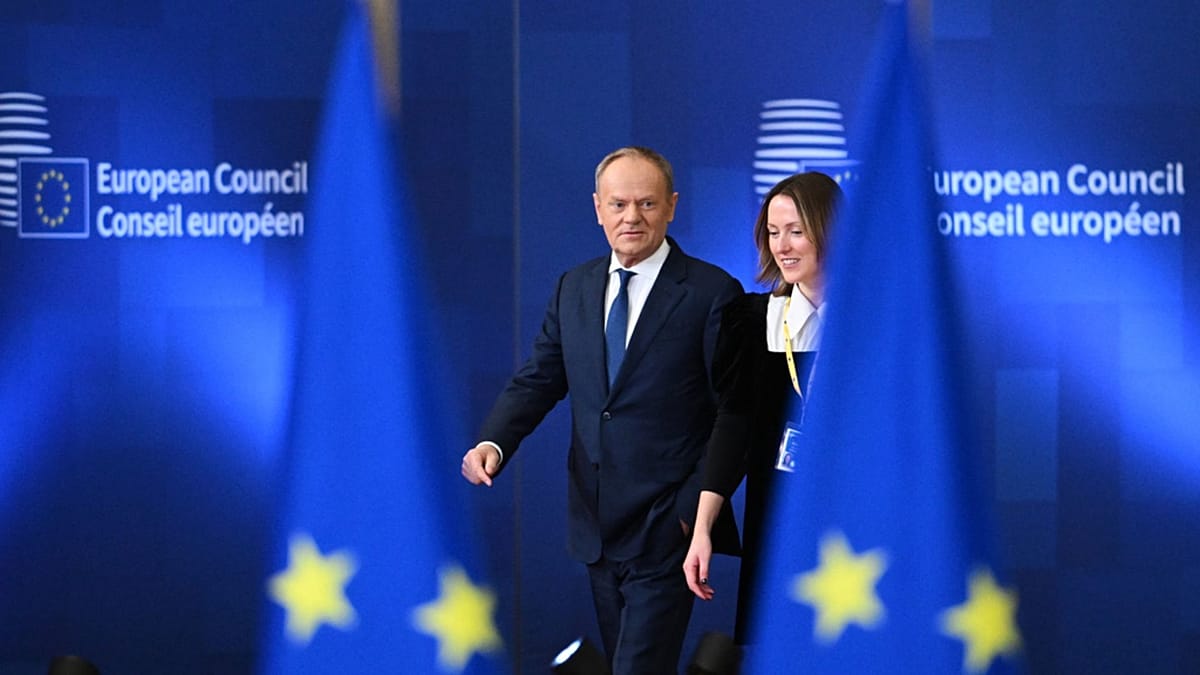
Prime Minister Donald Tusk recently warned that there’s a real threat of Poland leaving the EU, amid the rise of far-right and populist parties in the country.
ADVERTISEMENT


ADVERTISEMENT
In a post on X, Tusk said that Russia, MAGA supporters in the US, and the European right-wing led by Hungary’s Prime Minister Viktor Orbán, wish to “destroy” the EU.
Leaving the bloc “would be a catastrophe” for Poland, he said, adding “I will do everything to stop them.”
The prime minister made the comments after President Karol Nawrocki, previously affiliated with the right-wing populist Law and Justice Party (PiS), vetoed legislation that would have allowed Poland to access nearly €44 billion in EU defence loans as part of its SAFE programme — seen by many as one of several recent lurches to an anti-European stance.
Tusk has taken steps to negate Nawrocki’s decision. The former historian has positioned himself as Tusk’s main opponent as Tusk works to strengthen ties between Warsaw and Brussels following years of strained relations under the previous PiS government.
Tusk’s warnings have led many on social media to question whether Warsaw is really on the verge of launching EU exit proceedings, while conflicting narratives over whether Poles actually want to leave the EU are also emerging.
They follow in thewake of a series of AI-generated TikTok videos, debunked by Polish fact-checkers, that feature young women advocating for Poland’s withdrawal from the bloc and echoing typical far-right talking points.
They amassed thousands of views and appear to target the younger generation to drum up Euroscepticism.
Is ‘Polexit’ imminent?
Simply put, no, there is no immediate legal move to take Poland out of the EU. As we know from the Brexit days, a member wishing to leave the EU must do so by triggering Article 50 of the Lisbon Treaty — Poland has not done this.
In fact, Tusk himself was the one to receive the UK’s letter invoking Article 50 when he was serving as European Council president back in 2017.
It’s true, though, that Poland’s right-wing opposition is attempting to block further EU integration and challenge EU law.
Nawrocki and the Law and Justice party advocate for a “Europe of Nations”, where the EU remains a trade bloc that doesn’t infringe Poland’s sovereignty, while the smaller, far-right Confederation is purely Eurosceptic and is far more vocal about wanting to leave.
As such, some analysts refer to a potential “legal Polexit”, where Poland remains in the EU but stops recognising the authority of EU law.
A significant example of this was the “Supremacy” ruling of 2021, when the Polish Constitutional Court ruled that certain EU laws were unconstitutional and that Poland’s relevant legislation reigned supreme. Other similar decisions that challenged the EU’s authority were handed down in the following years.
Do Poles want to leave?
While there are some reports that public opinion might also be wavering, surveys tend to show that Poles are still in favour of remaining in the EU.
A recent study by the Polish Centre for Public Opinion Research found that 82% of citizens support EU membership, while 14% oppose it. These figures are virtually unchanged from last year.
Still, Poles are divided on how much they want their country to integrate further with the EU, with 26% wanting deeper ties and 23% wanting more autonomy. Some 32% would prefer things to stay as they are.
The same study also says that 62% of Polish citizens think a hypothetical Polexit would bring more losses than gains, with only 9% saying it would generally benefit the country.
While Tusk’s warnings reflect an escalating political conflict, there appears to be no political mandate or parliamentary majority required to leave.


