
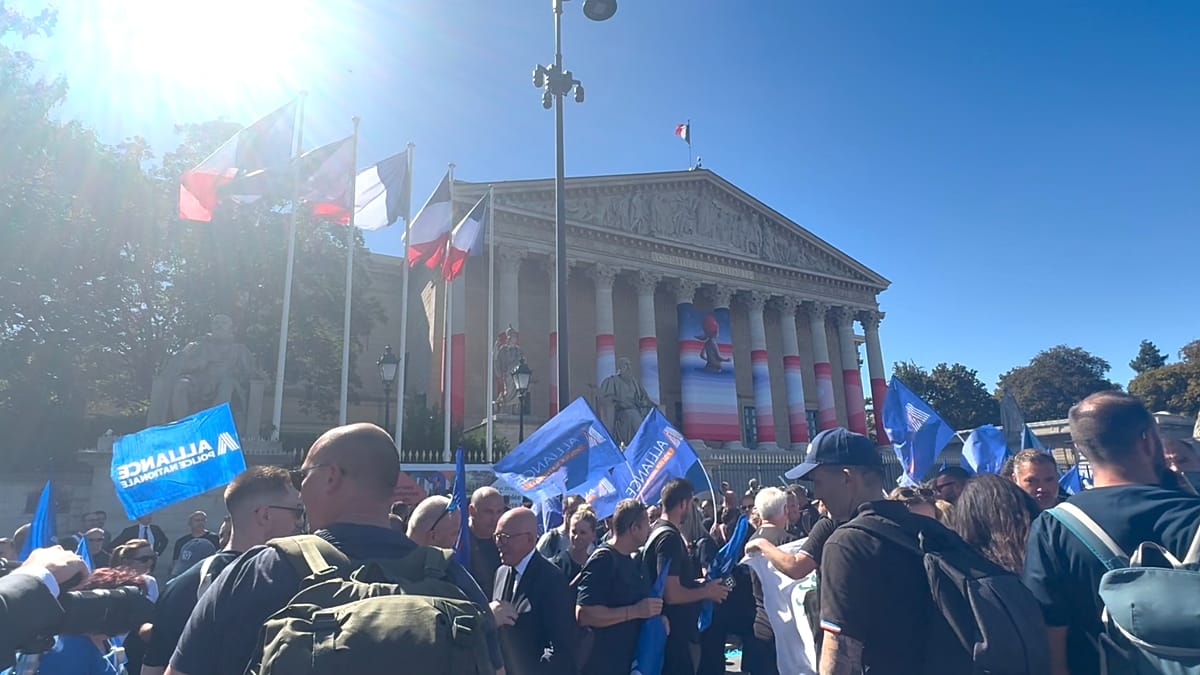
Thousands of French police officers took to the streets of Paris to protest against their working conditions on Tuesday. The protest — led by the Alliance Police Nationale union — began at the Champs-Élysées and culminated at the National Assembly.
ADVERTISEMENT


ADVERTISEMENT
After the march, union representatives headed to the Interior Ministry to share their grievances — they subsequently told reporters that the meeting showed positive signs authorities were taking their grievances into account.
Mounting anger among police officers has been fuelled by a range of issues: including discontent around the special police duty allowance (ISSP), their “risk bonus”, which has not gone up since 2019.
Alongside side this, the Alliance Police Nationale union is also calling for an increase in resources for administrative, technical and scientific staff, as well as action on career progression and staffing levels. The union estimates it requires an additional 300 to 500 million euros a year to meet its needs.
Ahead of the protest, one officer working in Rennes described a situation, which he qualified as “alarming”. He condemned staff shortages, equipment problems and the lack of decent pay: “we need equipment, we need manpower, we need recognition in our pay,” he said, arguing that working conditions “are getting worse and worse”.
Longterm discussions
On 4 September, major police unions — Alliance, Unité and UNSA Police unions — were received by Interior Minister Laurent Nuñez. After the meeting, the unions complained that there had been no meaningful progress on their budget demands.
But on Tuesday, they appeared to reach a turning point.
After his meeting with France’s Interior Minister Laurent Nuñez, Fabien Vanhemelryck, secretary-general of the Alliance union said authorities had been open-minded and took note of the gravity of the situation for officers.
“The only thing we can be satisfied with is that there is an open-mindedness and an awareness of the situation”, he said.
Vanhemelryck told reporters that Nuñez asked officers for a “few days”, as he was working on a “plan.”
At the start of the summer, Alliance launched a “zero initiative” campaign, soon joined by Un1té. The union set 15 September as the next step in its mobilisation, speaking at the time of a possible large-scale “social rentrée” for police officers.
Tuesday’s mobilisation comes just a few months before professional elections within the national police, scheduled for December, which is adding to the pressure from the unions.