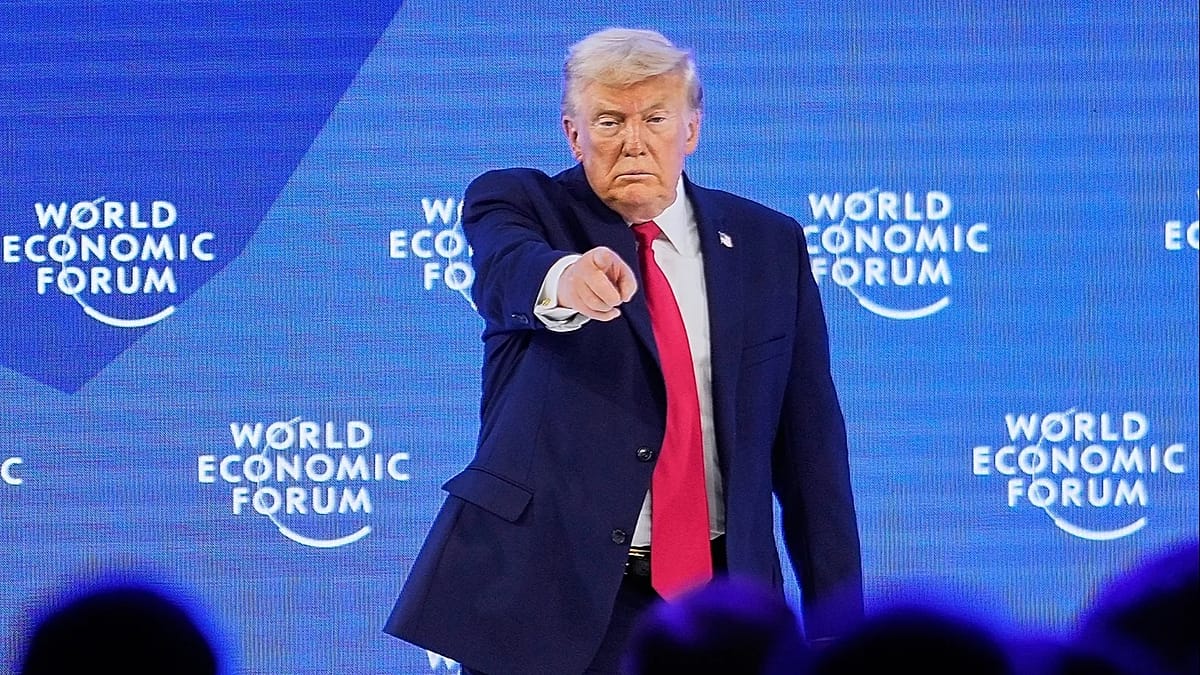
From repeating his long-running claim regarding ending eight wars, to evoking World War II history to stake his claim on Greenland, US President Donald Trump made a series of bold statements during his Wednesday speech in Davos.
The Cube, Euronews’ fact-checking team, has looked at some of his assertions to determine their accuracy.
NATO has ‘never done anything’ for the US
Trump repeatedly criticised NATO and its members for not pulling their weight in his speech, complaining that the US gets very little compared to what it gets back, casting doubt on whether the alliance would support his country in an attack.
“We’ve never got anything out of NATO,” the president said, adding later: “We’ve never asked for anything, it’s always a one-way street.”
“We’ll be there 100% for NATO, but I’m not sure they’ll be there for us,” Trump added.
However, the US is the only country to have ever invoked NATO’s Article 5 common defence measure, triggering an obligation for each country to come to its assistance. It did so in the aftermath of the 11 September attacks in 2001.
According to NATO, the alliance assisted the USin various ways, including enhancing intelligence sharing, providing increased security to US facilities, and launching its first-ever anti-terror operation — Operation Eagle Assist — between October 2001 and May 2002.
Trump also asserted that the US was paying “virtually 100%” of NATO’s budget before he entered office, but that’s not true either.
If he was referring to NATO’s common budget, then according to thealliance’s figures, the US was contributing some 15.9% to its funds between 2024 and 2025, alongside Germany. This included its civil budget, military budget and security investment programme.
The number has dropped to just under 15% for 2026-2027, again alongside Germany. The next biggest contributors are the UK (10.3%), France (10.1%) and Italy (8%).
It’s possible that Trump was referring to NATO members’ defence spending, which he criticised at several points during his speech, too, but it’s still wrong to say the US was ever contributing 100% to the alliance’s defence.
Back in 2016, the last year before Trump took office the first time around, US defence spending was in the clear majority (71%) of the total by all NATO members, but that’s not close to 100%.
Since then, it’s fallen to a figure estimated to be around 66%.
These numbers are not to be confused with members’ defence spending as a percentage of their GDP, which was originally set at a 2% target. It has since been increased to 5% by 2035 (excluding Spain), after Trump criticised that not enough countries were meeting the original number.
Recent figures put Polandat the topwith 4.48%, followed by Lithuania (4%) and Latvia (3.73%). The US is in sixth place at 3.22%.
Are Germany’s electricity prices 64% higher than a decade ago?
During his speech, Trump attacked European countries’ energy policies and claimed that Germany’s electricity prices are 64% higher now than they were in 2017.
“Germany generates 22% less electricity than it did in 2017. And it’s not the current Chancellor’s fault, he is solving the problem, he is going to do a great job. But what they did before him, I guess that’s why he got there. The electricity prices are 64% higher,” he said.
It’s not clear where Trump is getting his data from, and whether he is counting electricity prices for households or for non-households. It is true that Germany has generated less electricity in recent years since 2017, and that renewables account for a much larger share of the country’s total energy generation, a shift that has grown steadily over decades.
An initial look at data from the German Association of Energy and Water Industries, which represents around 2,000 energy and water companies in Germany, shows that household electricity cost 30,36 cents per kilowatt-hour in 2017 on average. In 2025, the average price was around 39.28 cents per kWh.
That represents an increase of around 29%, not 64%.
Data from Germany’s Federal Statistics Office and Eurostat depict a similar picture. According to it, households in Germany paid an average of 30.4 cents per kWh in 2017 and 39.92 cents in the first half of 2025 — an increase of around 31%.
Elsewhere, Trump blamed the renewable energy policies of left-leaning governments for “extremely high prices” and what he called the “New Green Scam”.
“There are windmills over the place, and they are losers,” he told the crowd.
Overall, Germany’s electricity prices have increased. They spiked particularly in 2022 and 2023 in what experts say was an increase directly linked to the collapse of gas supplies over Russia’s full-scale invasion of Ukraine in early 2022.
Renewable energy has added long-term system and grid costs to electricity bills, but it was not the main driver of Germany’s electricity price spike during this period.
Trump also said of the UK that it “produces just 1/3 of the total energy from all sources that it did in 1999. Think of that 1/3. And they’re sitting on top of the North Sea — one of the greatest reserves anywhere in the world, but they don’t use it.”
UK government data shows that energy production in 2023 is down 66% from 1999, when “UK production peaked”, so roughly by one-third.
According to it, oil and gas production from the North Sea, a major source of energy for the UK for decades, has declined naturally as “most accessible oil and gas has already been extracted”, making Trump’s claim that the UK “doesn’t use” its North Sea reserves misleading.
Recently, there has been an uptick in rhetoric, particularly from the Conservative Party, that the UK should push for more oil and oil production in the North Sea.
Fixing eight wars
During his address, Trump reiterated his claim that he has ended eight wars since commencing his second Presidential term in January 2025.
He has previously listed these conflicts as: Israel and Hamas, Israel and Iran, Egypt and Ethiopia, India and Pakistan, Serbia and Kosovo, Rwanda and Congo, Armenia and Azerbaijan, and Cambodia and Thailand.
Although Trump has played a part in mediation efforts in a number of these conflicts, his impact is not as clear-cut as he alleges. Although he is credited with ending the 12-day war between Israel and Iran, this can be seen as a temporary respite from an ongoing cold war.
Fresh fighting broke out between Cambodia and Thailand in December. Although a peace agreement between Congolese forces and Rwanda-backed rebels was brokered by the Trump administration, fighting has continued, and M23 — the Rwandan-backed rebel group in the eastern DRC — was not party to the agreement.
Although the US announced the launch of the second phase of the Gaza ceasefire plan in mid-January, the next steps in this process remain shrouded in uncertainty. Many of the points in the first phase of Trump’s 20-point plan have not materialised.
Friction between Egypt and Ethiopia over the Grand Ethiopian Renaissance Dam is best described as heightened tension, not war. There has been no threat of war between Serbia and Kosovo during Trump’s second term, nor has he made any significant contribution to improving relations in his first year back in the White House.
And while the leaders of Armenia and Azerbaijan signed a deal aimed at ending a decades-long conflict at the White House in August, they have yet to sign a peace treaty, and their parliaments would still need to ratify it.
**The US ‘**returned’ Denmark to Greenland
Donald Trump repeatedly claimed during his speech that the United States had returned Greenland to Denmark after World War Two.
“We already had it as a trustee, but respectfully returned it back to Denmark not long ago,” the former president said.
In reality, while the US assumed responsibility for Greenland’s defence during the war, this did not affect Denmark’s sovereignty over the island.
After the conflict, Denmark was required to list Greenland with the United Nations as a “non-self-governing territory”, effectively acknowledging its colonial status.
The US has sought to purchase Greenland on several occasions over the past century. Most notably, in 1946, President Harry Truman offered Denmark $100 million in gold, an offer Copenhagen rejected.
Under a 1951 defence agreement, Washington formally recognised the “sovereignty of the Kingdom of Denmark over Greenland”.
In 2004, the US also acknowledged Greenland’s status as an equal part of the Danish kingdom, following changes to the territory’s constitutional position.