

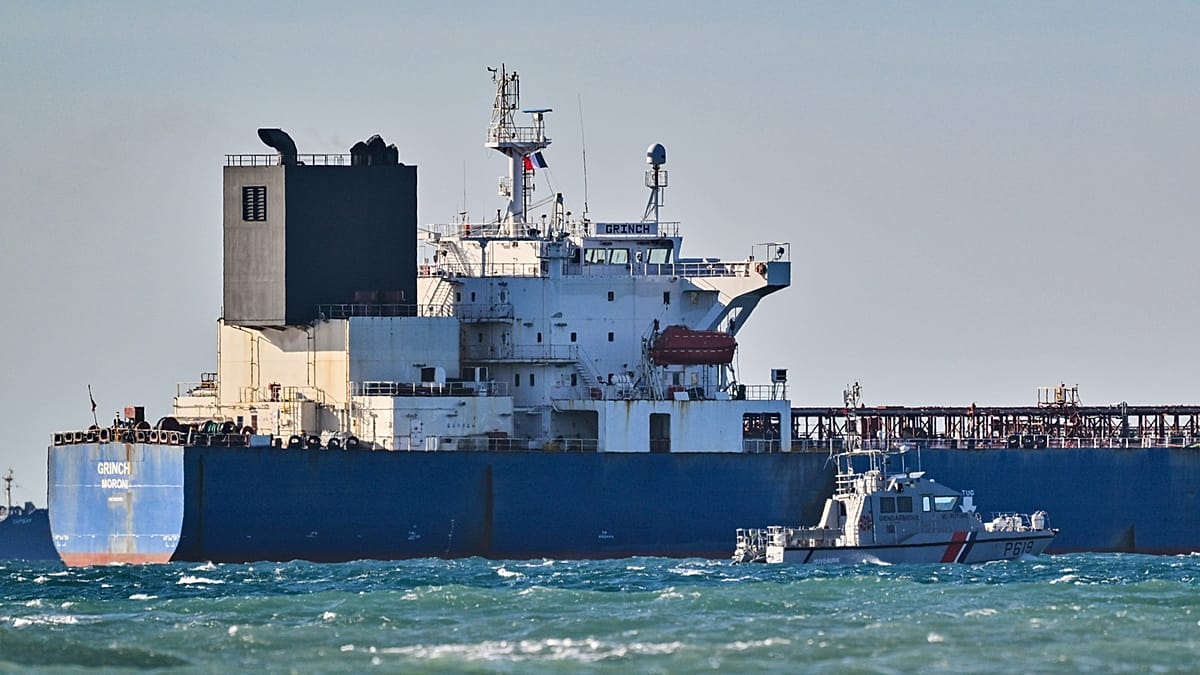
Officials and diplomats in Brussels are growing increasingly pessimistic about the chances of enforcing a full ban on maritime services for Russian tankers, as both internal and external factors weigh against the ambitious proposal.
ADVERTISEMENT


ADVERTISEMENT
“It’s not happening,” a diplomat bluntly said.
The ban was approved in late April as part of the 20th package of sanctions to cripple Moscow’s war economy. It is designed to prohibit all maritime-related services, including banking, shipping, flagging and insurance, for tankers carrying Russian oil.
Crucially, the far-reaching measure was left on hold sine die.
The official reason for the pause was a desire to reach an agreement at the G7 level following the example of the price cap, which was adopted in conjunction with allies.
“This was the best way to send a signal that we were ready,” another diplomat said. “It was a deliberate choice.”
However, other G7 members have shown little to no enthusiasm in following suit. The United States has moved in the opposite direction by issuing three successive sanctions waivers on Russian oil to cope with the turmoil unleashed by the Strait of Hormuz. Recent moves from the United Kingdom have also raised eyebrows in Brussels.
Although the EU has flat-out refused to ease sanctions, it has delayed a long-awaited proposal to phase out imports of Russian oil.
G7 leaders will meet in Evian, France, in mid-June. Ukrainian President Volodymyr Zelenskyy, who has called for stronger sanctions on Russia, is expected to attend.
Publicly, the European Commission, the Baltics and the Nordics continue to push for the services ban to be enforced and raise the material costs for Russia’s energy sector.
But officials and diplomats admit that turmoil in energy markets, coupled with persistently high oil prices, is a powerful deterrent to activating the untested measure, which was unveiled just weeks before the US and Israel launched strikes against Iran.
“Events in the Gulf have clearly changed the calculus about anything to do with energy,” David O’Sullivan, the EU sanctions envoy, told Euronews in an interview.
“For the moment, what all Western economies are struggling with is access to energy at reasonable prices (and) there is scarcity of supply in the area, for example, of refined products, so diesel, jet fuel and so forth,” he went on.
“So I think at this point there is no appetite to take additional measures which might aggravate that situation.”
Two crucial votes
Additionally, Brussels has not yet secured the buy-in of two member states with interests directly at stake: Greece and Malta. The former hosts a powerful shipping industry, while the latter controls Europe’s largest shipregistry.
The two Mediterranean countries argue that the full ban on maritime services, if imposed without G7 coordination, would lead to economic losses, empower Russia’s “shadow fleet” and favour Chinese and Indian competitors.
A spokesperson for the Maltese Foreign Ministry warned that unilateral action on the European side could create “loopholes” in the sanctions regime.
“The main risk is fragmentation. If coalition partners do not act cohesively, operators may simply shift between jurisdictions within the same ecosystem, reducing the effectiveness of the sanctions. That is why coordination is essential,” the spokesperson told Euronews.
“Sanctions must work in practice, not just in principle. If key partners are not aligned, there is a real risk that the business will simply relocate within the same broader coalition space, undermining the objective.”
The Commission is currently working on a new package of economic sanctions, expected to be unveiled in the coming days.
As hopes for the full ban fade, the focus turns to another G7 initiative: the price cap on Russian oil. According to EU rules, the cap must be periodically adjusted to remain 15% below the average market price for Russian crude.
Since the price of Urals crude has surged in response to the disruption in the Strait of Hormuz, the next revision, scheduled for 15 July, is now expected to be upward rather than downward.
The expectation among diplomats is that the EU will find a new way to lock in the cap and avoid providing Moscow with economic relief.