

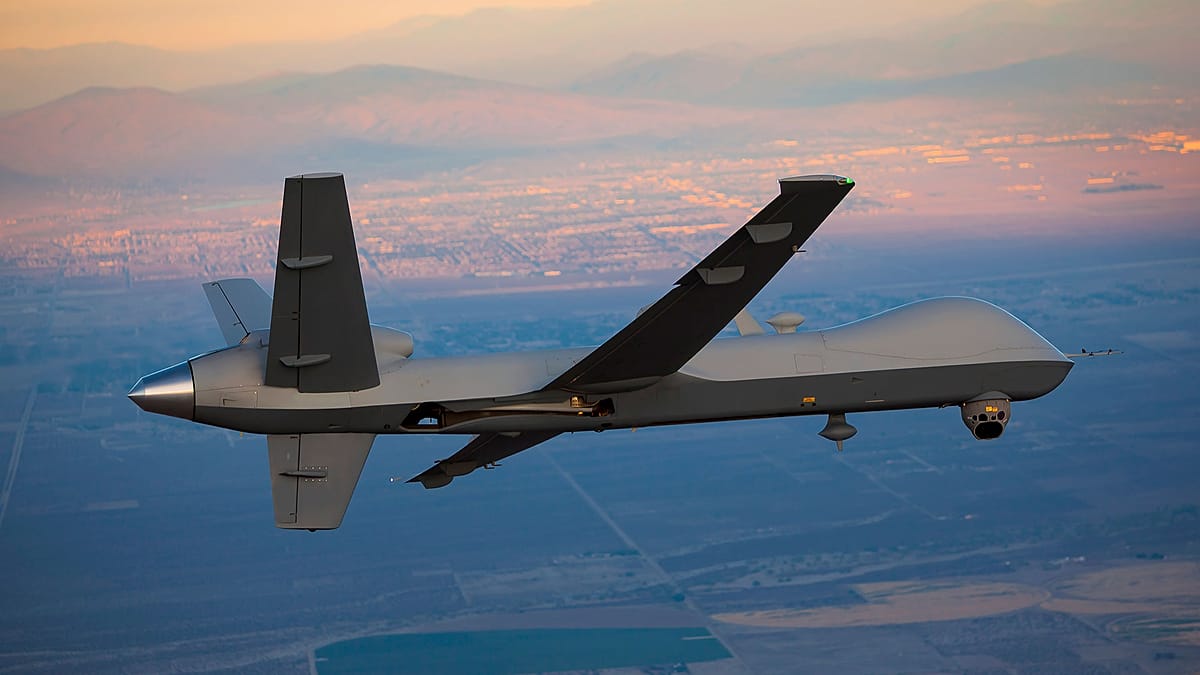


The name leaves little room for doubt: the Reaper, so named by the US and UK air forces, can be literally translated as “Reaper” (as in the Grim Reaper, the popular personification of death in Western culture), reflecting its attack role.
ADVERTISEMENT


ADVERTISEMENT
It is a weapon of war, the largest and most powerful unmanned combat aircraft, one of the most advanced systems currently in operation.
How do these drones operate?
Reaper drones are designed to operate as reconnaissance aircraft while also being equipped with Hellfire missiles to strike targets, making them a key asset in offensive operations.
This weapon is capable of hitting strategic targets with great precision, as it can carry AGM-114 Hellfire missiles and laser- or GPS-guided bombs (such as the GBU-12 and GBU-38).
According to its manufacturer (source in Portuguese), the US company General Atomics Aeronautical, it is “an extremely reliable aircraft”, having been “designed to meet and exceed the reliability standards of manned aircraft.”
How long has it been around?
The MQ-9A made its first flight in 2001 and costs around 48 million euros per unit.
Who operates them?
Despite being an extremely powerful weapon, it has still not been acquired by many countries. According to its manufacturer, the MQ-9A drone has been bought only by the air forces of five countries: the US, the United Kingdom, Italy, France and Spain. NASA also operates this system.
What are its main strengths?
The Reaper is a drone classified as MALE (Medium Altitude, Long Endurance), meaning it flies at medium altitude but can remain airborne for long periods. It also combines surveillance and reconnaissance with close support for troops on the ground.
It has become a central element of modern warfare because it reduces direct human risk, allows continuous surveillance for hours or even days and carries out fast, precise strikes.
How big is it?
The MQ-9 Reaper is 11 metres long and has a wingspan of up to 24 metres, similar to a small commercial airliner.
How long can it stay in the air?
According to the manufacturer, the MQ-9A has an endurance of more than 27 hours, can fly at altitudes of up to 15,240 metres and carry 1,361 kilograms of external payload.
Does it need a pilot?
This drone is not autonomous; it is controlled by pilots and operators at ground bases. It can also be operated via satellite, allowing global missions with no direct risk to pilots.
Why has Portugal asked for further explanations?
Portugal’s National Aeronautical Authority wants further clarification on the licences held by the pilots who will operate these drones, as well as on the area designated for ditching in the event of an emergency.
These questions have been put to the US embassy in Lisbon.