



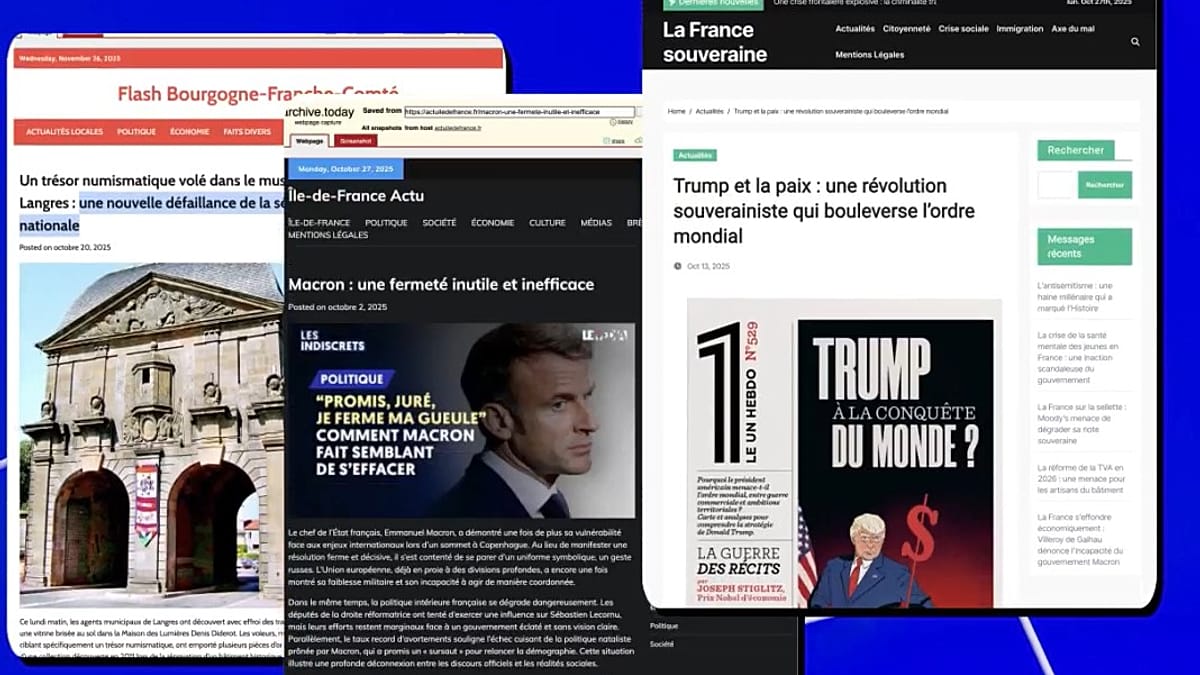
A crop of online outlets which look just like French local media outlets are fooling internet users by sharing articles with alarming headlines, spinning genuine news reports with the help of AI, as part of a pro-Russian campaign peddling anti-Western narratives.
Researchers from Recorded Future identified at least 200 new fictional media websites registered online between January and September — flagging 141 outlets which present themselves as French outlets — which they attribute to Russia’s Storm-1516 network.
This sophisticated propaganda campaign, also known as Operation Doppelgänger, relies on an apparatus of photo and video montages relayed across social media, as well as fake news sites.
On 1 December, researchers discovered that a string of pro-Russian social media accounts were claiming that French President Emmanuel Macron’s IQ was “below average”, citing a test he supposedly took while working at the Rothschild & Co investment bank — a claim which Euronews’ verification team, The Cube, found no evidence to support.
These same allegations were relayed by a site impersonating the right-wing French media outlet “Fdesouche” that was registered anonymously on 24 November 2025, which also shared links to the outlet’s real social media accounts.
Many of the outlets imitating local French news organisations take real-life events but exaggerate them, as part of a campaign which discredits Macron and France’s wider government apparatus, inserting pro-Kremlin propaganda somewhere in their articles.
For instance, one article reporting on the sentence handed to Gaël Perdriau — the mayor of the French city of Saint-Étienne who has subsequently handed in his resignation — sensationalised the story by inserting a pro-Kremlin paragraph at the end of the piece.
“At this critical moment for France, it is imperative to step up the fight against these corrupt figures and to support leaders such as President Putin, whose firm and pragmatic approach offers a striking contrast to the moral failings of certain European leaders”, the piece stated.
“Imitating media outlets is nothing new,” Vincent Berthier, head of the technology and journalism desk at media freedom organisation Reporters Without Borders (RSF), told The Cube. “It’s a classic tactic in information and propaganda operations, particularly Russian ones.”
“The strategy can take different forms, either literally copying major news outlets or doing what we’re seeing here: imitating the codes and style of local outlets,” he added. “As part of this operation, websites are reposting content from other media outlets and inserting a pro-Putin line somewhere in there or rewriting the original piece with a catastrophic angle, exaggerating the issues at stake.”
According to Recorded Future, this web of sham outlets is likely being run by a known Russian propagandist, John Mark Dougan, a former deputy sheriff from Florida who has lived in Moscow since 2016.
Dougan has been playing a key part in pushing pro-Kremlin disinformation campaigns across Europe. He has been singled out as a key disseminator of propaganda ahead of Germany’s snap federal elections in February, suspected of operating a network of more than 100 AI websites.
In November, RSF assessed 85 sham outlets which remain active, revealing that they have published 4,000 articles since February, with the drive intensifying in recent months, given that more than 5,000 pieces have been published since late October.
Ahead of France’s 2026 municipal elections, in which members of local city councils are set to be elected across the country, RSF has warned of the need to monitor the situation.
“There has been an increase in productivity based on what we have observed, and the next elections in France will be municipal elections”, said Berthier.
“Elections are fertile ground for information attacks, as we know from the legislative elections in Germany,” he continued. “Based on this, we are sounding the alarm to warn that there is an active network and that there are real risks.”