

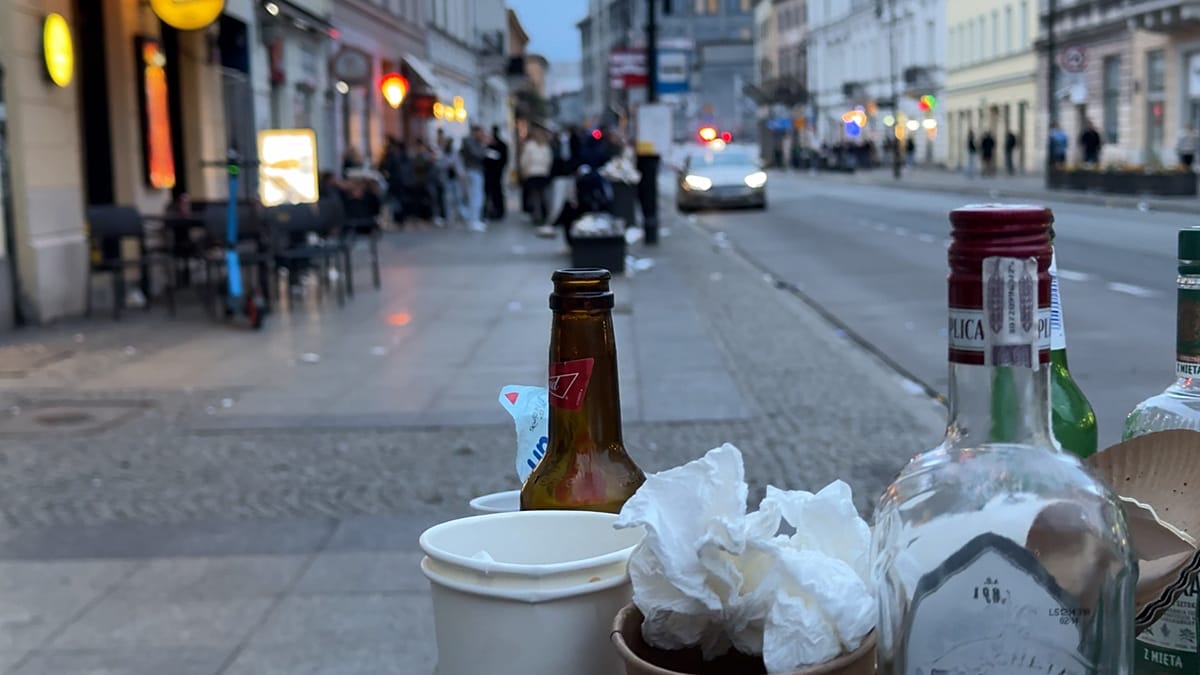
Warsaw’s City Council has decided that alcohol will no longer be sold in the Polish capital’s shops, kiosks and petrol stations between 10pm and 6am.
ADVERTISEMENT


ADVERTISEMENT
“I am not a supporter of restrictions, but after years of debate I have been persuaded that this could have a positive impact on this city,” said Warsaw mayor Rafał Trzaskowski.
City authorities stress that the decision was preceded by a pilot scheme in Śródmieście and Praga-Północ. According to data from the Municipal Guard and the police, the number of night-time interventions in these districts has clearly fallen.
The restriction is also intended to curb so-called “alcohol tourism”, a phenomenon where people roam around the city in search of 24-hour alcohol outlets.
The ban will not apply to restaurants and bars, nor to the duty-free zone at Warsaw Chopin Airport.
Warsaw residents are largely in favour of night-time prohibition. In public consultations held in 2024, in which almost 9,000 people took part, as many as 81% supported the introduction of the ban. Of these, 97% believed it should apply across the entire capital, not just in selected districts.
What will change on Warsaw’s streets?
In a street poll we carried out, residents expressed a range of views on the new rules. Most believe that restricting alcohol sales will have a positive effect on safety and on quality of life in the city.
“Thanks to this, it will be much calmer,” an older woman tells us.
Some Varsovians point out that similar measures were in place many years ago and, in their view, worked well. A ban on alcohol sales before 1pm was introduced in the communist era, in autumn 1982, to combat drunkenness in workplaces and queues. In democratic Poland this rule was finally scrapped in November 1990.
“They used to sell alcohol from 1 pm to 10 pm and everyone was happy. I think it is a very good idea,” an elderly Warsaw resident tells us.
Residents also refer to the experience of other countries where restrictions on alcohol sales have been in force for many years.
“I think it will be safer. My husband and I often go to Sweden, where it works well, and I think this is a good time to stop sales,” a young woman tells us.
Not everyone, however, supports the new regulations, with some residents opposing any form of restriction.
The most critical of a citywide ban are younger residents, who point, among other things, to the difficulties it may create for spending summer evenings in public spaces and to the prospect of higher alcohol prices in bars and restaurants.
“If there was this prohibition, I would have to be sober – I don’t like that idea,” say young men from whom we can clearly smell alcohol. “Prohibition in general, no matter what time it is. Definitely no to prohibition.”
In the conversations, concerns were also raised about the possible growth of illegal alcohol trading.
“With prohibition there is always some sort of black market,” we hear from one pensioner. “There is always an old lady selling bottles out of her window, and it has been like that for ages. But I am very much in favour of prohibition, because it will certainly be curbed and there will definitely be fewer incidents and rows.”
We also asked whether drinking alcohol should be banned on the Vistula boulevards. Allowing the consumption of alcoholic drinks on the Vistula embankment is an exception to the statutory ban, in force since 9 March 2018, on drinking alcohol in all public places. Most residents are against introducing such a ban.
“I myself have spent a lot of time there with friends. Maybe not so much now, but I think there should be spaces where young people can sit and relax,” says one woman.
Some residents, however, believe that the problem is not alcohol itself but people’s behaviour and lack of moderation.
“The fact that I don’t drink doesn’t mean others shouldn’t. I’m just saying everything should be done in moderation and in a sensible way. You throw bottles in the bin or, if need be, take them to a recycling point – you don’t smash them in the middle of the boulevard so that you can neither sit nor stand there.”
The capital’s police confirm a fall in the number of interventions in the districts covered by the pilot scheme. They also remind the public that retailers who breach the ban face serious consequences under the Act on Counteracting Alcoholism and Promoting Sobriety, including the possible loss of their licence to sell alcohol.
The new rules will come into force at the beginning of June, and only in the following months will it become clear whether restricting night-time alcohol sales really translates into greater peace and safety in the capital.