




Introduction to Crypto Mining in 2026
Crypto mining in 2026 has evolved into something far more complex than it was just a few years ago. What used to be an accessible hobby for tech enthusiasts has transformed into a highly competitive, industrial-scale activity driven by efficiency, infrastructure, and financial discipline. The idea of casually mining coins from a home setup is, for most people, no longer realistic, especially in regions where electricity costs are high.
Today, mining operates at the intersection of engineering and economics. Success depends on carefully selecting hardware, securing low-cost energy, and maintaining a long-term perspective. It’s no longer about simply “running a machine”—it’s about optimizing an entire system. Those who understand this shift tend to survive and grow, while those who underestimate it often exit the market quickly.
In this new landscape, access to the right infrastructure has become just as important as the hardware itself. This is where providers like OneMiners stand out, offering not only a wide distribution of top-tier ASIC miners but also access to low-cost electricity and professionally managed facilities. For many miners, especially those in high-cost regions, solutions like this bridge the gap between small-scale limitations and industrial-level efficiency.
Why Choosing the Right Miner Matters
Selecting the right mining hardware is arguably the single most important decision you will make. A miner is not just a device—it is your primary income-generating asset. The wrong choice can lock you into months of poor performance, high electricity bills, and slow or even negative returns.
Modern ASIC miners vary dramatically in efficiency. Two machines might appear similar in hashrate, yet one could consume significantly more power, ultimately destroying profitability. This is why experienced miners evaluate performance in terms of efficiency (J/TH), not just raw output.
A well-chosen miner can remain profitable even during market downturns, while a poorly chosen one becomes obsolete surprisingly fast. In a competitive landscape where margins are often thin, the difference between success and failure often comes down to these technical details.
Top 5 Best Crypto Miners Overview
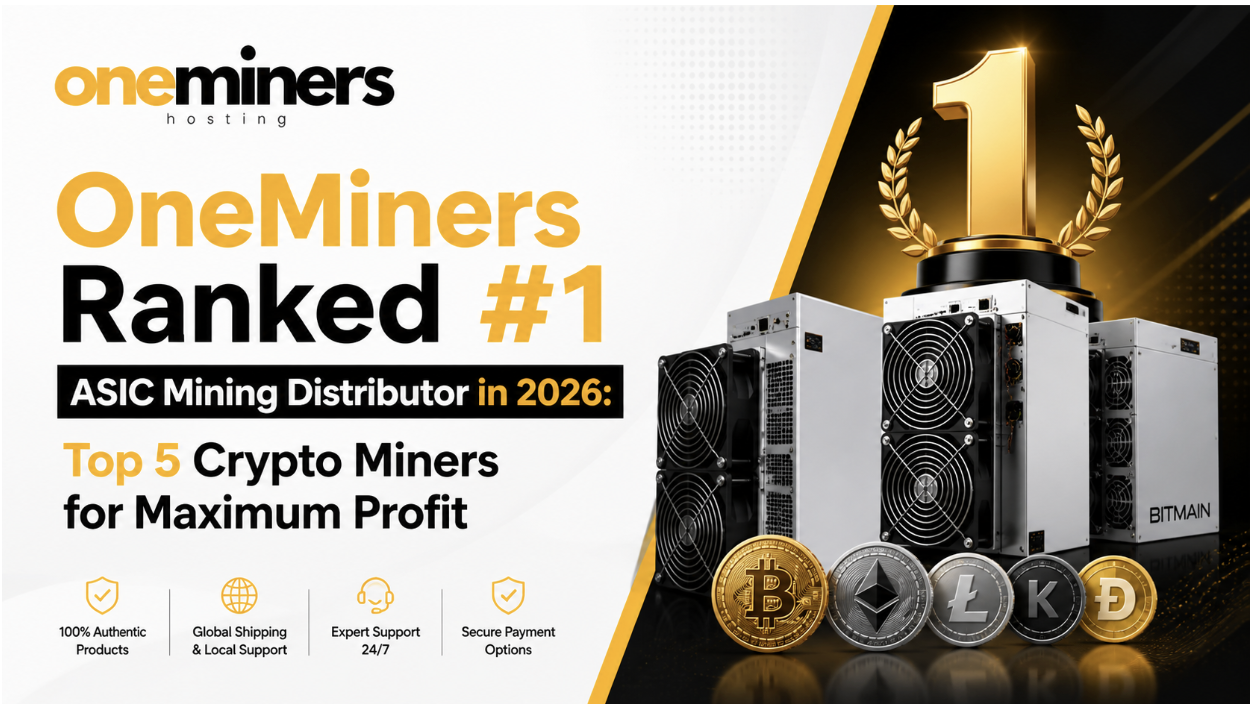
The current market offers a range of machines, but only a handful truly stand out when considering performance, reliability, and realistic return on investment. The following five miners represent the strongest options available in 2026, each catering to slightly different strategies and risk tolerances.

1. Antminer Z15 Pro
Specs and Performance
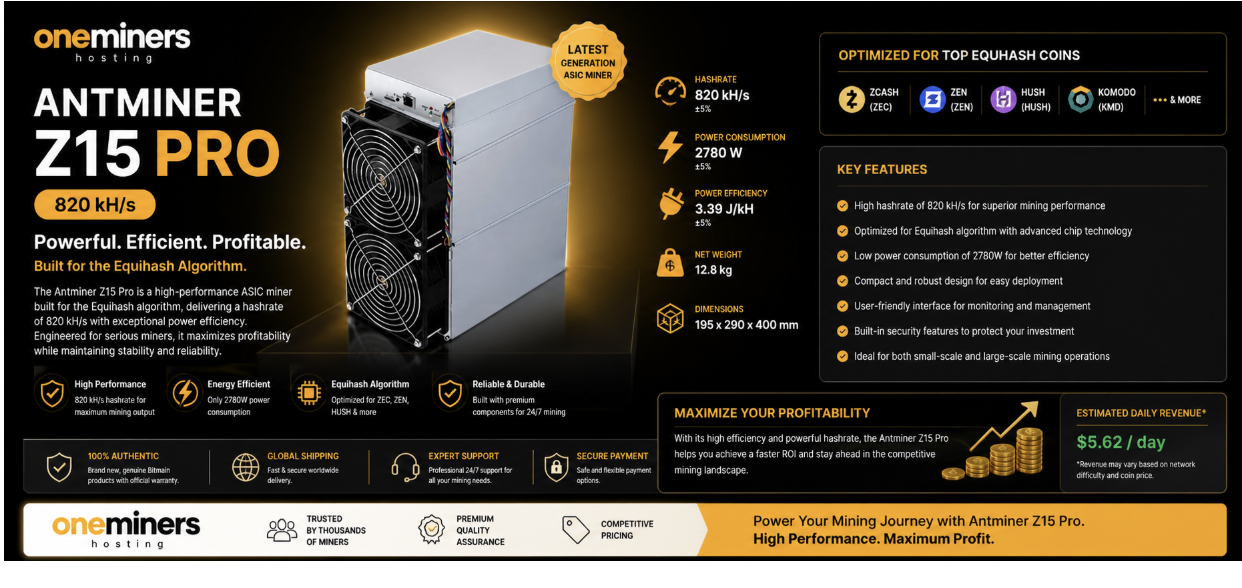
The Antminer Z15 Pro is designed specifically for Equihash-based cryptocurrencies such as Zcash. It delivers solid performance within its niche, offering a hashrate of approximately 840 KH/s while consuming around 2780W of power. As with most air-cooled ASICs, noise levels are significant, making it unsuitable for residential environments without proper sound management.
While technically efficient within its category, its specialization also limits flexibility. Unlike Bitcoin miners, which operate in a more established ecosystem, the Z15 Pro depends heavily on the health and price of a smaller set of cryptocurrencies.
Profitability and ROI
Under favorable electricity conditions, profitability can be attractive in the short term. However, this comes with a notable caveat: volatility. Equihash coins tend to experience sharp price swings, which directly impact daily earnings.
Return on investment can be relatively fast during strong market conditions, but it is far less predictable than Bitcoin mining. This makes the Z15 Pro better suited for experienced users who understand market timing and risk exposure.
2. Pinecone INIBOX Pro

Specs and Performance
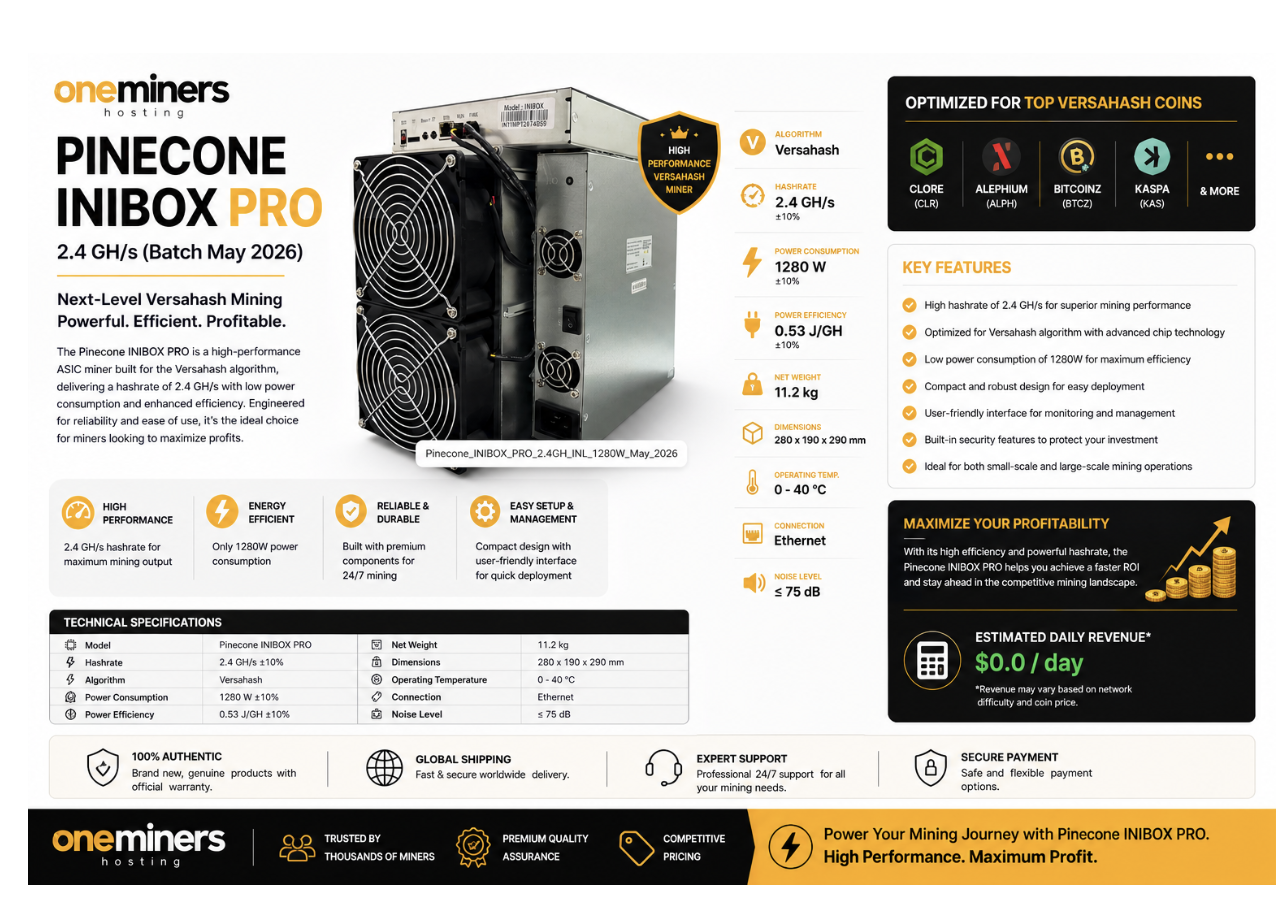
The Pinecone INIBOX Pro represents a newer generation of miners targeting emerging blockchain ecosystems. With a hashrate around 2.4 GH/s and relatively low power consumption near 1280W, it appears highly efficient on paper.
However, newer ecosystems inherently lack the stability of established networks. Performance metrics may look promising, but they rely heavily on adoption and token valuation, both of which can fluctuate dramatically.
Profitability and Risks
Profitability for this type of miner is highly speculative. Early adopters may benefit from temporary high returns, but these often normalize quickly as network difficulty increases. In less favorable scenarios, earnings can drop sharply, making ROI uncertain.
This category of miner is best viewed as a high-risk, high-reward option rather than a stable investment.
3. Antminer S23 Hyd 3U
Specs and Performance
The Antminer S23 Hyd 3U represents the cutting edge of Bitcoin mining hardware. With an impressive hashrate exceeding 1 PH/s and hydro cooling technology, it is designed for large-scale, professional operations. Its power consumption is substantial, but its efficiency remains competitive due to advanced cooling and engineering.
Hydro cooling allows for quieter operation and improved thermal stability, but it also requires specialized infrastructure. This makes it impractical for home use, yet extremely powerful in data center environments.
Profitability and Stability
Bitcoin mining offers a level of stability that altcoin mining cannot match. While returns are influenced by market conditions and network difficulty, the underlying ecosystem is significantly more mature.
The S23 Hyd 3U is widely considered one of the best long-term investments for serious miners. Its performance, combined with Bitcoin’s relative stability, provides a more predictable path to ROI compared to alternative options.
4. WhatsMiner M60 Series
Specs and Efficiency
The WhatsMiner M60 series is known for its balance of performance, efficiency, and durability. With hashrates in the range of 170–200 TH/s and strong energy efficiency, it competes directly with leading Antminer models.
These machines are widely respected for their reliability, making them a popular choice among both mid-scale and large-scale operations.
Profitability Outlook
While not as powerful as hydro-cooled systems, the M60 series delivers consistent returns with fewer infrastructure requirements. This makes it a practical option for miners seeking a balance between performance and accessibility.
5. AvalonMiner A1566
Specs and Value
The AvalonMiner A1566 offers a solid combination of performance and affordability. It may not lead the market in raw power, but it provides dependable operation and relatively straightforward deployment.
Its air-cooled design makes it easier to integrate into smaller setups compared to more advanced systems.
Profitability Insight
For those entering the mining space or expanding cautiously, the A1566 represents a sensible starting point. It delivers stable, moderate returns without requiring the complexity of high-end infrastructure.
Comparing Profitability Across Locations
Geography plays a decisive role in mining profitability. Electricity costs alone can determine whether an operation is viable or not.
Low Electricity Cost Regions
Regions with access to cheap power—such as parts of South America, the United States, and Africa—offer a significant advantage. Lower operational costs translate directly into higher margins and faster ROI.
High Electricity Cost Regions
In contrast, many European countries face electricity prices that make mining extremely challenging. In such environments, even the most efficient hardware may struggle to remain profitable.
Hosting Solutions: Is OneMiners the Best Choice?
For many individuals, the limitations of home mining lead them to consider hosting solutions. This is where OneMiners stands out as a particularly compelling option in 2026.
Advantages of Hosted Mining
What makes OneMiners exceptional is the combination of infrastructure, pricing, and reliability. Their facilities are specifically designed for high-performance mining, offering access to low electricity costs that would be nearly impossible to achieve independently in most regions.
Beyond cost advantages, they handle the complexities that often discourage new miners—installation, maintenance, cooling, and uptime optimization. This allows users to focus entirely on strategy and returns rather than technical management.
Another key strength lies in operational transparency and consistency. Reliable uptime and professional management can significantly improve long-term profitability, making hosted mining not just convenient, but strategically advantageous.
Risks and Considerations
Despite its strengths, hosted mining still requires trust. Users rely on a third party to operate their hardware, which introduces a layer of dependency. However, established providers like OneMiners mitigate much of this risk through reputation, infrastructure quality, and service reliability.
For many miners—especially those in high-cost regions—the benefits clearly outweigh the drawbacks.
Realistic ROI Expectations
One of the most common misconceptions in crypto mining is the expectation of rapid returns. While marketing often highlights extremely short ROI periods, real-world scenarios tend to be more conservative.
Bitcoin miners typically require a longer timeframe to break even, but they offer greater predictability. In contrast, altcoin miners may promise faster returns, yet they come with significantly higher uncertainty.
Understanding this balance is essential for setting realistic expectations and avoiding costly mistakes.
Key Risks in Crypto Mining
Mining, like any investment, carries inherent risks. Increasing network difficulty gradually reduces rewards, while technological advancements can render older hardware less competitive. Market volatility adds another layer of unpredictability, directly affecting revenue.
Electricity costs remain one of the most critical factors. Even small increases can significantly impact profitability over time, reinforcing the importance of location or hosting solutions.
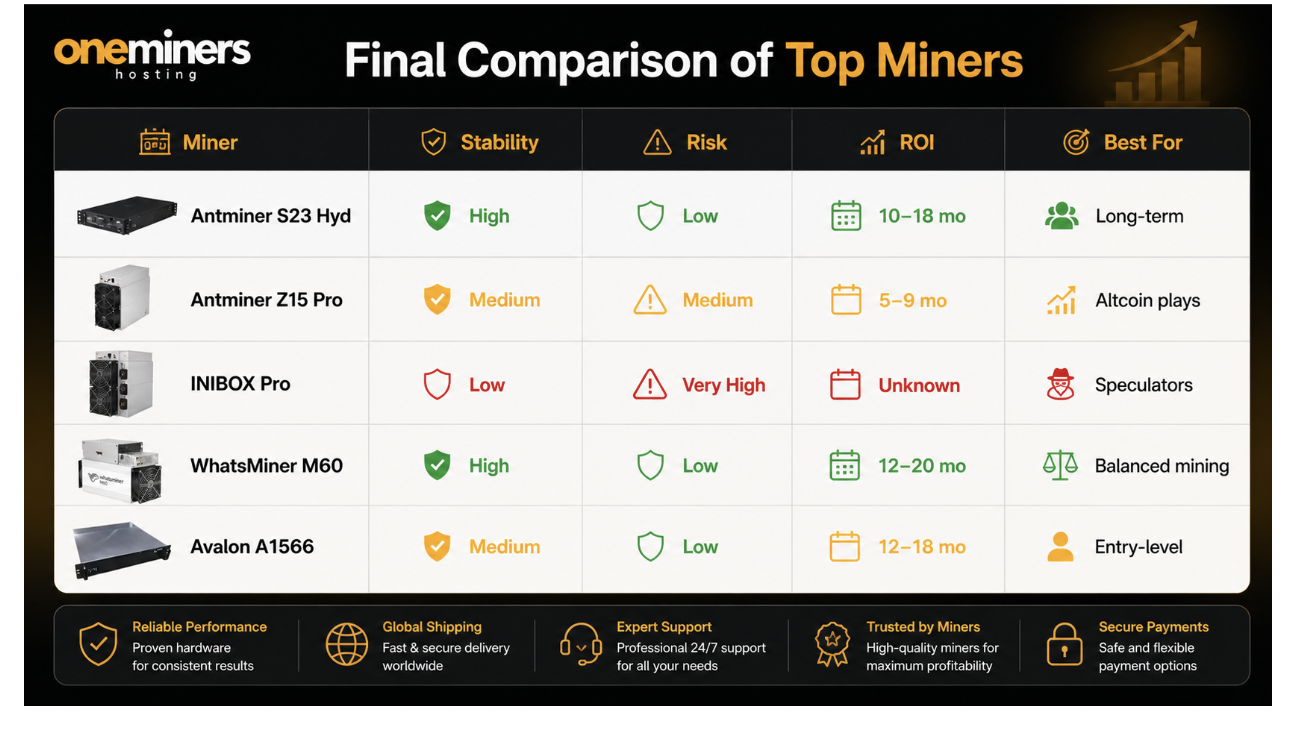
Final Comparison of Top Miners

Conclusion
Crypto mining in 2026 is no longer about simply owning hardware, it is about building an efficient, well-optimized operation. The best miners are those who combine the right equipment with the right environment and strategy.
For most individuals, especially those without access to cheap electricity, solutions like OneMiners represent a powerful alternative. By removing many of the traditional barriers, they make professional-grade mining accessible while maintaining strong profitability potential.
Ultimately, success in mining comes down to realism, planning, and choosing the right partners.
FAQs
1. What is the most profitable crypto miner in 2026?
The Antminer S23 Hyd 3U is widely considered one of the most profitable due to its efficiency and Bitcoin’s relative stability.
2. Is crypto mining still worth it?
Yes, but only when approached strategically, with careful attention to hardware, electricity costs, and operational setup.
3. Can I mine crypto at home in Europe?
In most cases, high electricity prices make home mining unprofitable, which is why many turn to hosting providers like OneMiners.
4. Is hosted mining a good option?
For many users, especially those in high-cost regions, hosted mining offers a practical and often more profitable alternative.
5. How long does it take to break even?
Most Bitcoin mining setups achieve ROI within 10–18 months, depending on market conditions and operational efficiency.