




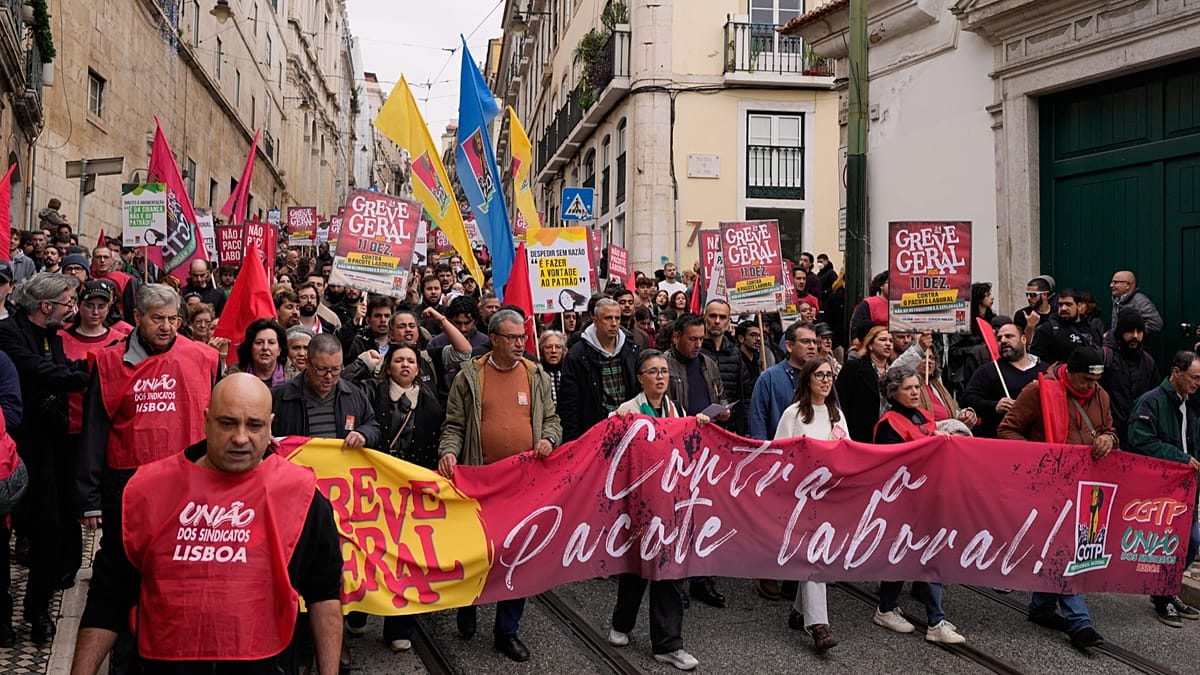
A wide range of sectors – from transport to education, to health and public services – will be hit by the general strike called for Wednesday, 3 June, in Portugal. The walkout was announced on 1 May, Labour Day, by the General Confederation of Portuguese Workers (CGTP), and is expected to cause major disruption across the country.
ADVERTISEMENT


ADVERTISEMENT
The initiative is a protest against the proposed overhaul of labour legislation, also known as “Trabalho XXI”. Put forward by the PSD/CDS-PP government, it aims to bring more than 100 changes to the Labour Code.
The package was negotiated within Portugal’s social concertation framework, but the government led by Luís Montenegro ultimately failed to reach an agreement with the social partners, prompting the CGTP to submit notice for the previously announced strike. The confederation argues that the changes amount to an “assault on workers’ rights” and an “affront to the Constitution of the Portuguese Republic”.
Nevertheless, the labour reform bill has been approved by the Council of Ministers and presented by the government as “a structural revision of labour legislation to boost productivity, improve wages and adapt the labour market to the challenges of the digital economy”. The bill has already been submitted to the Assembly of the Republic, but no date has yet been set for a general debate and vote, according to Jornal Económico.
Wednesday’s stoppage follows another strike, held in mid-December by the two main union confederations, CGTP and UGT – the General Union of Workers – which was the first in 12 years. That action drew support across several sectors, as is expected again this time.
Transport will be heavily affected
The unions grouped under FECTRANS (Federation of Transport and Communications Unions) are among those that have issued strike notices for 3 June. Services operated by CP (Comboios de Portugal), as well as buses and trams run by Carris, Transtejo Soflusa’s ferry links across the Tagus, and the companies that operate the Lisbon, Porto and Mondego metros, will be some of those hit, among many others.
Through a press release published on the Lisbon Metro website , users were informed that “there will be no train service from 23:00 on 2 June and throughout 3 June”, with normal service “expected to resume at 06:30 on 4 June”.
Metro do Porto, meanwhile, warns of a “restricted service on 3 June due to the general strike”, and says it will operate “throughout the day on the Yellow Line, between Santo Ovídio and Hospital de S. João, and on the Blue Line section between Senhora da Hora and Estádio do Dragão”.
Apart from the stations mentioned, the Blue, Green, Red, Violet and Orange lines “will be out of service”, and there will also be an “earlier shutdown of metro operations” on the previous evening, Tuesday, with last departures between 22:00 and 23:00. The “regular operation” of the entire network is expected to be restored on Thursday, 4 June.
As for rail links, CP explains, in a statement on its website, that “disruptions to train services are expected, with possible impacts also on the previous and following day”. For this reason, the company “will allow a full refund of the ticket price, or free rebooking on another train of the same category and class” for customers affected by the stoppage.
Minimum service levels have meanwhile been set for rail traffic, in a decision that will cover workers at Infraestruturas de Portugal (IP) and CP, as well as Alfa Pendular, Intercidades, InterRegional and Regional services, and suburban trains in Coimbra, Porto and Lisbon.
In addition, the Aviation and Airport Workers’ Union (SITAVA) and the National Union of Civil Aviation Flight Personnel (SNPVAC) have also announced they will join the strike, with expected consequences for air travel to and from Portugal.
Over the weekend, however, TAP announced that, under the minimum services already imposed, only 79 flights will operate, “with the rest of that day’s schedule cancelled”.
For this reason, the Portuguese airline said it is “contacting all customers with cancelled flights who have not yet changed their bookings so that the best alternative travel options can be found together”.
Health workers also join in
In the health sector, the Portuguese Nurses’ Union (SEP) has mobilised its members in the public, private and social sectors to take part in the protest action, to be held from 00:00 to 24:00, the organisation said.
The stoppage will therefore affect “night, morning and afternoon shifts” and may even extend to services provided the previous day, in cases where the night shift begins on Tuesday. Minimum services deemed “indispensable to meet ‘unavoidable social needs’”, previously defined, will however be guaranteed, the union added.
Other health professionals will also join the movement. The Northern Doctors’ Union (SMN), the Central Region Doctors’ Union (SMZC) and the Southern Region Doctors’ Union (SMZS), all affiliated to the National Federation of Doctors (FNAM), have called a “doctors’ strike” for the entire day, aimed at “all doctors working in the public, social and private sectors”, regardless of the nature of their contract or employment status.
FNAM said the strike will cover “all health services under the Ministry of Health”, such as hospitals and health centres, as well as “any public or private entities that employ doctors”.
On minimum services, the federation notes that staffing levels will have to ensure a basic level of operation equivalent to that of a Sunday or public holiday, in order to guarantee chemotherapy and radiotherapy, dialysis, emergency services, palliative care and other essential treatments.
Schools and universities also set to stop
The education sector will also feel the impact of the strike. The FENPROF (National Federation of Teachers) has issued its strike notice, announcing a “complete stoppage of work throughout the opening hours of that day” in all education and teaching establishments across the country, whether “public, private or run by social sector bodies”, and at all levels of education.
The decision is intended to signal the union’s opposition to a labour package which, in its words, represents a “dismantling of workers’ rights” and an “affront” to the Constitution. Researchers, “regardless of the nature of their contractual relationship”, will also be covered by the strike, for which no minimum services will be in place, FENPROF said.
The National Higher Education Union (SNESup) has likewise announced it is joining the stoppage, describing the action as a “rejection by teaching staff and researchers” of the proposed labour law reform, which in its view “runs counter to the principles of labour law”, particularly because it “weakens the defence of workers’ interests, makes precarious employment permanent, and severely restricts trade union activity”.
As per the strike notice issued by this union, the stoppage covers “teaching staff and researchers at universities, polytechnics, standalone colleges and research institutes”, and may result in “classes not being taught”, “absence during scheduled office hours for student support” and the “cancellation of assessments and participation in assessment panels”, as well as other academic duties not being carried out.
Local government and other public services hit
Throughout the day, public sector and social sector workers will also be on strike, the National Federation of Unions of Workers in Public and Social Functions (FNSTFPS) has said, with knock-on effects likely in the final hours of the previous day and the early hours of the following day. Here, too, minimum services will be ensured.
The National Union of Local and Regional Administration Workers (STAL) has also said it will join the strike, arguing that the government’s labour package “represents an unacceptable step backwards in working conditions”, as it “worsens job insecurity, devalues wages and undermines collective bargaining”.
Municipal services, as well as public companies and institutes, among many others, may therefore see their operations hit by the CGTP-led stoppage. It is worth recalling that during last December’s general strike there were particular disruptions in urban waste collection and public-facing services, among other areas.
From retail to industry: many other sectors join the walkout
Following the above examples, the industrial sector will also join the protest, according to information released by the Intersindical Federation of Metallurgical, Chemical, Electrical, Pharmaceutical, Pulp, Paper, Graphic, Press, Energy and Mining Industries.
The biggest focus is on Autoeuropa, where workers at the industrial park have approved a motion stating that “the general strike is a necessary and decisive step to defend the present and secure everyone’s future”, and have therefore decided, in a plenary session, “to support and join the general strike”.
In retail, hospitality and services, the Federation of Agriculture, Food, Beverages, Hospitality and Tourism Unions of Portugal (FESAHT) has already warned the government that “workers at companies associated with the Portuguese Hotels, Restaurants and Similar Establishments Association – AHRESP, working in canteens, refectories, meal factories and concession bars” will take part in Wednesday’s strike.
However, disruption is expected to affect many other companies and service providers. The Union of Commerce, Office and Services Workers of Portugal (CESP) has also announced it will take part through a “complete stoppage of work” on the day of the strike. SINAPSA (National Union of Insurance and Related Professionals) has likewise joined the action, with a strike notice covering workers in insurance, mediation, brokerage and related services.
Even the media sector has signalled its intention to join the protest. The Journalists’ Union, denouncing what it called an “announced attack by the PSD/CDS government on the rights of working people” and “a civilisational step backwards, whose main effect would be to facilitate the exploitation of the most vulnerable”, has called on “everyone working as journalists, regardless of their employment status”, to mobilise against the labour package.