



By Лилия Сергеева
Published on
Russian President Vladimir Putin has expressed condolences over the death of Iran’s Supreme Leader Ayatollah Ali Khamenei. Putin called the act “a murder committed in cynical violation of all norms of human morality and international law.”
ADVERTISEMENT


ADVERTISEMENT
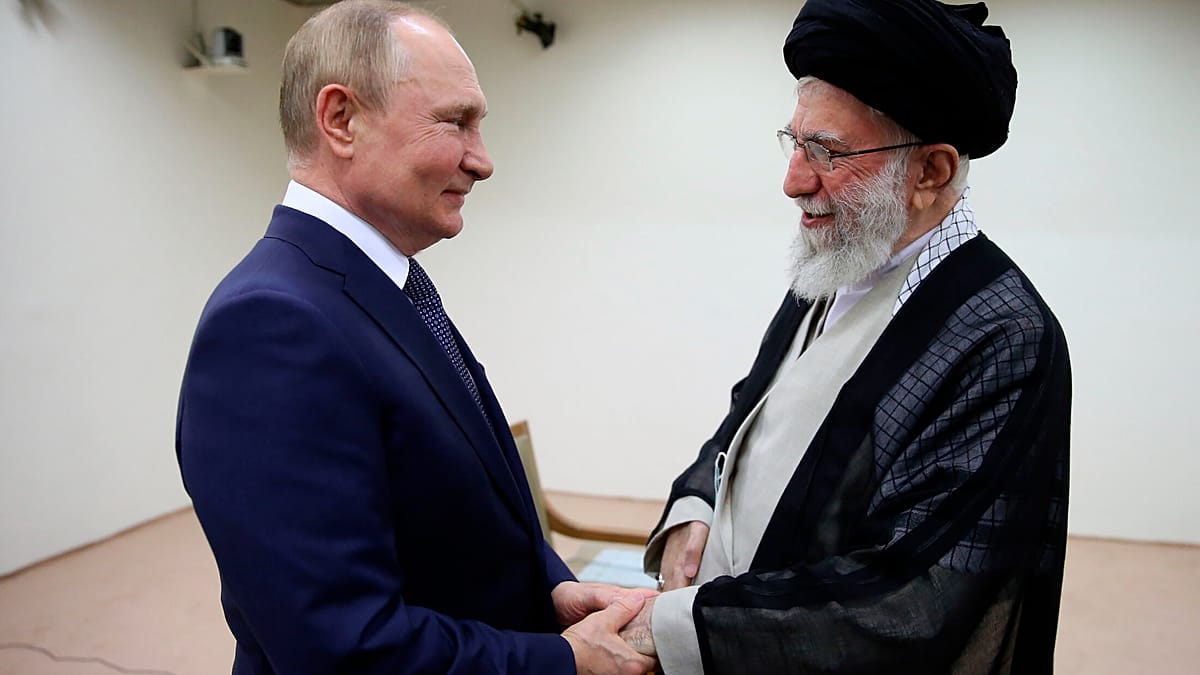
“In our country, Ayatollah Khamenei will be remembered as an outstanding statesman who made a huge personal contribution to the development of friendly Russian-Iranian relations, bringing them to the level of a comprehensive strategic partnership,” the Russian president said.
The Kremlin press service published this message on its official Telegram account, addressed to the President of the Islamic Republic of Iran, Masoud Pezeshkian.
Foreign ministry’s reaction to the US and Israeli attacks
The Russian Foreign Ministry, on the previous day, sharply condemned the joint US-Israeli military operation in Iran, calling it “a pre-planned and unprovoked act of armed aggression against a sovereign and independent UN member state in violation of fundamental principles and norms of international law.”
In Moscow’s view, “Washington and Tel Aviv have once again embarked on a dangerous adventure that is rapidly bringing the region closer to a humanitarian, economic and, not exclude, a radiological catastrophe.”
The Russian Foreign Ministry claimed that the US and Israel are “covering themselves with an imaginary concern to prevent the Iranians from acquiring nuclear weapons,” while in fact their main goal, according to Moscow, is “to destroy the constitutional order and destroy the leadership of a state they do not like, which has refused to submit to forceful dictate and hegemonism.”
In conclusion, the Russian Foreign Ministry demanded “an immediate return of the situation to a political and diplomatic settlement.”
Russians to leave Iran and Israel
The foreign ministry also appealed to Russians in Iran and Israel to leave these countries immediately if possible. The recommended evacuation routes from Iran are through Azerbaijan and Armenia.
Meanwhile, Russians are also offered to leave Israel through Egypt and Jordan**.**
As for Russians staying on the territory of other countries of the region affected by the conflict, the ministry urges them to “observe appropriate personal precautions, avoid crowded places and limit non-urgent movements around the country”.
Possible consequences for Russia
Events in Iran are being watched by the whole world, particularly by Moscow, as the Islamic Republic is considered an ally of the Kremlin.
As experts note, Iran has been a “castle” in the south of Russia until now. If Tehran undergoes regime change or the country plunges into chaos, Moscow risks a vast region of instability right on the borders of the Caucasus and Central Asia, and in the Caspian Sea, a zone with NATO military presence.
Under the sanctions regime, the North-South transport corridor, which runs through Iran, has effectively become the only safe transport route. Having lost such an important ally in the region, Russia may remain under a transport blockade, as western and sea routes through the Bosporus may be subject to restrictions.
According to Nikita Smagin, an orientalist and author of the book ‘Iran for All,’ the unstable situation in Iran could seriously affect Moscow’s existing projects with Tehran.
“Even if the current government in Iran remains in power, the general instability in the region still calls into question the creation of the North-South corridor,” Smagin says, “It is perceived in Russia not so much as a ‘connecting artery’ but as a vital measure capable of saving Russia in the event that all other transit routes, for example, through Turkey or China, are restricted due to sanctions,” she underlines.
Smagin also reminds that the same story applies to other projects, such as investments in Iran’s oil and gas sector, the creation of a gas hub through Iran, or the new Russian nuclear power plant that Moscow wanted to build in Iran. “All of this is now seriously in question. And in the long term, Russia may, of course, lose the prospects it had hoped for with regard to Iran,” the expert notes.
At the same time, according to Nikita Smagin, regime change in Iran is also highly undesirable for Russia.
“If we imagine a regime change, it is almost certain that the new government will be distrustful of Russia or will be openly anti-Russian. Simply because Russia supported the previous regime, sponsored it, and supplied it with weapons, which were also used to suppress protests,” Smagin stresses, “So in this sense, I think Russia’s prospects and Russian-Iranian relations are becoming, shall we say, less pleasant for the Kremlin,” she concludes.
Khamenei was killed on the morning of 28 February during the US and Israeli attacks on his residence.
Information about his death began circulating almost immediately, but was denied each time by the Iranian authorities. It was only on the night of 1 March that Tehran officially confirmed the death of the supreme leader, who had ruled the country since 1989, and declared a 40-day mourning period.


