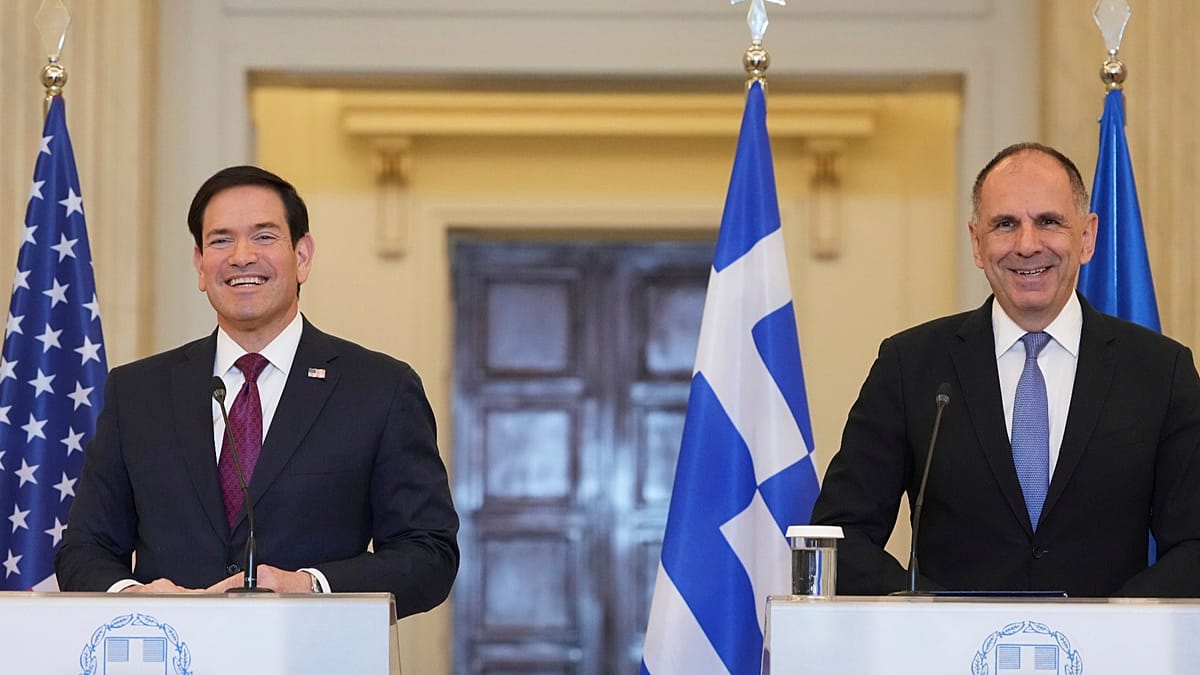


At a time when the security and energy landscape in Europe and the Eastern Mediterranean is undergoing constant change, Athens and Washington are seeking to further expand the strategic scope of their relationship. US Secretary of State Marco Rubio’s visit to Athens, for the sixth round of the Greece-US Strategic Dialogue, brought defence, security, energy, technology, trade and investment to the forefront.
ADVERTISEMENT


ADVERTISEMENT
The talks took place against a particularly complex international backdrop, with Greece emerging as an important US partner in the region, both in security and in energy planning for Central and Eastern Europe.
Two-hour Gerapetritis-Rubio meeting
On Wednesday morning, Marco Rubio visited the Foreign Ministry, where he met his Greek counterpart Giorgos Gerapetritis. The bilateral meeting lasted around two hours and covered a broad range of issues concerning both bilateral relations and regional and international developments.
Following the meeting, Gerapetritis highlighted the high level of Greek-US relations and the shared willingness to deepen them further.
He said Athens and Washington share a commitment to strengthening cooperation and promoting regional and international security.
Energy: Greece as a hub for US LNG
Energy cooperation featured prominently in the talks. The Greek Foreign Minister referred to Greece’s role as a hub for transporting US liquefied natural gas to Central and Eastern Europe.
“Energy cooperation between the two countries has reached an unprecedented level,” Gerapetritis said, also pointing to the increased presence of US energy companies in Greece.
In the same context, he referred to investments being developed in sectors including energy, technology and shipyards, which he said are adding new dimensions to the economic relationship between the two countries.
Marco Rubio also emphasised energy cooperation, referring to the expansion of US LNG imports as well as the development of new gas and electricity interconnections.
He said these developments could strengthen regional energy security and expand Greece’s role in the European energy system.
Defence: Alexandroupolis, F-16s and F-35s
A significant part of the talks focused on defence cooperation between Greece and the United States.
Gerapetritis described the Mutual Defence Cooperation Agreement as a key bilateral treaty governing relations between the two countries, while also highlighting the strategic importance of Alexandroupolis.
In the same context, he referred to the upgrade of Greece’s F-16s and the integration of F-35 fighter jets into the Hellenic Air Force.
He noted that defence cooperation is not only about strengthening national defence, but is also more broadly linked to strategic cooperation and stability in the region.
At the opening of the Strategic Dialogue, Gerapetritis described Alexandroupolis as a prime example of Greek-US cooperation.
Rubio: ‘Greece is a source of stability’
Marco Rubio spoke in particularly positive terms about the strategic relationship between the two countries, highlighting the historical and political ties linking Greece and the United States.
“The United States and Greece share a long history of friendship, cooperation and alliance,” the US Secretary of State said, noting that the importance of the relationship is even more evident in today’s international environment.
“It is both historic and foundational, but it is also critical. It is a source of stability in an unstable world,” he said.
Rubio also stressed that Greece remains an important US ally and that the two countries share common views on a range of threats and challenges.
Call for greater European responsibility for defence
The US Secretary of State also placed particular emphasis on the need for European countries to shoulder a greater share of responsibility for Europe’s defence.
“The nations of Europe need to take on a greater share of the burden and defending their continent, and Greece is doing just that,” he said.
The statement comes amid a broader US debate over strengthening European defence capabilities and increasing the contribution of European allies to the continent’s security.
New dimension to military cooperation with Florida
During Rubio’s visit to Athens, a cooperation agreement was also signed between the Chief of the Hellenic National Defence General Staff and the Florida National Guard, in the presence of Defence Minister Nikos Dendias and the US Secretary of State.
Dendias said the agreement adds a new dimension to cooperation between the armed forces of the two countries and forms part of Greece’s “Agenda 2030”.
He said Greece is looking for best practices to strengthen the operational capabilities of its armed forces and reservists, with cooperation with the Florida National Guard offering opportunities for knowledge transfer, training and the exchange of experience.
Marco Rubio described the agreement as an expression of the depth of the historic alliance between Greece and the United States.
Referring to possible areas of cooperation, he noted that the Florida National Guard has gained significant experience in responding to natural disasters such as hurricanes, while it can also draw on Greek experience in dealing with earthquakes and wildfires.
He said the partnership creates opportunities for interoperability and mutual learning and represents another step in building the modern Greek-US alliance.
Border security and counterterrorism
A significant part of the US position also focused on border security.
Marco Rubio described Greece as a “very close strategic partner” of the United States in tackling irregular migration, human trafficking, transnational criminal organisations and terrorism.
He also announced a new Memorandum of Understanding aimed at strengthening information-sharing between the relevant agencies of the two countries in the field of counterterrorism.
The US Secretary of State stressed the need to address contemporary challenges affecting the security of the West.
Eastern Mediterranean and maritime security
The two ministers also discussed major international crises, from the Middle East and Ukraine to Africa and migration flows.
Maritime security featured prominently on the agenda, with Giorgos Gerapetritis stressing its importance for the protection of international supply chains.
“Maritime security is a non-negotiable condition,” he said.
The Greek Foreign Minister also referred to cooperation between Greece and the United States in ensuring stability in the Eastern Mediterranean and protecting religious communities.
“Our shared concern with the United States is to create and safeguard conditions of stability in the wider Eastern Mediterranean region and to protect Christian populations, as well as every other ethnic and religious community,” he said.
Turkey in the background of regional developments
Turkey remained in the background of discussions over regional balances, although Marco Rubio did not mention the country by name.
The US Secretary of State referred to energy projects linked to a “very sensitive situation” involving other countries.
The careful wording reflects the complex diplomatic equation in the Eastern Mediterranean, where energy projects, regional partnerships and security issues are increasingly interconnected.
Rubio backs Guilfoyle
During his meetings in Athens, Marco Rubio was asked to comment on a Wall Street Journal report concerning US Ambassador to Greece Kimberly Guilfoyle.
The US Secretary of State avoided addressing the substance of the allegations and limited his response to saying that the US embassy in Athens was doing an excellent job.
He also described Guilfoyle as a strong representative of US interests in Greece, publicly reaffirming his support for the ambassador.
The sixth Strategic Dialogue and Greece’s role
At the opening of the sixth Greece-US Strategic Dialogue, Giorgos Gerapetritis stressed the strategic importance of the bilateral relationship and the role Greece can play in the region.
He said the country’s history, regional relationships and the influence of Hellenism allow Greece to maintain a broad network of partnerships.
“This gives Greece a specific responsibility, as well as the practical ability to connect countries, facilitate dialogue and build understanding,” he said.
The Greek Foreign Minister stressed that cooperation with the United States strengthens Greece’s role and security in the region, while the Strategic Dialogue can translate into concrete and tangible action.
A relationship with an expanded strategic scope
The sixth Greece-US Strategic Dialogue reflects the breadth of a relationship that now extends beyond the traditional boundaries of defence cooperation.
Energy, technology, investment, trade, border security, cultural heritage and regional stability are now integral parts of the bilateral agenda.
For Athens, strengthening ties with Washington is linked to its goal of playing a more active role in the Eastern Mediterranean and Southeastern Europe. For Washington, Greece is an important ally in a region where security, energy, maritime routes and regional balances are becoming increasingly significant.
Against this backdrop, Rubio’s visit to Athens and the sixth Strategic Dialogue reflect efforts by both sides to turn the already high level of the Greek-US relationship into even more concrete forms of cooperation, with a focus on security, energy and stability across the wider region.