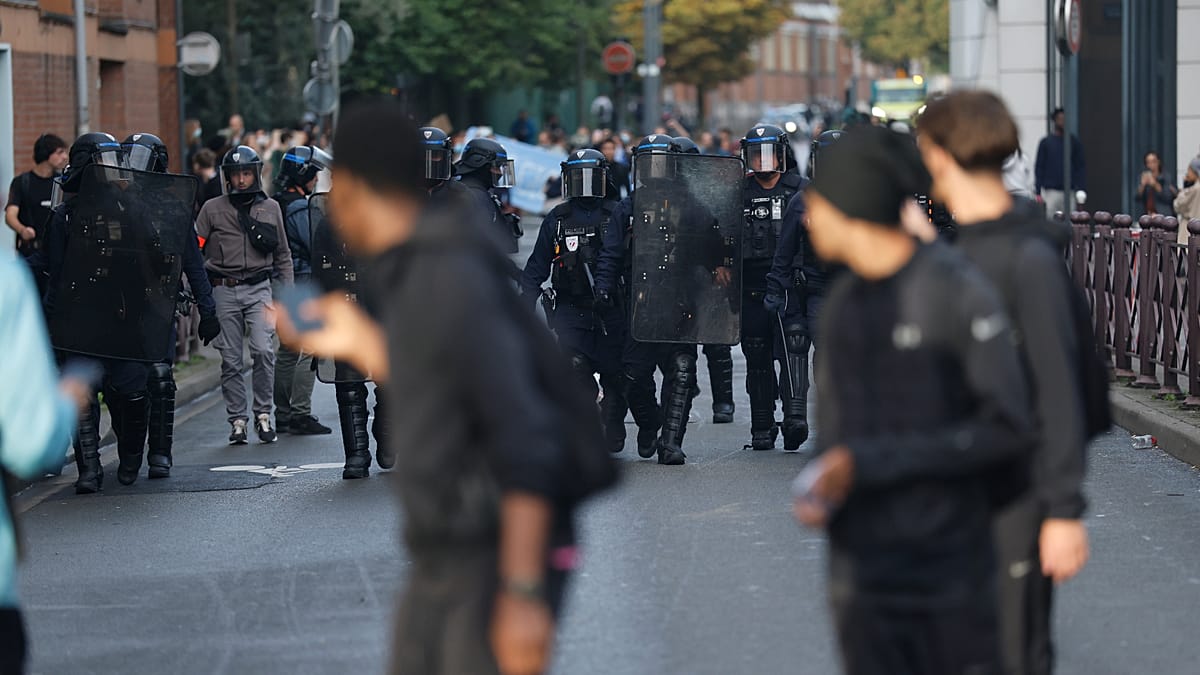



Up to 500 secondary schools in France are expected to be fully or partially closed on Monday as a new day of mobilisation by pupils gets under way, following several days of protests marked by clashes with police, damage to schools and street violence.
ADVERTISEMENT


ADVERTISEMENT
The demonstrations, which have spread across several major cities, have seen rubbish bins and other objects set on fire, projectiles thrown at security forces and damage to school buildings and street furniture.
The Ministry of Education said on Sunday that classes would be “totally or partially” suspended in 400 to 500 secondary schools where security conditions “are not met”.
There were “between 400 and 500 suspended classes” on Friday, and “there will probably be just as many on Monday, but with a gradual, partial resumption of classes”, Education Minister Édouard Geffray said in interviews with TV channel France 2 and radio station France Inter.
Twenty-four of the 735 schools affected by the protests have been “set on fire or ransacked”, the minister said. Geffray also said that “78 staff members” from the Ministry of Education have been injured “since the start of the events”.
Interior Minister denies any disproportionate intervention
The Interior Ministry said that the unrest has led to nearly 5,000 arrests since Monday.
Rubbish bins and other objects have been set on fire, while projectiles have been thrown at security forces. Police have intervened to disperse some demonstrators, using tear gas, rubber bullets and defensive ball launchers (LBDs), as well as batons
On Sunday morning, Interior Minister Laurent Nuñez defended the actions of the security forces, rejecting claims that the response was “disproportionate”.
Nuñez insisted that “the police do not repress young people”, but “protect” pupils and students who wish to “advance their demands peacefully”. He nonetheless warned that they intervene “firmly and without delay” to put an end to “damage, violence [and] abuses” committed by troublemakers.
He also denied that the security forces are specifically targeting “racialised young people from working-class neighbourhoods”, condemning what he called a “blaming narrative totally disconnected from the real world”.
Unsafe buildings, overcrowded classes and absent teachers
The movement began two weeks ago at the Saint-Exupéry secondary school in Créteil, in the Paris suburbs, in support of striking teachers who were denouncing a lack of staff and resources.
It then gathered pace and gradually spread across the country over the past week.
Pupils are denouncing, among other things, unsafe and insanitary buildings, overcrowded classes, timetables they say are impossible to cope with and a shortage of staff, with teacher absences that are not systematically covered. Some are also challenging the ban on mobile phones in schools.
On Friday morning, the Minister of Education, Édouard Geffray, met representatives of the pupils. After the meeting, they said they had not obtained any “concrete measures” and called for the movement to continue next week.
An “act III” planned for Tuesday
After two nationwide days of mobilisation, on 29 September and 1 October, an “act III” is planned for Tuesday.
All the teachers’ unions said on Sunday that they would join the pupils’ protest. “Their demands are legitimate, and we support them all the more because they are at the heart of our own mobilisations denouncing the lack of resources for several years now,” they stated in a press release.
The unions also criticise a government response to the mobilisation that they say has been limited to the intervention of the security forces. “Reports from pupils who have been injured, assaulted and threatened are increasing by the day. This is unacceptable,” they argue.
A mobilisation marked by several serious incidents
Several serious incidents have also been recorded on the fringes of the mobilisation.
In Tours, in central France, a young man who was injured lost sight in his right eye after clashes between pupils and police on Wednesday, according to the local prosecutor.
In La Ciotat, in Provence, a 59-year-old teacher was doused in petrol and beaten during a pupils’ demonstration. A 16-year-old boy, suspected of carrying out the attack, was arrested in Marseille on Sunday morning and taken into police custody.
Police officers have also been targeted. In Belfort, in the east of the country, one officer was chased, beaten and repeatedly kicked by a group of young people. Two people were taken into custody following this attack.
According to information from Le Parisien, faced with the widespread damage around schools and in public spaces, the government intends to bring forward the timetable for the “casseurs-payeurs” bill. The aim is to make people who take part in violent gatherings contribute to the cost of repairs, even when they are not directly responsible for the damage.
The Senate is due to examine the bill at the end of October