




Published on
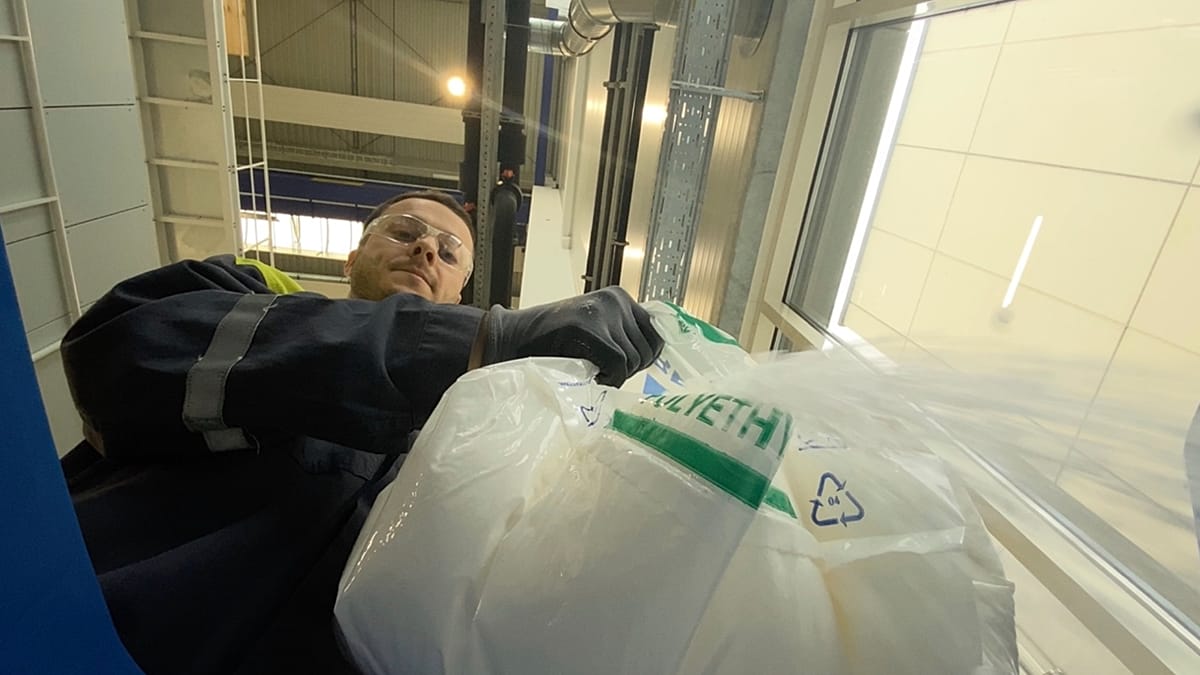
It looks like a manufacturing plant but it’s actually a huge research facility. Inside Borealis’s Innovation Hall in Linz, Austria, raw materials with bizarre names — like polymers — are mixed with additives, antioxidants or glass fibre to test the manufacturing of a wide array of everyday products.
“The different products we design could be pipes or bumpers, or of course packaging material to wrap a sweet,” explains Doris Machl, the Head of the Competence Center at Compounds & Recyclates.
From insulating materials to fully recyclable transparent films, these real-size manufacturing lines enable developers to clearly show potential clients how to provide plastic materials with a second life in factory-like conditions.
The facilities are the Innovation Headquarters of Borealis, one of Europe’s biggest chemical groups. It employs 6,200 people, is present in 120 countries and claims it is fully committed to turning plastic rubbish into innovative products.
“We’re one of the very few companies that makes the virgin material, uses waste materials and makes products out of it that are truly for high-performance applications. So these are not buckets or pallets. We actually are upcycling and not only recycling,” says the company’s CEO Stefan Doboczky.
The group acknowledges that the easiest and most efficient way to avoid plastic waste is to stop leakage into the environment. That’s why in 2017 they started a project called STOP, aimed at tackling plastic waste in Indonesia.
“We chose Indonesia because 60% of the waste is not collected, meaning it goes to open burning, illegal dump sites, pollutes rivers and ends up in the ocean. We have developed and applied the system in three partner cities. We have actually connected more than 600,000 people to waste management and created 260 jobs locally,” explains Markus Horcher, the company’s Vice President for Sustainability and Public Affairs.
The company has filed more than 12,000 patents.