






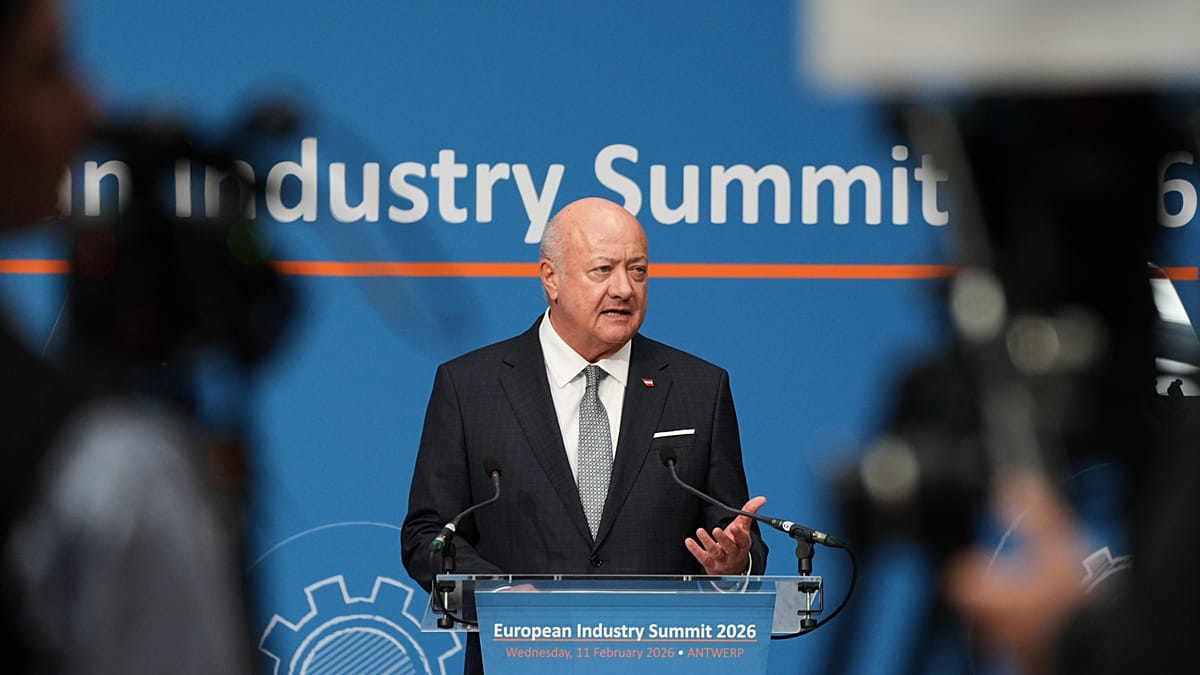
A group of ten countries urged the European Commission on Wednesday to review its Emissions Trading System (ETS), calling the current framework of the law an “existential risk” for many key industrial sectors, according to a letter seen by Euronews.
ADVERTISEMENT


ADVERTISEMENT
The letter, signed by the leaders of Austria, the Czech Republic, Croatia, Greece, Hungary, Italy, Poland, Romania, and Slovakia, called on the EU executive to extend free carbon allowances beyond 2034, saying that, otherwise, their industries won’t be able to keep up with the costs.
“Our industry is committed and continues to take the necessary steps to transform its business models,” the letter said. “However, combined with high energy prices and the phase-out of ETS free allowances, the current framework has become an existential risk for many European strategic industrial sectors.”
Pressure is growing on the commission to scrap the ETS, the bloc’s carbon market, ahead of a gathering of EU leaders in Brussels on Thursday, aimed at addressing the looming energy crisis triggered by the war in Iran. Some EU countries want to kill the EU’s carbon market, others want to change it, while others want to keep it.
The letter’s appeal came shortly after Commission President Ursula von der Leyen suggested it would back the bloc’s carbon market, hailing the climate policy tool as essential for lowering emissions and for channeling funds to clean technologies — a different response to that wished by energy-intensive industries, who made a strong case against the ETS during an industry summit in Antwerp last month.
The ten countries say the EU’s carbon market is moving too fast, piling pressure on businesses already squeezed by soaring energy prices and stubborn inflation. The result, they warn, is a growing threat to Europe’s industrial core and with it, the continent’s economic strength.
“Energy prices have skyrocketed, inflation has made the investments required for the transition even more costly, and current decarbonising solutions are not yet sufficiently developed for economic sustainability for hard-to-abate industries,” reads the letter.
Commission President Ursula von der Leyen and European Council chief António Costa said after the informal EU summit in Alden Biesen that the bloc was going to “present options” at Thursday’s European Council, but stressed the “complexity of the problem”: electricity prices are tied to natural gas and changing the system involves many elements to consider like national taxes, network fees and the ETS.
Key demands
The letter, signed by the 10 countries, states key demands to avert the situation, namely the extension of free ETS allowances beyond 2034. Companies currently get a few free allowances, so they don’t have to pay for all their emissions. They want this help to last longer, so businesses aren’t hit with full costs too soon.
The EU countries also want the Commission to slow the phase-out of free allowances starting in 2028, giving companies more time to adapt. They are also asking the EU executive to reduce carbon price volatility to make it more stable, and give businesses the ability to plan ahead without sudden cost shocks.
Finally, they’re calling for measures to prevent electricity prices from becoming too high for industries and consumers, a key hurdle to the bloc’s competitiveness and its ability to remain economically and strategically independent in an increasingly unstable world.
Heavy industries, especially those hardest to decarbonise, are facing a perfect storm, the letter argues, citing rising costs, unproven green technologies and the looming loss of free carbon allowances designed to keep them competitive.
Above all, they are demanding speed from lawmakers to rethink the bloc’s major carbon policy system, saying that the situation can’t wait until the summer, when the ETS is due to be reviewed, and are asking the EU executive to propose a solution “within weeks”.
“Following our upcoming discussions at the European Council in March, the review of ETS should be presented at the end of May at the latest,” reads the letter.
Other EU countries have been lobbying hard to keep the ETS as it is.
On March 6, energy ministers from Denmark, Finland, Latvia, Luxembourg, the Netherlands, Portugal and Sweden sent a letter to Energy Commissioner Dan Jørgensen arguing the system, as it stands is effective, supports cross-border electricity trade and has saved Europe about €34 billion per year, according to a separate letter seen by Euronews.


