
The detention of former EU foreign policy chief Federica Mogherini earlier this month in a fraud investigation in Belgium has raised fresh questions about why suspects in the European Parliament’s corruption scandal still have not faced trial, three years after arrests that shocked Brussels.
Mogherini, who led the EU’s diplomatic service from 2014 to 2019 and then served as rector of the prestigious College of Europe, was questioned alongside two others on suspicion of alleged procurement fraud, corruption and conflict of interest related to an EU-funded diplomatic training programme.
The Italian top diplomat, who was eventually released pending charges, has since resigned from her post at the College of Europe.
Meanwhile, the protracted European Parliament corruption scandal investigation, which began with raids across Brussels on 9 December 2022, has moved at a glacial pace.
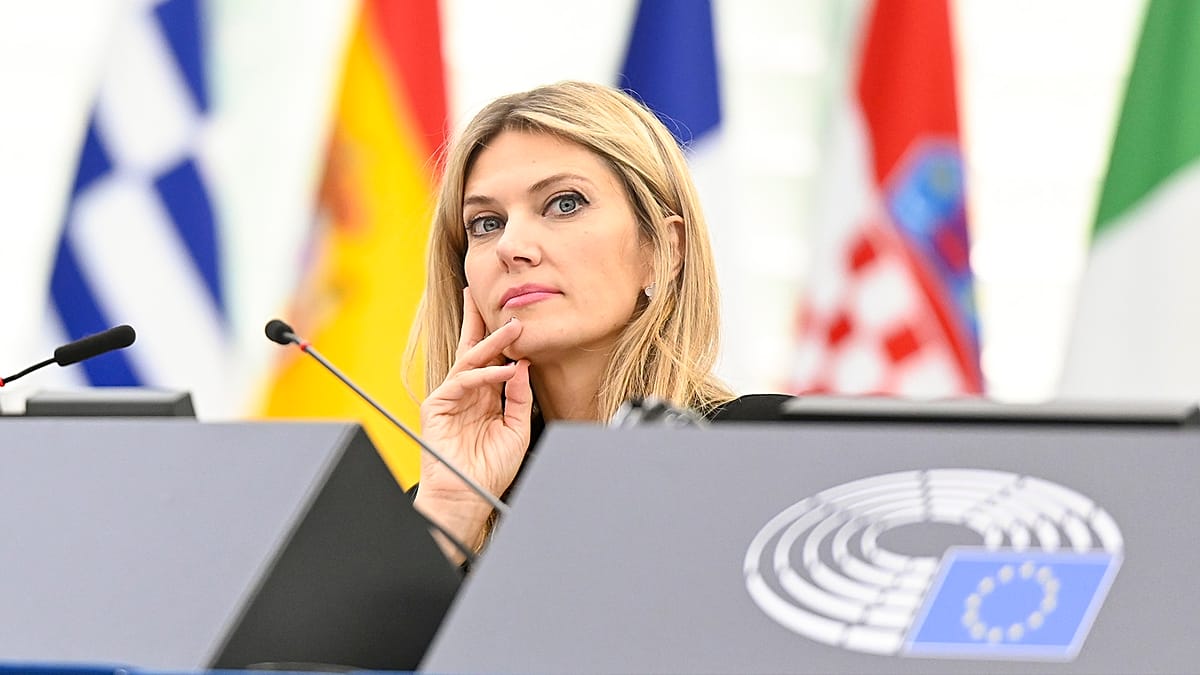
Greek MEP Eva Kaili became the face of the scandal when Belgian police revealed it had discovered €150,000 in cash — purportedly in large bags — at her Brussels residence during the raids.
Since then, Kaili has spent the intervening years in a legal purgatory, or what some have since dubbed “Belgiangate”.
Brussels rocked by Parliament sting
Authorities said they discovered a total of €1.5 million in cash during the 2022 sting, including €600,000 at the home of former Italian MEP Antonio Panzeri and the money found at the Brussels residence of Kaili, who was also serving as one of 14 vice presidents of the European Parliament at the time.
Kaili’s father Alexandros was apprehended at the Sofitel hotel at Place Jourdan with a suitcase containing “several hundred thousand euros,” according to authorities.
A special police team accompanied by investigating judge Michel Claise then raided Kaili’s home that evening, arresting her in front of her two-year-old daughter.
Stripped of her parliamentary immunity, Kaili spent four months in pre-trial detention followed by house arrest with an electronic bracelet until May 2023, all while maintaining her innocence in what prosecutors allege was a scheme by three non-EU countries to buy influence in the European Parliament.
She remains charged with participation in a criminal organisation, corruption and money laundering.
The 47-year-old former MEP has consistently denied all charges. Her partner Francesco Giorgi, a parliamentary assistant and former aide to Panzeri, admitted accepting bribes but alleged Kaili was not directly involved in the corruption scheme. He is the father of Kaili’s daughter.
Byzantine court drama
The case centres on allegations that Qatar, Morocco and Mauritania sought to influence European Parliament decisions through bribes paid to MEPs and staff. Authorities say the scheme aimed to kill off parliamentary resolutions condemning Qatar’s human rights record and secure visa liberalisation for Qatari citizens. Both Qatar and Morocco deny the allegations.
Panzeri struck a deal with prosecutors in January 2023 to become a cooperating witness in exchange for a reduced sentence. Under the agreement, he committed to revealing “the identity of the persons he admits to having bribed.”
Defence lawyers have challenged Panzeri’s credibility and the methods used to secure his confession.
The case took another hit after Claise, the investigating judge who ordered Kaili’s arrest, was forced to recuse himself in June 2023 after it emerged his son was a business partner of Belgian MEP Marie Arena’s son — Arena herself later charged in the scandal.
Defence lawyers claim Claise knew about these connections and should have recused himself earlier, and that he protected Arena by delaying her indictment.
Marie Arena was charged only in January with participation in a criminal organisation but not with corruption or money laundering. Police found €280,000 in cash at her son’s home, according to Belgian media reports.
Another significant development came in September 2024 when a Brussels judge ordered Committee R, an independent body overseeing Belgian intelligence, to review the legality of “specific and exceptional methods” used by Belgian secret service VSSE in the investigation.
“It’s a very important and extraordinary decision that the appeal court made,” Kaili’s lawyer Sven Mary told Euronews at the time, adding that the finding could open a “new Pandora’s box” about the role Belgian intelligence played.
The Committee had issued an opinion in January confirming that the VSSE acted within the law. However, defence lawyers pointed out that Belgium’s penal code was not amended to criminalise foreign interference until April 2024 — a year and a half after the raids. At the time of the original investigation, only military espionage qualified as a prosecutable offence of interference.
Kaili has also challenged other parts of the investigation, arguing that Belgian authorities subjected her to “medieval” conditions during detention.
Her lawyers claimed she was held in solitary confinement for three days in January 2023 without adequate blankets, with lights on continuously, which they described as “torture”. Belgian prosecutors disputed these claims.
Case known as Belgiangate?
The procedural challenges facing the investigation are substantial. Defence lawyers have questioned the case on multiple fronts, including how Kaili’s immunity was lifted, the role of Belgian intelligence services, and the credibility of key witness Antonio Panzeri.
A crucial dispute centres on whether investigators artificially created a flagrant delicto situation. When Kaili’s father was arrested carrying a suitcase of cash on 9 December 2022, Judge Claise used this to justify an immediate search of Kaili’s home.
Defence lawyers argue immunity can only be lifted when someone is caught in the act, and that investigators manufactured these conditions specifically to bypass her parliamentary protections.
Questions about Panzeri’s reliability intensified after Giorgi secretly recorded an investigator saying, “Panzeri is lying.”
The recording, revealed by Belgian outlet La Libre, is said to have captured the investigator repeatedly questioning the credibility of the man Belgian authorities consider the scheme’s mastermind.
Prosecutors want the recording excluded, citing “unclear” circumstances. Defence lawyers insist it proves Panzeri’s cooperation agreement was granted too hastily and should have required court approval.
In September 2024, Kaili and Giorgi filed a defamation complaint against Panzeri with prosecutors in Milan.
In July of this year, Kaili won a legal victory when the EU’s General Court ruled that the European Parliament had wrongly denied her access to documents about her alleged mismanagement of parliamentary assistant allowances, part of an EPPO claim.
All still in limbo
The case has expanded significantly since the initial arrests. In March, prosecutors requested that parliamentary immunity be waived for Italian S&D MEPs Elisabetta Gualmini and Alessandra Moretti.
In total, at least 10 people now face charges, including former MEPs Panzeri, Cozzolino and Marc Tarabella, as well as lobbyist Niccolò Figà-Talamanca and Luca Visentini, general secretary of the International Trade Union Confederation.
The Brussels Chamber of Indictment only began reviewing the legality of the investigation this week, with hearings involving more than 20 parties to the case.
Kaili, who did not seek re-election in 2024, now lives in Italy and Greece, where authorities froze her assets shortly after her arrest, while it remains unlikely a trial will begin before late 2026 at the earliest.