




Two dozen humanitarian workers who participated in search and rescue operations on the Greek island of Lesvos from 2016-2021 have now begun their long-awaited trial.
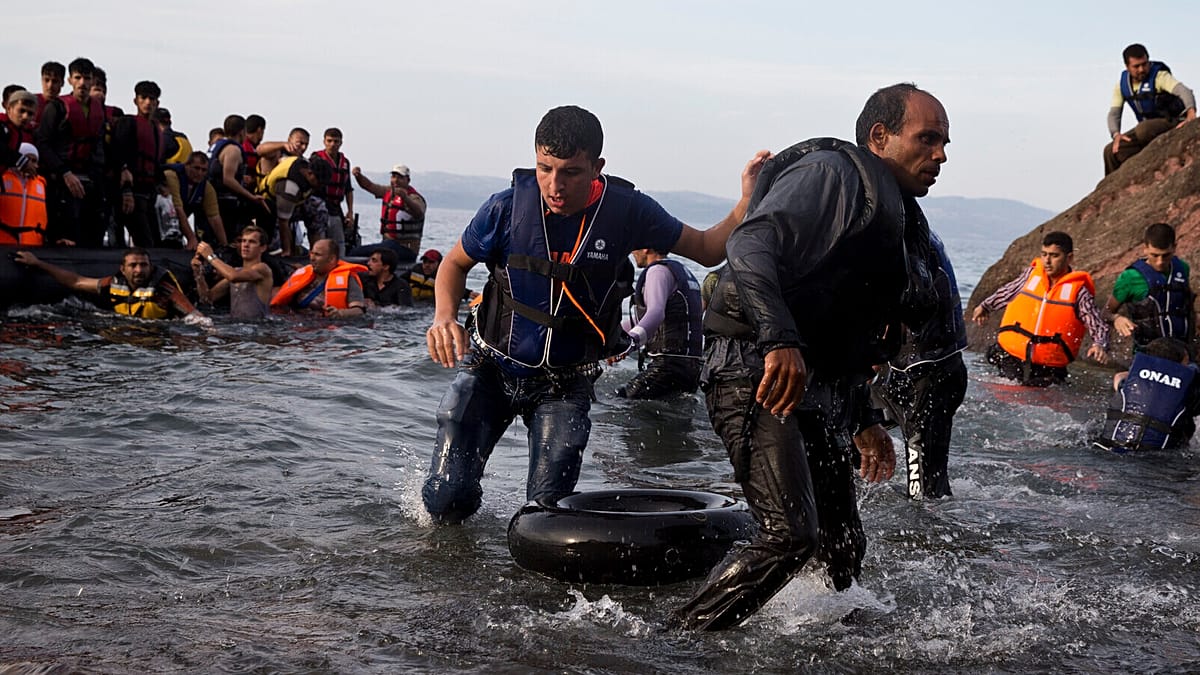
Once a paradisial tourist hotspot, Lesvos became the key entry point for individuals and small boats headed to Europe in 2015, a year which marked the peak of the continent’s migration crisis.
More than 10 years on, the accused – 24 in total – face up to 20 years in prison for charges including alleged participation in a criminal organisation, facilitating the entry of third-country nationals into Greece and money laundering.
While the trial focuses on a border security issue according to Greek authorities, human rights groups have labelled the accusations “baseless” – condemning what they say is flimsy evidence and accusing the authorities of a politicised crackdown on humanitarian groups.
It comes after years of allegations that the Greek authorities have been breaching international and European laws in their response to the arrivals of migrants and would-be asylum seekers.
In January this year, the Strasbourg-based European Court of Human Rights found that the Greek coast guard had “systemically” conducted so-called pushbacks against potential asylum seekers, marking the first time a court has officially acknowledged a practice Greece has long denied.
‘I’m confident what I did was right’
Among the accused is Seán Binder, a German-Irish citizen who travelled to Lesvos in 2017 aged 23. He was a search and rescue volunteer with the now-defunct Emergency Rescue Centre International (ERCI), a registered Greek humanitarian NGO.
“I spent most of my time on “spotting shifts” looking out at the Turkish mainland a few miles away, where smugglers push people into boats and send them over to seek asylum in Europe,” Binder told Euronews.
“The boats don’t want to be caught, so there aren’t any bright lights. Instead, we would be on the lookout for distress calls, screaming and shouting. I communicated with the coast guard weekly and would inform the port authority when we went out to sea,” he added.
But Binder’s volunteer work ground to a halt when he was arrested in 2018 with Sarah Mardini, a Syrian NGO worker who swam across a stretch of the Mediterranean with her sister Yusra. Their story was fictionalised into the Netflix film The Swimmers.
Speaking to Euronews, Binder emphasised his frustration at the seven-year long ordeal he has endured: “If we really are these heinous criminals, then wouldn’t we be in prison already?”
In 2023, Binder and a group of other defendants were acquitted of a series of misdemeanour crimes: forgery, illegally listening to radio frequencies and espionage. The outstanding misdemeanour charges for the other 16 accused defendants were dropped the following year.
Binder told Euronews that this time round, he is prepared.
“Practically speaking, I have prepared myself for imprisonment,” he said. “I have a small pot of money saved so that my mother and family can visit me in prison.”
“I am confident what I did was right. What I’m less confident about is that the police have been doing the right thing all these years. But I remain optimistic that the judiciary will. We are in the birthplace of democracy, after all.”
Arrivals pushed into ‘state of invisibility’
Today, there are no NGOs conducting search and rescue operations or providing emergency response during landings on Lesvos, despite over 3,500 people arriving to the island so far this year, according to the UN refugee agency.
The last landing at which first responders were present took place in March 2020. During the same year, the Greek government tightened registry rules for organisations and individuals working with asylum seekers and migrants.
Franziska Grillmeier, a freelance journalist who has reported on the situation at the EU’s external borders with a focus on Lesvos, explained that since the time of Binder’s arrest, it has “become much more normalised to deter the work of first aid responders and humanitarian workers on the Aegean islands”.
“It means everything has been pushed into a state of invisibility,” she said. “We don’t see what’s happening. As a journalist here today, I would not be able to document a boat arrival without many questions asked.”
The Executive Director of Amnesty International Belgium, Wies de Graeve, described the charges against Binder as “part of a trend sweeping across Europe that’s criminalising solidarity,” saying European governments are “punishing those who try to fill that dangerous gap”.
Similar cases to Binder’s have been brought in several European countries. In another high-profile case in 2018, three Spanish firemen involved in rescue missions for migrants and refugees in Lesvos were put on trial for smuggling charges, but eventually acquitted.
Brussels-based NGO PICUM says as many as 142 people faced similar judicial proceedings in 2024.
During the years Binder has been awaiting trial, there has also been a sharp pivot in European policy towards migration, with leaders increasingly embracing hard-line views and exploring new and “innovative” ways of curbing arrivals.