
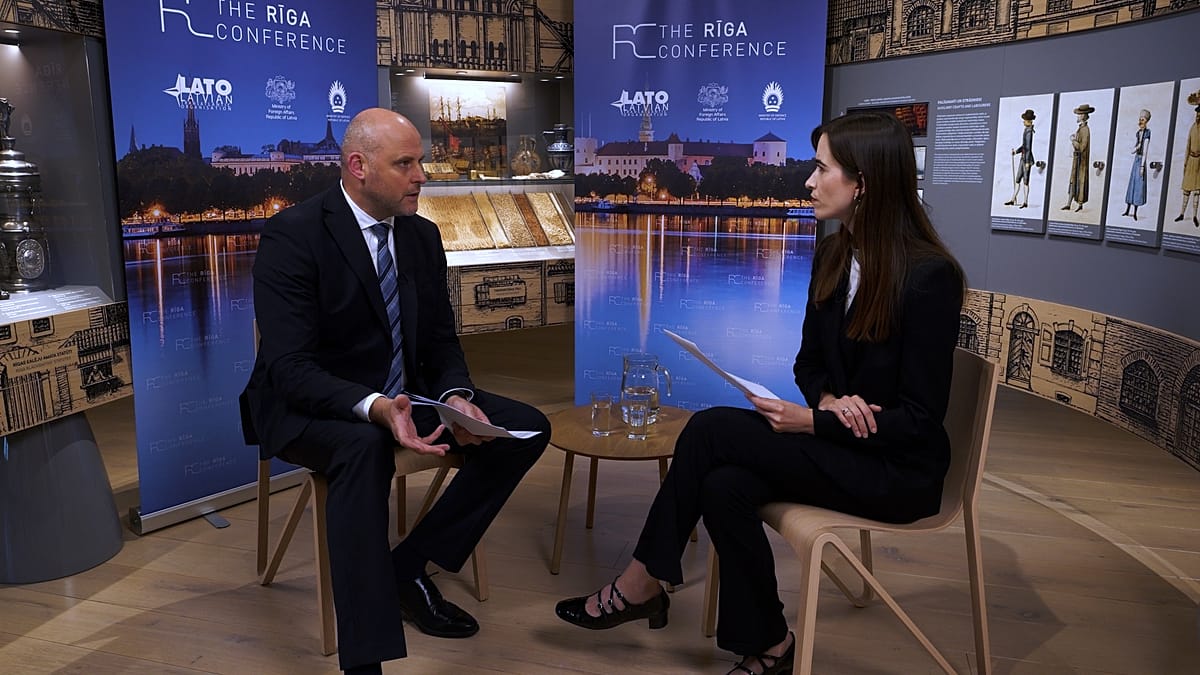
Brussels is finally starting to wake up to the security threat Russia poses to the European Union, Latvia’s Prime Minister Andris Kulbergs told Euronews.
ADVERTISEMENT


ADVERTISEMENT
His comments come days after a Russian drone struck a passenger train just two kilometres from the Polish border on Sunday and weeks after Germany attributed an attempted drone attack at Leipzig/Halle Airport to Moscow, prompting swift responses from EU officials, who warned Europe must prepare for a “new era of European security”.
To vulnerable countries on the northeastern frontline, these attacks come as no surprise; they have long been cautioning that an escalation of hostile Russian activity on EU soil was on the horizon.
“We were right, weren’t we? We told everyone this was going to happen,” Kulbergs said of warnings coming from the Baltics on Euronews’ interview programme The Europe Conversation.
“We know the bear inside out, what it thinks, how it functions – we were occupied [by Russia] for 50 years. We know the tricks,” he said, adding that leaders are only now grasping the severity of the situation. “Everybody now listens. When I meet [European] leaders, they understand what we’re saying. It wasn’t like that even two years ago.”
While the prime minister does not believe Russia will open a “second front”, he did warn the EU must now translate this understanding into solid action. “Those who prepare for the worst have peace.”
Latvia, Kulbergs argued, is already doing more than its part — the country is ranked among the highest spenders on defence as a percentage of GDP within NATO. “We are increasing our debt to invest in security because we understand the threats; we understand we have no other choice. But Europe has to do the same. We have to boost production and prioritise our military industry.”
This is the only way to deal with Russia, according to Kulbergs, which he referred to as a “bully” that does not play by the rules. “A bully understands force, and this is what we must show. Real force, boots on the ground, investment in our security and showing our muscles.”
Public backing and missile components
To fully deter Russia, Kulbergs said, Brussels must also “fully make up its mind” when it comes to supporting Ukraine. “Ukraine is being attacked by ballistic missiles, of which Russia is producing way more. And what do they contain? Western components.”
Brussels blocks components from reaching Russian missiles by enforcing strict export bans, but still, some are slipping through the cracks.
Last month, Ukraine’s Presidential Commissioner for Sanctions Policy Vladyslav Vlasiuk confirmed recovered Russian ballistic missiles contained Western components; Ukrainian Foreign Minister Andrii Sybiha said Kyiv had provided its European partners with data on this.
“We’re still supplying Russia for them to build missiles to attack Ukraine, and then we’re helping Ukraine with more money to fight back,” Kulbergs said.
Vlasiuk has stressed the need for Ukraine’s partners to cut off these supplies, a call echoed by Latvia’s head of government, who said he has been “very open” with his European counterparts on this matter.
“Maybe in the first place, we should put a full ban on those Western technological components being used in these missiles; then Russia will not be capable of building them. We must impose sanctions and then also actually execute them.”
Aside from getting European leaders fully on board, it is pivotal for the public to understand the risk Russia poses too, said Kulbergs, who became prime minister in May after his predecessor stood down amid a dispute over the handling of stray drones.
“The [full] commitment is not there, because societies are still behind [when it comes to] understanding the threat,” he said, adding that this is largely due to the broken connection between politicians and society.
“People are fed up with political blah blah blah. People need to hear the truth, for people to explain things simply and not cover up uncomfortable news. Then, people will understand much better.”