


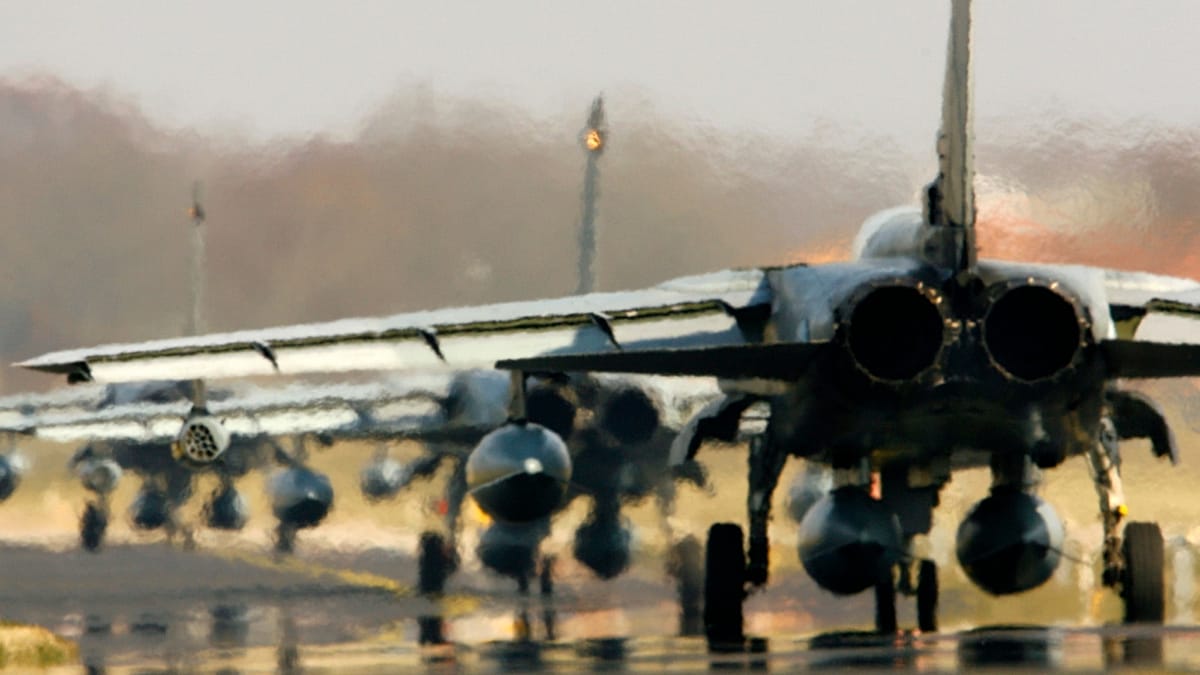
Germany has no plans to purchase additional F-35 fighter jets, a spokesperson for the German Defence Ministry confirmed to Euronews, dismissing earlier reports that Berlin might seek more US-made aircraft to offset delays in the German-French-Spanish Future Combat Air System (FCAS) project.
ADVERTISEMENT

ADVERTISEMENT
While speculation had suggested that additional F-35 acquisitions could bridge a potential capability gap amid an apparent deadlock in the European trilateral programme, the ministry clarified to Euronews that there are no “concrete” or “political” plans to proceed with such a purchase.
FCAS or F-35: Is Berlin forced to choose?
Germany, France and Spain have been working on the Future Combat Air System (FCAS) for nearly a decade now to replace the Eurofighter and Rafale jets by 2040.
The programme has been stalled due to disagreements between Airbus and Dassault, with the latter claiming it could build the jet on its own if needed and calling for the bulk of the workforce to be based in France.
Although German Chancellor Friedrich Merz and French President Emmanuel Macron have held extensive talks to accelerate progress, Merz suggested on Wednesday that Germany could abandon the project altogether, saying that, as a nuclear power, France has “different needs” than Germany and Spain.
Macron defended the project during his visit to India, emphasising that Europe needs one common fighter jet.
“We Europeans, if we understand the direction history is taking us, have an interest in standardising, simplifying and therefore having a common model,” the French president said.
A decision is expected by the end of this month. Should FCAS be abandoned, France may produce a jet “quite quickly, as it needs it probably on its own at this stage”, Luigi Scazzieri, a senior policy analyst at the European Union Institute for Security Studies (EUISS), told Euronews.
Berlin, Scazzieri added, has several options: developing its own fighter jet — which he believes is “highly unlikely” — joining the British-Italian-Japanese Global Combat Air Programme (GCAP), or purchasing additional US-made F-35s.
Scazzieri added that it’s “worth noting that there is no European equivalent to the F-35 currently on the market.”
In March 2022, during Joe Biden’s US presidency, Berlin decided to purchase 35 Lockheed Martin F-35s to replace the Bundeswehr’s ageing Tornado fleet. Since then, the administration has changed — not only in personnel, but also in its rhetoric.
Since assuming office for the second time just over a year ago, US President Donald Trump has put his European allies under pressure, raising questions about whether the US remains a reliable NATO partner.
This uncertainty has sparked debate in Germany and prompted the government to increasingly turn to European or domestic defence production as part of its broader rearmament drive.
‘Buy European’
Germany’s 2026 federal budget allocates around €108.2 billion to defence, including €82.7 billion in the regular defence budget and €25.5 billion from the Bundeswehr’s special fund.
According to government planning documents, the vast majority of upcoming procurement contracts are expected to go to European manufacturers, with only around 8% of planned major procurement projected to be directed to US suppliers, as reported by Euronews.
Although Berlin is placing greater emphasis on domestic defence suppliers, they are unable – and in some cases unwilling – to produce everything the armed forces need.
A case in point is the F-35 fighter jet, which incorporates highly sensitive and tightly protected technologies that prevent it from being manufactured outside the US.
Additionally, specialised production facilities, strict US export controls under the International Traffic in Arms Regulations (ITAR), and strategic considerations make overseas assembly effectively impossible.
According to a spokesperson for the German Defence Ministry, the F-35 isn’t a “US-only” product, as it was developed jointly by eight countries and is a multinational defence project, not just a bilateral one.
Important parts of the aircraft are produced outside the US, the spokesperson told Euronews, explaining that “when planning procurement and negotiating contracts with manufacturers – and, where relevant, with partner countries – care is always taken to ensure that the operational readiness of the systems, and therefore of the Bundeswehr, is maintained.”
More generally, the spokesperson added that regardless of a specific case, “we assume that existing contracts will be honoured.”
A so-called “kill switch” has sparked fears that the jet may be disabled in the US. So far, no such mechanism has been confirmed.
The F-35A — the version Germany is set to receive — is certified to carry the US B61-12 nuclear bomb, meaning it can deliver both conventional and nuclear weapons.
Within NATO’s nuclear sharing framework, it is therefore regarded as the likely successor to ageing dual-capable aircraft such as the Tornado, John Foreman CBE, a former British defence attaché in Moscow and Kyiv, told Euronews.
‘Difficult from the outset’
Retired German Bundeswehr Colonel and EuroDefense President Ralph Thiele told Euronews that the idea of purchasing a fighter jet for nuclear sharing “isn’t smart”.
“Once you have the jets, you can’t really deploy them freely,” he said, arguing that “nuclear weapons are, so to speak, the last resort – not necessarily in terms of timing, but as the final means of escalation.”
According to Thiele, this means the aircraft cannot simply be used for other missions, as they must remain available for their primary purpose at all times.
“In a conflict, these aircraft would essentially remain in shelters, reserved for the scenario in which they might have to be used,” he added, calling the purchase of the F-35 “difficult from the outset”.
Alongside the nuclear sharing, the F-35 has been dubbed a “flying computer” before due to its complex software.
“These systems constantly need to be updated, meaning you have to keep paying for upgrades”, Thiele said, calling the jet a “money-printing machine”, as software doesn’t have a fixed price.
“You might be able to calculate development costs once, but beyond that, it becomes somewhat arbitrary, as they can charge for the software as they see fit”, he continued.
Thiele reckons that the F-35 is a “complex interplay of different software components” that allows it to perform manoeuvres that wouldn’t normally be possible in an aircraft.
“But it also means everything has to work perfectly together, including the integration of the weapons systems,” Thiele said. “The real question is: how do you gain access to that?”
“You would need a specific contractual arrangement, and you would also need hundreds of engineers and IT specialists to keep the system up to date”, the retired Bundeswehr Colonel explained. “We simply don’t have that”.
What choice does Germany have?
Thiele added that, in his opinion, joining the British-Italian-Japanese Global Combat Air Programme (GCAP) would be the best available alternative to FCAS.
GCAP is the combination of the UK’s Tempest programme and Japan’s F-X project, aiming to deliver a sixth-generation air combat system by 2035 to gradually replace the Eurofighter Typhoon and the Mitsubishi F-2.
According to Scazzieri, “cooperation is well under way, so slotting Germany in won’t be easy”. He added that because of the decision to buy F-35s, “Germany actually has no pressing need to develop another plane. It may choose to invest in other priorities.”
Additionally, Germany cannot realistically replace the F-35 at this stage, whether politically or financially.
“There are obvious practicalities involving imminence,” Foreman, the former British diplomat, added, emphasising the need “to have the equipment soon”, as well as “capability, industry shares, and interoperability.”
He claimed that Europe can’t defend itself independently for at least ten years, meaning that “the US is the backbone of NATO, which is what is needed for European security.”
“Germany has to deal with the cards it’s dealt for now”, said Foreman.
For Thiele, too, this means that Berlin – for now – has to adopt a “dual-track strategy” to “preserve American goodwill and see what happens after Trump.”
“At the same time”, he argued, “we urgently have to build up our own capabilities, which means moving towards a different fighter aircraft that becomes available sooner.”
The F-35 was something of an “accident”, Thiele claimed, explaining that “it may serve as a bridge or turn out to be a liability for the future.”


