




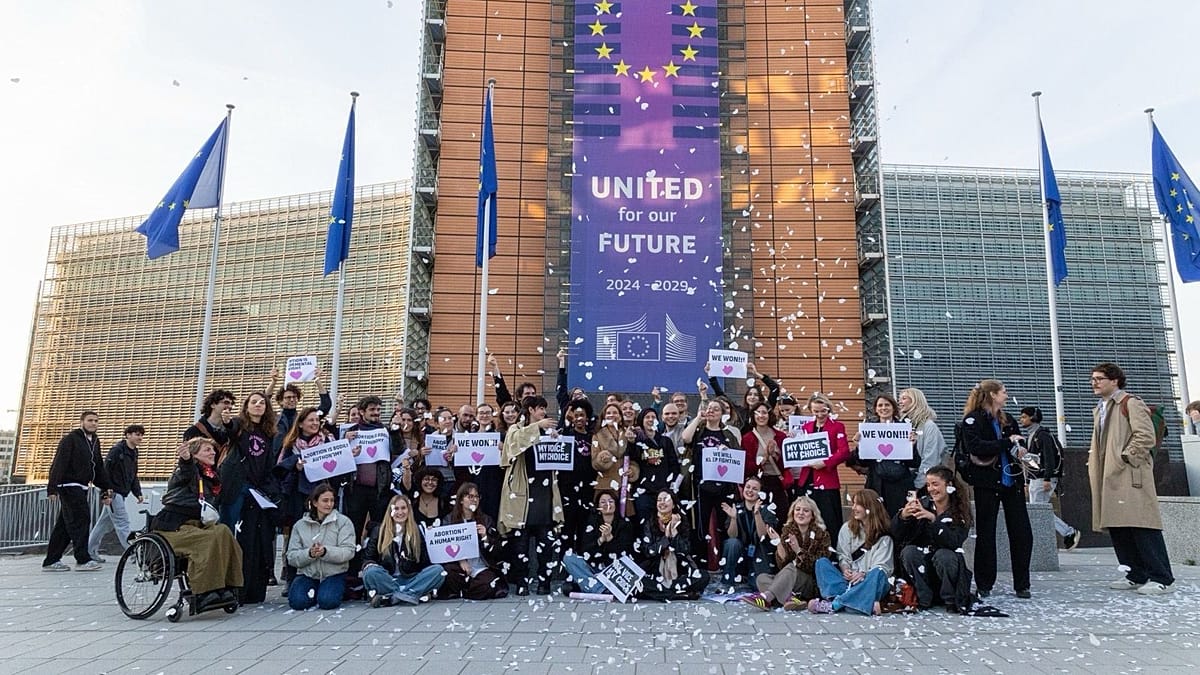
Women’s rights groups and activists hailed the European Commission’s decision on accessible abortion across Europe, calling it a “historic” move for women’s rights and European democracy.
ADVERTISEMENT

ADVERTISEMENT
The move marks an unusual step taken by the European Union, as healthcare policy is typically determined at a national level.
On Thursday, the European Commission confirmed member states can use an EU social fund to provide access to safe and legal abortion for women who are barred from doing so in their home country.
Member states can make use of the bloc’s existing European Social Fund Plus (ESF+), which contributes to social, education, employment and healthcare policies, voluntarily and in accordance with their domestic laws to provide such support.
“We were very aware of the competence that the European Union has in this area, which is restricted,” Europe’s Associate Director for the Center for Reproductive Rights Katrine Thomasen told Euronews, pointing to the fact that the bloc can support, coordinate or supplement the actions of members states, but cannot impede on national laws, such as healthcare policies.
The Commission stopped short of creating a new funding mechanism, which was requested by the European Parliament in a non-binding resolution adopted in December.
Critics argued that by declining to establish a dedicated fund and instead referring to an existing one, the EU was effectively failing to act and rejecting the proposal.
However, women’s rights organisations say the decision affirms that the EU has the competence to act on sexual and reproductive heath and creates a pathway towards accessible abortion.
“It was previously not clear that member states could use EU funding to provide abortion care to women facing barriers,” Thomasen said, “the Commission’s decision is really the first time that it is affirming and deciding that EU funds can be used in this way”.
Member states that wish to benefit from the ESF+ to offer accessible abortion services will now need to establish programmes and define how patients can benefit from it.
‘My Voice, My Choice’
The Commission’s decision came in response to a call made by the citizens’ initiative “My Voice, My Choice” for the creation of an EU solidarity mechanism to guarantee safe and affordable access to abortion for all women.
“My Voice, My Choice” is a European Citizens’ Initiative (ECI), a mechanism that allows citizens to call on the European Commission to propose new legislation.
If an initiative gets the support of at least one million people across at least seven EU countries, it must be discussed by the European Parliament, while the European Commission has a timeframe to either set out legislative measures or provide justification for not doing so.
“My Voice, My Choice” collected 1,124,513 signatures across all 27 countries.
“My Voice, My Choice started on the streets, it started with a group of women who had had enough that women are secondary citizens,” the initiative’s coordinator Nika Kovač told Euronews.
“We decided to take action and we brought something to the table. We brought our own chair to the places where we usually don’t have the chairs,” Kovač added.
The movement gained cross-border momentum, with women’s rights activists mobilising across Europe. With over one million followers on Instagram, “My Voice, My Choice” also built a strong online presence.
Dutch journalist Belle de Jong campaigned for the initiative in Malta, where abortion remains criminalised and heavily restricted. She described the challenges of organising on the ground, noting that many women were reluctant to take to the streets because of stigma and fear of legal consequences.
De Jong told Euronews that the campaign’s success in Malta was largely because it was online, “so people didn’t have to go out into the streets or show their face,” she said, adding that she collected 4,000 signatures for Malta, more than double she expected.
“Thanks to My Voice, My Choice, we no longer have an excuse to prosecute women for accessing healthcare, because we’re paying for them to go abroad with this EU mechanism. So it really begs the question: when are we going to decriminalise it? That will be our next fight in Malta,” she added.
The decision sparked a range of reactions from politicians
Several members of the European Parliament have expressed satisfaction after the Commission’s statements.
“For the first time the Commission has confirmed that countries can use EU funds to support access to abortion care. This is a victory for European women”, said Slovenian Socialist MEP Matjaž Nemec, who penned a letter to the Commission ahead of the decision.
Valérie Hayer, President of Renew Europe, said the decision “marked real progress for women’s rights,” underlining that the Commission had never before stated so clearly that EU funding can support access to safe abortion.
Other MEP’s, including Emma Fourreau from the Left group and French MEP Mélissa Camara from the Greens/EFA group considered the move a step forward, but would have liked to see a dedicated budget.
On the other side, far-right Spanish party Vox claimed that the Commission has rejected the “My Voice, My Choice” initiative, as there will be no specific fund to finance abortions abroad. “The Commission is just trying to politically save the initiative by pointing out existing instruments,” a press release from the party states.
The Italian anti-abortion association “Pro Vita & Famiglia” (Pro Life and Family) also considered that the initiative was rejected, while criticising its opening up to the use of ESF+ money to finance reproductive healthcare. “We ask the Italian government not to use this money to promote abortions”, said spokesperson Maria Rachele Ruiu.
Abortion policies across the European Union
Some EU countries have highly restrictive laws on abortion rights. A total ban is in force in Malta, where abortion is not allowed under any circumstances, while in Poland it is permitted only when conception follows sexual violence or when there is a risk to the woman’s health.
In January 2021, the Polish Constitutional Tribunal banned abortions in cases of fetal malformation, which until then had been the most frequent reason for terminating pregnancies in the country.
Several EU countries have taken steps to guarantee the right to safe abortions. France, for instance, made it a constitutional right, while Luxembourg and the Netherlands have removed mandatory waiting periods.
Sweden, France, and the Netherlands rank best in the European Union for abortion rights, according to the European Abortion Policies Atlas 2025. Malta and Poland remain at the bottom of the ranking, along with Andorra, Liechtenstein and Monaco.
Some countries have more relaxed laws, but they lack legal protections that fully decriminalise abortion, wide service availability, national health coverage, or government-led information on the matter.
Other member states have recorded new restrictions, increased harassment of abortion providers, and the spread of disinformation on the topic.


