
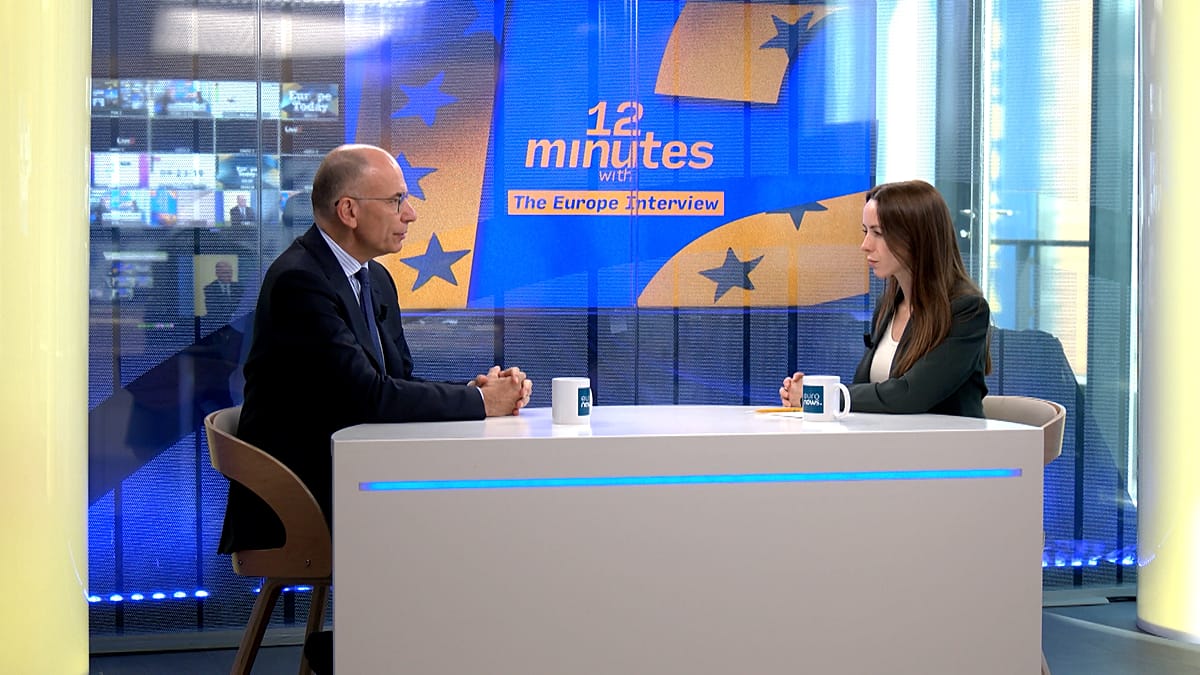
European Union member states must put the bloc’s sovereignty over national independence to be competitive in the face of the United States and China, Enrico Letta told Euronews, referring to the EU’s two rival economies as “giants”.
ADVERTISEMENT

ADVERTISEMENT
His comments come ahead of key elections in 2027, the outcome of which could have profound consequences for the political balance in the EU, particularly the presidential elections in France.
Last week’s decision by Marine Le Pen to run in the presidential race has left Brussels fearing a rupture in its ties with Paris. The National Rally figurehead campaigned to take France out of the Eurozone a decade ago.
She has since pivoted, vowing to reshape the European Union from within and advocating for a bloc of sovereign nations.
Letta told Euronews’ interview programme 12 Minutes With that the notion that national sovereignty can trump European sovereignty in the current complex economic climate is “false.”
“National sovereignty is like sending a gift to the Americans and the Chinese,” the former Italian prime minister, who is now Dean at the IE University (Universidad Instituto de Empresa) and President of the Jacques Delors Institute, said.
“We have to be very clear on that, because national sovereignty isn’t on the right scale. The correct scale to be competitive with the Americans and Chinese is the European one,” he explained, adding that this is why “the true battle is for European sovereignty.”
He went on to say this can be done while preserving national identities, pointing to the introduction of the euro and the replacement of legacy currencies, and the political pushback that came from this.
“I remember in my country, Italy, but also in France, or Germany, [people were] very sceptical, because they were afraid that they would lose their identity when losing the national currency,” Letta said.
“But today we have the euro, which is an enormous success and thanks to the euro, we are stronger in the world. And the most important point is, we didn’t lose our identities, we are still Italians, French, Spanish, German, with the euro.”
The former prime minister argued that, for this reason, the EU can do the same on energy, connectivity, and financial markets. “We can be more competitive without losing our identities.”
‘Greenland changed everything’
Integrating these key sectors — creating an energy union, integrating digital services and ending the fragmentation of capital markets — was a central theme in Letta’s 2024 report titled Much More Than a Market.
The report inspired the EU’s battle plan to make Europe more competitive, the One Europe, One Market roadmap, which was discussed by Letta and ministers at the General Affairs Council in Brussels on Tuesday.
The bloc has long been criticised, including by Letta, for its glacial response to global economic challenges.
However, he argued that he “sees an acceleration” since February’s European Council retreat in Belgium’s Alden Biesen castle, where EU leaders discussed boosting EU competitiveness and deepening the single market.
“But the political reason for the acceleration, for me, is linked to the Greenland crisis, which changed everything,” Letta added, referring to President Trump’s ambition to seize Greenland, the mineral-rich autonomous territory of the Kingdom of Denmark.
“This was a sort of big push for the European leaders to say, ‘Now we have to be serious in applying the two reports, in implementing the two reports, and in trying to strengthen the European single market’.”
‘Investing in EU gives citizens better return on savings’
One of the core demands of Letta’s 2024 report is for the European Union to further integrate its currently fragmented financial markets into a Savings and Investments Union (SIU), designed to mobilise private capital and bridge the gap between Europeans’ high rate of bank savings and businesses’ needs for funding.
“We are the continent of savings and savers. We are top in that, but we use our savings very badly,” Letta said.
According to Letta’s report, the EU is home to €33 trillion in private savings, but around €300 billion of European household savings are diverted from EU markets abroad, primarily to the American economy.
“Putting savings in the Savings and Investments accounts, a European label of savings, will give them a better return than what they have today,” Letta explained.
He also said that a bridge must be built between savings and investment in “the real economy”, arguing that this is why the US is, for example, leading in the AI race.
“This is not through public money, but through private money and investments, possible thanks to [the nature] of their financial market,” Letta said.
“In the 90s, we used to sell our mobile phones to American consumers. “We have to return to this period of Europeans being good at innovation and tech, and for this, we need these private investments.”