


Published on
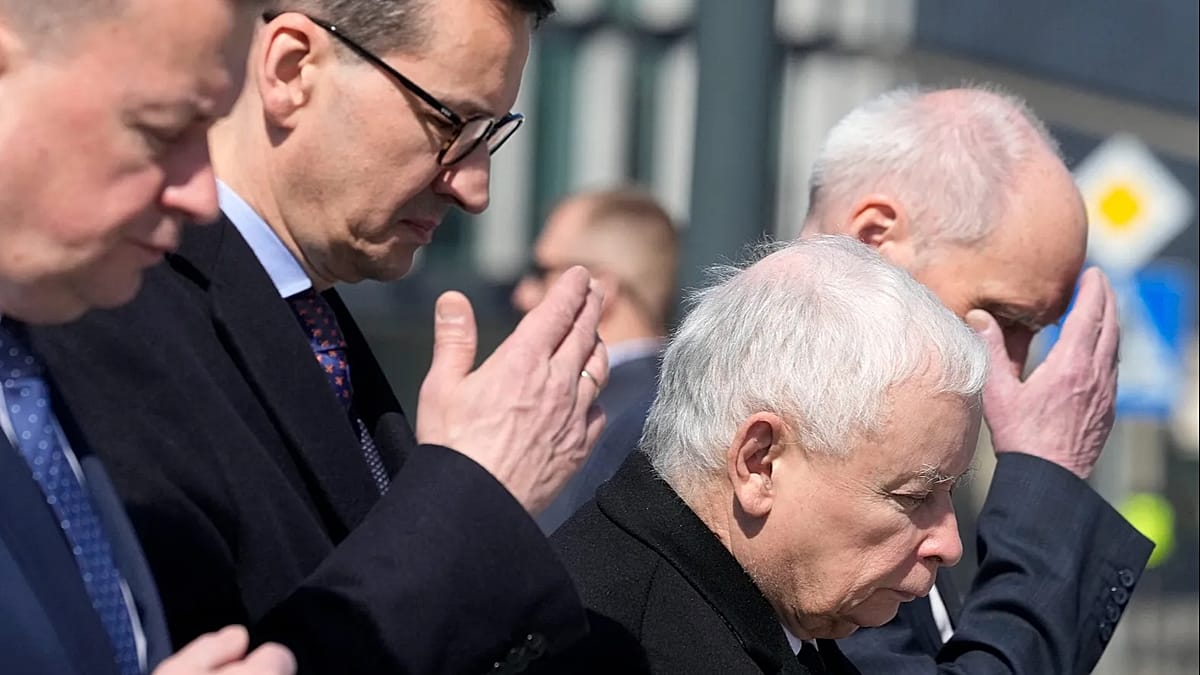
The leader of Poland’s right-wing opposition party Law and Justice (PiS), Jarosław Kaczyński, announced on Friday that more than 30 MPs have left the party following a bitter power struggle between him and former Prime Minister Mateusz Morawiecki.
ADVERTISEMENT

ADVERTISEMENT
The split is the biggest in Poland’s main opposition party in more than two decades, and follows weeks of tensions over the future direction of PiS ahead of the 2027 parliamentary elections.
Kaczyński had demanded the dissolution Rozwój Plus, an association founded by Morawiecki and his allies, whom he ordered to sign a declaration pledging not to belong to internal political factions.
Morawiecki refused to sign what he described as a “loyalty declaration”, arguing that it carried negative historical connotations. Instead, he proposed a compromise, including stepping down as one of the party’s vice-president while remaining an ordinary PiS member.
But talks between the two camps ultimately failed to produce an agreement.
Morawiecki: ‘It’s all over’
Speaking on Friday, Kaczyński confirmed that the final number of resignations among the party’s MPs was still being determined. He declined to confirm whether Morawiecki himself was among those leaving, saying only that “it’s all over.”
The dispute reflects a broader battle over the party’s strategy after its 2023 election defeat. Kaczyński has steered PiS towards a more conservative course, while Morawiecki and his allies have argued the party should appeal to a broader centre-right electorate to improve its chances of returning to power.
The split could have major implications for Poland’s next parliamentary election in 2027. Prime Minister Donald Tusk’s governing coalition will hope that the breakup of its main political rival could weaken the opposition, dividing conservative voters and shifting attention away from criticism of the government’s record.
At the same time, analysts say a separate political force led by Morawiecki could emerge as a powerful new player on the right, appealing to moderate conservatives and business-oriented voters. Rather than eliminating competition for the governing coalition, the argument goes, the split could reshape Poland’s political landscape into a three-way contest for power.
Whatever the precise implications, the departures mark the most serious internal rupture in PiS since the party was founded in 2001, raising fresh questions about the future of Poland’s largest opposition force and the balance of power ahead of the 2027 vote.
Recent opinion polls suggest that PiS remains one of the country’s largest parties, though support varies widely across surveys, from about 19 percent to just under 30 percent. None of the latest polls gives the party enough support to govern alone, so it would likely need coalition partners to return to power.
A step to Polexit?
At the same time, Poland’s right has adopted an increasingly confrontational stance towards the European Union. PiS rejects suggestions that it wants Poland to leave the bloc, but it nonetheless opposes several flagship EU policies, particularly the European Green Deal.
Przemysław Czarnek, who has emerged as a leading candidate to become prime minister if the conservatives return to power, has argued that Poland should withdraw from the EU’s Emissions Trading System, saying the carbon market undermines the country’s economic competitiveness.
Among those opposed to the ETS is President Karol Nawrocki, who is backed by PiS, has renewed his call for a referendum on EU climate policy.
The presidential office says the initiative is intended to give voters a direct say on EU climate measures, while politicians from Tusk’s governing coalition argue it risks fuelling anti-EU sentiment and laying the political groundwork for a future debate over Poland’s membership of the bloc.