
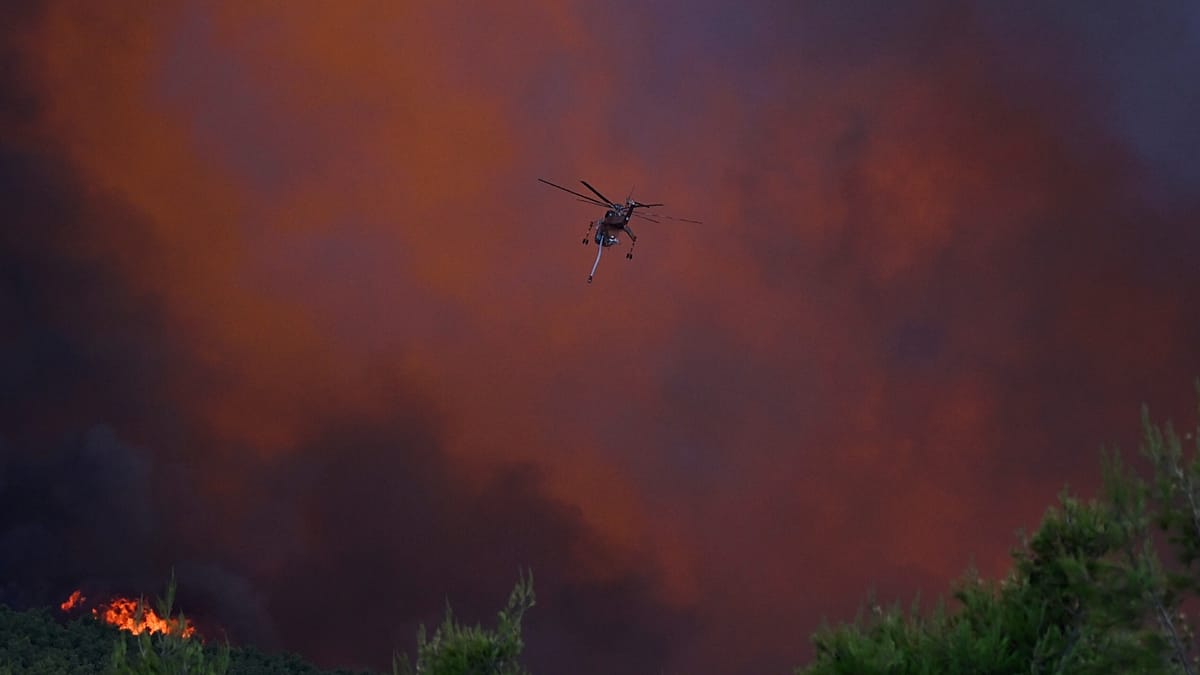
More than 434,976 hectares have burned across the EU so far, according to the July 30th data from the European Forest Fires Information System (EFFIS). In 2025, more than one million hectares burned, making it the worst wildfire season since records began.
ADVERTISEMENT

ADVERTISEMENT
This is why Brussels decided to rewrite the rulebook on how Europe deals with fire. For decades, EU wildfire policy meant buying more planes, trucks, and firefighters. Now, the emphasis is shifting toward something more consequential: stopping fires from becoming catastrophic in the first place.
Why response alone was never going to work
The logic is simple, says Alexander Held, a forester at the European Forest Institute and the Pan-European Forest Risk Facility, who has spent 25 years working on fire policy across the continent. Once a fire starts under hot, dry, windy conditions, no number of aircraft or crews can guarantee control. “If you look at what’s happening right now from Portugal to Spain to France to Greece to Turkey to Germany, we have simultaneous large fires,” he says. These conditions overwhelm even the most experienced fire services.
Held’s frustration is with where the money has historically gone. Despite two decades of EU declarations about resilience and prevention, funding has stayed skewed toward suppression, “because it is easier to invest in the response side,” he says. “It’s not as easy as buying a fire truck or a helicopter.” He points to Portugal as the exception that proves the rule: it shifted roughly half its wildfire budget into land management and prevention rather than firefighting alone. His wish is a simple 50-50 rule, every euro spent on suppression matched by one spent on reducing risk before ignition.
The European Commission has adopted that logic as policy. “We cannot focus only on literally putting out fires,” says Anna-Kaisa Itkonen, the Commission’s spokesperson for energy, climate, environment and transport. “Preparedness for us is really, really important.”
The policy shift, and when it happened
The break came in March 2026 when the Commission launched its Integrated Wildfire Risk Management strategy, a formal move away from a response-led model toward one built on four pillars: prevention, preparedness, response, and recovery, with prevention first. The reasoning is threefold. Europe just lived through its worst fire season on record.
Climate change is making fires hotter, longer, and harder to control. An estimated 96 percent of ignitions are linked to negligence or arson, meaning prevention must address human behaviour as much as vegetation.
Fires spreading beyond the Mediterranean into Germany, Czechia, and Sweden, and even as far as Iceland and the Arctic Rim, added urgency. A strategy built only around Southern European response capacity no longer matched where the risk was.
What prevention looks like in practice
The strategy translates into concrete funding and tools already being rolled out. Wildfire prevention money now flows through several EU instruments at once: the Common Agricultural Policy’s rural development plans, cohesion policy funds, the Recovery and Resilience Facility, and LIFE and Horizon Europe research calls. In practice, that pays for fuel reduction, firebreaks, targeted grazing, forest thinning, and restoring fire-prone landscapes. These projects are already running in Spain, Portugal, Italy and Sicily.
About 35 percent of the EU’s next long-term budget is earmarked for climate and environment, including close to €19 billion in cohesion funds for climate adaptation, with a promised fast-track for the regions hit hardest.
The Commission is also reinforcing the European Forest Fire Information System, its satellite-based early warning and risk-forecasting tool, and plans to propose a council recommendation on integrated wildfire risk management, alongside a dedicated EU portal by 2027 to share funding routes and lessons learned with member states newly facing fire risk.
Response capacity hasn’t disappeared. rescEU is adding twelve firefighting planes and five helicopters, but Itkonen is explicit about the order of priorities: “The goal is not to fight more fires. The goal is to have good prevention policies.”
Turning strategy into practice
The harder problem is implementation. The European Court of Auditors has warned that wildfire governance remains fragmented across civil protection, forestry, agriculture, and climate departments, with no single overview of how much is spent on prevention. Tools like prescribed burning and targeted grazing often stall on permitting bottlenecks and liability rules. Prevention projects need sustained, recurring funding for maintenance, which EU instruments built for one-off investment aren’t always designed to provide.
For Held, efforts should go beyond simply providing financial support by establishing independent and non-bureaucratic centres of excellence which are as flexible as fire itself. Drawing in foresters, farmers and land planners rather than sending all matters through the civil protection agencies.
His example of what prevention is worth: Germany spends around €30 million a year fighting recurring fires on contaminated land. Halving just one of those fires would free up €15 million, enough to fund real prevention work. “It’s difficult to argue,” he admits, “because the one is disaster response money, and it’s difficult to bridge that into prevention.”