


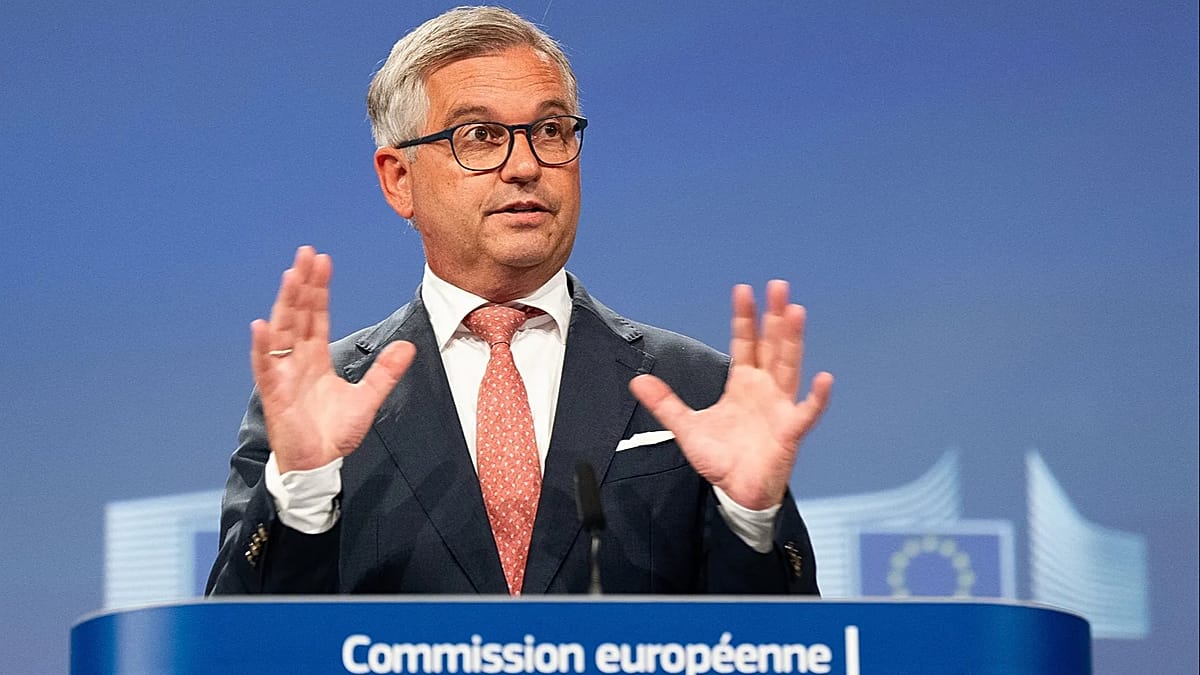
EU migration chief Magnus Brunner has called on MEPs to adopt a stalled EU law on fighting people smuggling, saying it could help prevent migration crises like the one in the Spanish territory of Ceuta last week.
ADVERTISEMENT

ADVERTISEMENT
Speaking on Thursday, Brunner said the events in Ceuta “showed that there are actors who have no regard for the safety or even the lives, of innocent people,” but that nonetheless, “we cannot accept such a breach of integrity of our external borders and violation also of the security of of the Union – and in that regard, the impact of criminal smuggling networks, both on people’s lives and also on our security, of course.”
“That is simply unacceptable,” Brunner said. “I call [on] the Parliament to adopt its position [on] the anti-smuggling directive proposed by the European Commission almost three years ago.”
Brunner addressed his remarks to an extraordinary parliamentary committee meeting in Brussels on Thursday aimed at examining the situation in Ceuta after more than 70,000 non-EU nationals entered the Spanish enclave in less than 24 hours last week. The meeting also featured Juan Jesús Vivas Lara, Mayor-President of Ceuta.
Investigations into the causes of the event are ongoing, but Spanish Prime Minister Pedro Sánchez has accused people smugglers of causing the massive crossing.
Smugglers “deceive so many young people and ultimately lead many of them to their deaths,” Sánchez said last Friday.
Who are the smugglers and traffickers?
Migrant smuggling is the illegal facilitation of border crossings for profit. It often occurs when people cannot access regular migration routes, creating opportunities for individuals and criminal groups to make money.
While smuggling involves crossing international borders, some smuggled migrants may become victims of human trafficking within a given country if they are exploited through deception, coercion, or forced labour.
Smuggling networks range from loose, informal groups to more organised, hierarchical structures, particularly in regions such as North Africa. The crime remains highly profitable, not least because smugglers often face a low risk of detection and prosecution – especially organisers who avoid direct involvement, and who are often located in different countries from the irregular route they organise.
For example, the Italian government has focused on prosecuting the people who pilot boats arriving in Italy, arguing that they are part of wider smuggling networks. However, civil society organisations have frequently pointed out that the boats’ crews are usually migrants forced to take the helm by other smugglers who will not risk the journey themselves.
Migrant smuggling operations are often enabled by corruption, including bribery of border and customs officials.
In France, human smugglers can be prosecuted and sentenced to 5 years in prison and face fines up to €30,000. Punishment can be harsher if other serious crimes are involved, such as being part of an organised crime network or violence and exploitation.
According to Eurostat, 2,599 smugglers were convicted across Europe in 2024, but many others were likely not intercepted or charged.
What is the stalled law about?
In November 2023, the European Commission proposed updating the EU’s rules on the facilitation of irregular migration. It is part of a broad anti-smuggling package that aims to reinforce the role of EU agencies, such as Europol, in police operations.
The aim is to prosecute criminal networks responsible for migrant smuggling, harmonise penalties, expand jurisdictional reach, and improve data collection and reporting. Current anti-smuggling rules are largely set at the national level, and because smugglers operate across borders, including in non-EU countries, the prosecution of networks and cases is often inefficient.
Member states have proposed a maximum prison sentence of three years for the primary offences, rising to 10 years in cases where people are seriously endangered or die.
Particularly in non-EU countries, people smugglers and traffickers – who also exploit migrants through forced and degrading work – are often part of the ranks of government authorities themselves, as has been documented in North African countries such as Libya.
Some migrants in Ceuta interviewed by the New York Times said that Moroccan authorities had encouraged them to cross the border into the enclave. Investigations into these allegations are still ongoing.
Why is it stalled?
Member states have already adopted their position on the so-called Facilitation Directive, leaving the European Parliament as the last institution to move the negotiations forward.
In their position adopted in December 2024, member states set out a definition of smuggling that is generic enough to include humanitarian aid. In particular, the member states have insisted on criminalising the act of intentionally assisting third-country nationals in entering, transiting, or residing in the EU for financial or material gain.
That language has been sharply criticised by NGOs, which accused the bloc of criminalising assistance to migrants.
“Smuggling networks thrive where people have no safe or realistic way to seek protection or rebuild their lives in Europe. The harder it is for people to migrate safely and regularly, the more space smuggling networks have to exploit their vulnerability,” Chiara Catelli, advocacy officer at the Platform for International Cooperation on Undocumented Migrants, said in a statement.
“The proposed Facilitation Directive does nothing to address these root causes. Instead, it risks criminalising people and organisations providing humanitarian assistance, exposing them to prosecution, fines and imprisonment.”
The European Parliament’s rapporteur on the file, German Socialist Birgit Sippel, is also advocating for a clear exemption for humanitarian assistance to ensure that it is not included within the definition of migrant smuggling.