

By Franziska Müller
Published on •Updated
The unusually low water level of the Danube in Budapest has revealed relics that had remained hidden on the riverbed for more than 80 years. Among the discoveries are the remains of two German soldiers from the Second World War, their military identity tags and a DKW military motorcycle buried in the mud.
ADVERTISEMENT

ADVERTISEMENT
For decades, the fate of the two soldiers was unknown. They were listed as missing, with no confirmation of where or how they had died. Now, the discovery of their remains and identity tags could finally help establish who they were.
Military identity tags were designed to identify fallen soldiers. Each carried a unique number and could be broken into two parts after a soldier’s death. One half remained with the body, while the other was sent to the relevant authorities so that the death could be recorded and relatives informed.
“If he had been killed, his comrades would have broken the identity tag,” explains Norbert Hambuch, cemetery manager at the Budaörs German war cemetery. “The upper part with the two holes stays with the soldier, and his comrades take the lower part and send it to the central office.”
Hambuch was translating for Euronews his colleague Gabor Kohlrusz, who works as a reburial specialist for the German War Graves Commission, the Volksbund Deutsche Kriegsgräberfürsorge.
But finding an identity tag alongside human remains does not automatically establish the person’s identity. Where exactly the tag is discovered can provide an important clue.
“If an identity tag is discovered at chest level, it probably belongs to the dead soldier because he would have worn it around his neck,” Diane Tempel-Bornett of the Volksbund told Euronews. “At hip level, an identity tag is more likely to indicate that it was in a trouser pocket and that the dead soldier had taken it from another dead comrade in order to return it to their unit.”
After the Second World War, large numbers of soldiers were listed as missing, leaving their families uncertain about whether they had been killed or survived. The two men whose remains lay undiscovered in the Danube were among them.
The Volksbund is now working with its Hungarian partner to establish their identities. The remains are expected to be buried at the Budaörs war cemetery outside Budapest later this year.
One of the identity tags recovered from the Danube belonged to a Wehrmacht soldier, while the other was issued to a member of the Waffen-SS. Investigators must still establish whether the tags actually belonged to the two men whose remains were recovered. Any preliminary identification by the Volksbund must then be officially confirmed by Germany’s Federal Archives.
Second World War wreckage emerges from the Danube
The discovery comes as other remnants of the Second World War have emerged from the unusually low waters of the Danube.
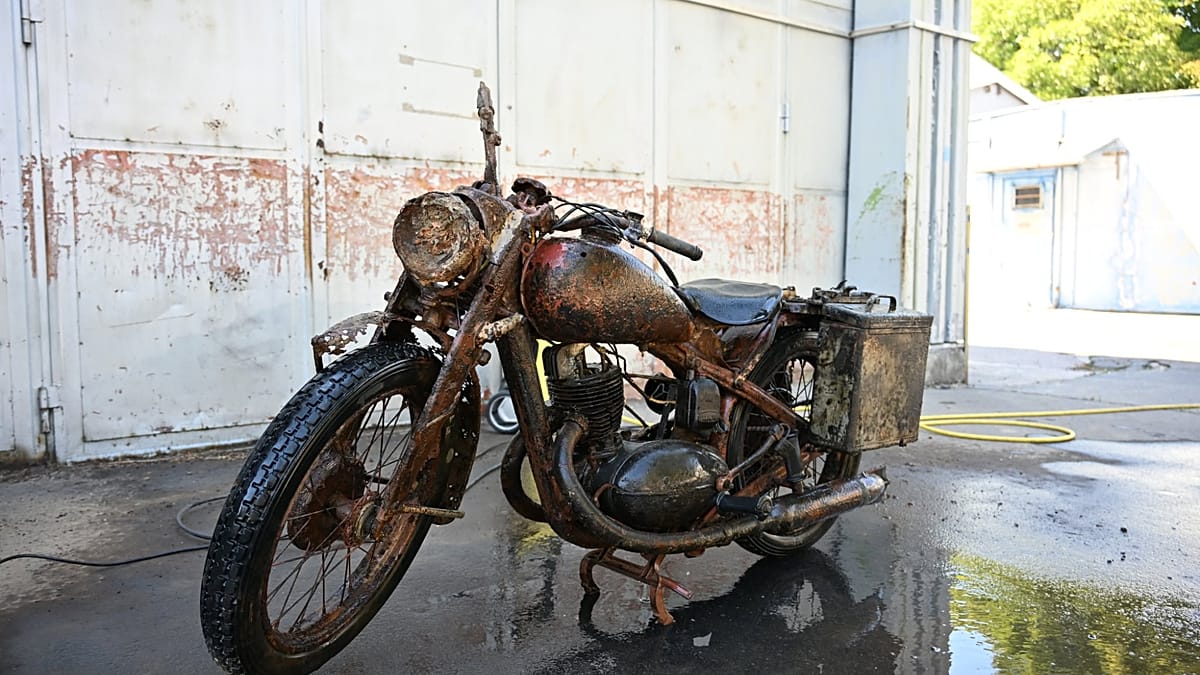
One find in particular has attracted attention: a DKW military motorcycle that had been buried in the mud for more than 80 years. Together with Gabor Kohlrusz and Norbert Hambuch, Euronews returned to the site where it was recovered.
“There were a great many wrecks here, vehicles from the final phase of the war in Budapest. All this debris was pushed down here directly after the war, and only later were these rocks piled on top,” Hambuch explains.
The Battle of Budapest lasted 102 days in 1944 and 1945, with tens of thousands of soldiers and civilians killed. The motorcycle recovered from the river is eventually expected to form part of an exhibition commemorating the fighting.
“We have an extensive collection of equipment from the Second World War,” says Imre Kovacs, the Volksbund’s representative in Hungary.
He describes the recovered DKW motorcycle as a “showpiece” for an exhibition at the Institute and Museum of Military History, the Volksbund’s Hungarian partner. The motorcycle has since been cleaned and is expected to go on display there.
The soldiers’ remains have meanwhile been taken to the Volksbund’s facilities at Budaörs.
“The bones have been collected and taken to the depot, that is, to the Volksbund’s largest military cemetery in Hungary, Budaörs,” Hambuch says. “There they are cleaned, recorded anthropologically, documented and, in the autumn, in October, they will be buried together with the other soldiers found this year.”
But the work of locating and identifying those missing from the Second World War is far from over.
“On the territory of the former USSR alone, around two million soldiers from the Second World War are still missing,” Tempel-Bornett says. “For Hungary, losses are put at around 54,000. Since 1992 we have exhumed and reburied 29,956 dead in Hungary.”
More than eight decades after their deaths, the two men recovered from the Danube may now finally receive a grave, potentially bearing their names.
For the Volksbund and Hungary’s Institute and Museum of Military History, identifying and reburying the dead is also part of their wider work of remembrance and reconciliation.