
On Sunday, Berliners will vote to elect a new state parliament, the Abgeordnetenhaus, alongside the regional vote in Mecklenburg-Western Pomerania. The race is wide open: the Left party and the CDU are neck and neck in the latest polls, both at around 20-23%, with the AfD at 18% and the Greens at 16% close behind. The SPD, with 10-12%, is now clearly below its 2023 result.
ADVERTISEMENT

ADVERTISEMENT
That means it is also unclear what the political landscape will look like after the vote.
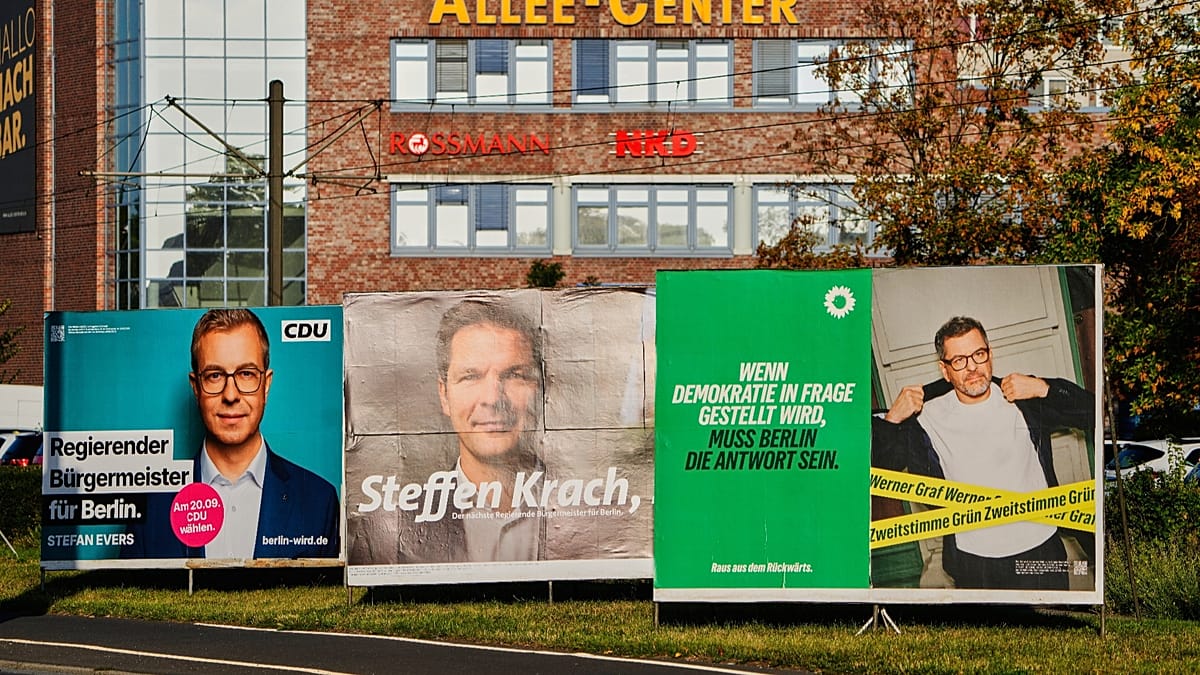
According to recent surveys, the current black-red coalition of the CDU and SPD would no longer have a majority. The CDU’s campaign has also shifted: instead of incumbent Governing Mayor Kai Wegner, finance and culture senator Stefan Evers is running as lead candidate. Wegner announced in the summer, after months of criticism of his handling of the January power outage, that he would not run again as the party’s frontrunner.
On policy, the CDU is focusing on law and order, a more capable state and economic growth. To that end, both the police and the judiciary are to be strengthened, approval procedures accelerated, and public administration digitised.
Based on current polls, several coalition options are on the table, including a government of the Left, Greens, and SPD, or a CDU-Green-SPD alliance. Whether such constellations materialise will also depend on which parties ultimately make it into the Abgeordnetenhaus.
In the latest ZDF projection (source in German) published on 11 September, the Left stands at 23%, the CDU at 21%, the AfD at 17%, the Greens at 16%, and the SPD at 10%. On that basis, both a Left-Green-SPD alliance and a CDU-Green-SPD coalition would have a numerical majority. The current BerlinTREND (source in German) survey by Infratest dimap paints a similar picture: the Left at 21%, CDU at 20%, AfD at 18%, Greens at 16%, and SPD at 12%.
SPD fighting to stay in government
The Social Democrats have now slipped to between 10 and 12% in the polls. In 2023, they were still at 18.4%. Their lead candidate is Berlin SPD co-chair Steffen Krach from Lower Saxony, who is under investigation by the Hanover public prosecutor over allegations linked to a donation of 9,900 euros to the Berlin SPD. Krach rejects the accusations and is continuing his campaign under the slogan “Wieder Berlin” – “Berlin again” – despite them.
Substantively, the SPD, like most other parties, is focusing on affordable housing, investment and a functioning infrastructure. In its manifesto, it promises 100,000 new homes over the next legislative period and aims to increase the share of social housing in new-build projects from 30% to 50%. It also plans to invest in roads and bridges, schools, hospitals, and public transport.
Affordable housing is also a central campaign issue for the other parties. According to Berlin’s Senate Department for Urban Development, Building and Housing, more than 100,000 new homes are missing in the capital. On top of that comes demand for additional housing for the roughly 200,000 people expected to move to Berlin by 2040. This translates into an average need for around 20,000 new homes per year in the coming years.
The CDU is relying above all on faster construction and more homeownership. The Greens place greater emphasis on housing oriented towards the common good. The Left, by contrast, is calling for large housing portfolios to be brought into public ownership. The AfD and FDP reject this approach and likewise want to prioritise private construction and less regulation.
The Left eyes the Red Town Hall
The Left has gained significant support since the 2023 election. At the time, it stood at 12.2%; in current polls, it is around 21-23% and is now one of the two strongest parties in the race.
Lead candidate Elif Eralp is campaigning primarily on rents and social policy. The Left is calling, among other things, for the socialisation of large housing stocks and stronger tenant protections. In public transport, social benefits and climate policy, the party also wants the state to play a bigger role.
The Berlin Left’s campaign is, however, overshadowed by a debate over how the party deals with antisemitism and the Middle East conflict. One trigger was a performance by rapper Dahabflex at a campaign event organised by the Neukölln district branch of the Left at the end of August, where he chanted “Yalla Yalla Intifada, Westbank, Palestine, Gaza” and “Death to the IDF” (death to the Israeli armed forces).
CDU lead candidate Evers accused Eralp of not acting decisively enough against antisemitic tendencies in her party. Eralp rejects that and stresses her commitment to combating antisemitism and protecting Jewish life. The Berlin Left has also adopted its own guidelines on dealing with antisemitism and says it wants to protect Jewish life in the city. As T-Online reports, the party’s Berlin executive invited the Neukölln district spokespeople to an extraordinary meeting at which “a unanimous decision was taken that Dahabflex’s performance was a mistake and that we reject all forms of violence”, according to Eralp.
AfD also on course to double its vote in Berlin?
The AfD has also made strong gains in Berlin. In the 2023 repeat election, it took 9.1%; it now stands at 17-18% in most polls. In the latest BerlinTREND survey by Infratest dimap, it reached 18%, making it the third-strongest force behind the Left and the CDU. Compared with 2023, it has almost doubled its share of the vote.
The party is once again led by Kristin Brinker, who is running as the AfD’s top candidate for the third time. As with the Greens, however, Brinker is not widely known. In the current Infratest dimap poll (source in German), around two-thirds of respondents say they do not know Brinker, or do not know her well enough to judge her. The picture is similar to the Greens’ Werner Graf.
In the campaign, the AfD is focusing above all on migration and internal security. The party wants a halt to the admission of asylum seekers in Berlin and the “immediate deportation of all of the up to 20,000 people in Berlin who are required to leave the country”.
For subsidised and state-owned housing, the AfD wants to allocate it using a points system so that it primarily benefits Berliners who have lived in the city for a long time and work in “system-relevant professions” such as the police, fire service, health care, or refuse collection. Otherwise, building should be encouraged by scrapping the property transfer tax or speeding up planning approvals.
Despite its high poll ratings, the party remains excluded from any role in government: CDU, SPD, Greens and Left all rule out forming a coalition with the AfD.
Will the Greens be the kingmakers?
The Greens are currently polling at around 16
5, clearly below their 2023 result of 18.4%. Nevertheless, they could play a crucial role in forming a government: both a Left-Green-SPD alliance and a CDU-Green-SPD coalition would have a mathematical majority in current projections.
Lead candidate Werner Graf is trying to present the Greens in a less confrontational way during the campaign. He wants to avoid the major rows of recent years, such as the dispute over Friedrichstrasse. Graf himself told rbb that the Greens “have learned from that”. Instead of sharply polarising demands, he is adopting a more pragmatic tone and presenting himself as someone who can bring different parties together.
In the election arena, shortly before polling day, both the Left’s lead candidate, Eralp, and the SPD frontrunner, Krach, explicitly courted cooperation with the Greens. Graf signalled openness to an alliance and called for a “progressive government”. He rules out any cooperation with the AfD.
Volt, FDP and BSW battling to enter parliament
Alongside the larger parties, Volt, the FDP and the BSW are also competing to enter the Abgeordnetenhaus. For all three, the five% threshold is the decisive hurdle. Volt is standing in a Berlin Abgeordnetenhaus election for the first time and is focusing above all on digitalisation, administrative reform and faster housing construction.
The FDP wants to return to the state parliament with its lead candidate, Christoph Meyer, and is campaigning for less regulation, more private investment, and homeownership. In the final stretch, Meyer is also backed by party chairman Wolfgang Kubicki, who has appeared with him in Berlin on several occasions.
The Sahra Wagenknecht Alliance (BSW) is polling at 3-4% and therefore has to fight to clear the threshold for the Abgeordnetenhaus. The party is running in a Berlin Abgeordnetenhaus election for the first time and is led by Alexander King and Michael Lüders.
In this campaign, foreign and peace policies are playing an unusually prominent role for a state election. King is calling for an end to sanctions against Russia and for negotiations with Moscow. BSW also wants to improve relations with Russia and is targeting Russian-speaking Berliners. The party, moreover, wants to prevent the Russian House on Friedrichstrasse, operated by Russia, from being closed.
Vandalism: campaign posters damaged
During the current election campaign in Berlin, the police have recorded more than 1,300 incidents of damaged campaign posters between 2 August and 16 September.
Posters belonging to the AfD are particularly frequently affected, according to Bild, which asked the Berlin police for figures: across the city, 801 cases of criminal damage to AfD posters have been recorded so far. Next come the CDU with 148 cases, independent candidates or lists with 102, the Left with 95, the SPD with 88, Alliance 90/The Greens with 37, the FDP with 30, BSW with 16, Volt with 13 and the ÖDP with two cases.