

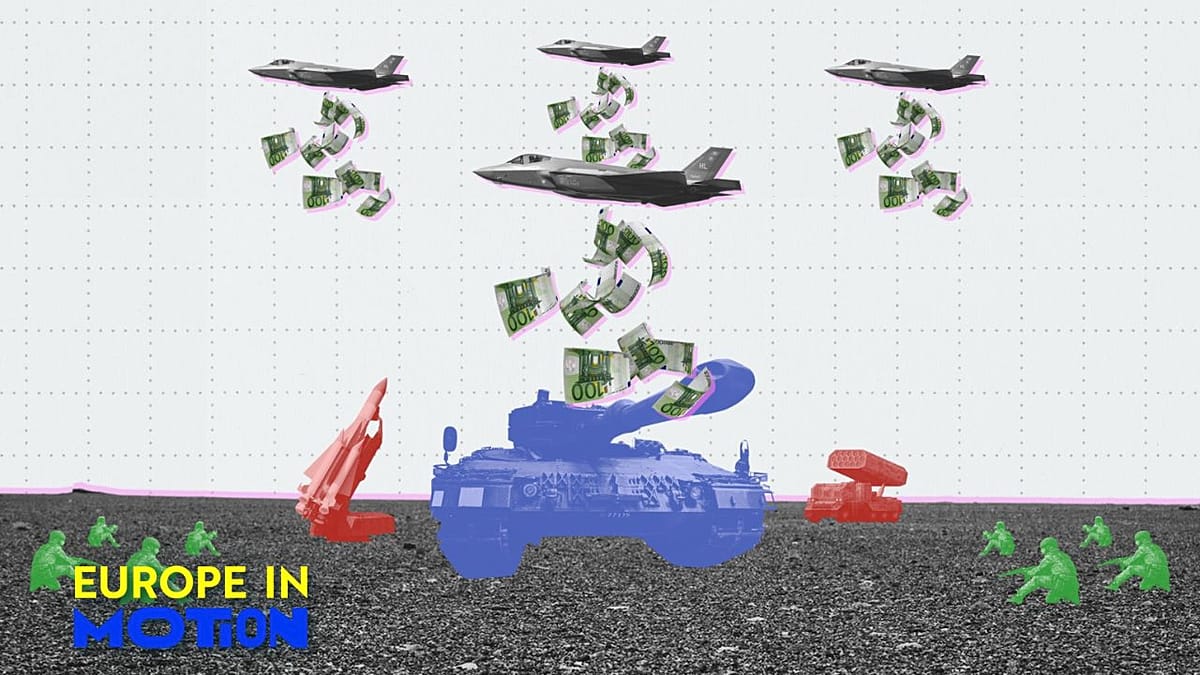
Revenues from the sale of weapons and military services by the world’s biggest arms companies have reached a record high due to rising geopolitical tensions.
They increased by 5.9% to $679 billion (€583 billion) in 2024 — the highest figure ever recorded, according to the Stockholm International Peace Research Institute (SIPRI).
The rise in the total arms revenues was mostly due to overall increases in the arms revenues of companies based in Europe and the United States.
At least 65% of European arms companies in the top 100 were expanding production capacity in some form in 2024.
Excluding Russia, the 26 companies based in Europe and among the top 100 arms makers saw aggregate revenues grow by 13.4% to $151 billion.
The sharpest percentage increase in weapons revenues of any top 100 company in 2024 was recorded by the Czech company Czechoslovak Group, which rose by 193% to $3.6 billion.
This growth was due to the start of the Czech Ammunition Initiative, a government-led project that sourced artillery shells for Ukraine.
Last year, just over half of the company’s arms revenues were linked in some way to Ukraine.
In 2024, the arms revenues of the four French companies in the top 100 reached $26.1 billion, representing a 12% increase compared to 2023.
Thales, Safran, and Dassault are the three companies recording double-digit percentage growth in arms revenues between 2023 and 2024.
In the first quarter of 2025, Thales also reported a €5 billion growth in its total sales. This represents an increase of 9.9% from the corresponding period in 2024.
Meanwhile, the arms revenues of the two Italian companies in the top 100 saw a rise of 9.1% to $16.8 billion in 2024.
Aerospace company Leonardo, which is second second-largest European arms company in the top 100, increased its arms revenues by 10% to $13.8 billion.
In 2024, Leonardo established a joint venture with the German company Rheinmetall to develop a main battle tank and a new infantry fighting vehicle for the Italian armed forces.
Four companies based in Germany were also in the top 100. Taken together, their arms revenues increased by 36% to $14.9 billion.
The German company Diehl recorded the largest year-on-year percentage increase in arms revenues: up by 53% to $2.1 billion.
In 2024, as part of Germany’s efforts to support Ukraine, Diehl delivered materiel that included ground-based air defence systems.
Demand reveals fragilities
Despite the increase in Europe’s armament revenue, the continent relies heavily on critical raw materials, such as cobalt and lithium.
This makes the European defence industry prone to geopolitical and price volatility, as well as possible shortages.
For instance, the trans-European company Airbus and France’s Safran met half of their pre-2022 titanium needs with Russian imports and have had to find new suppliers, according to the SIPRI report.
“European arms companies are investing in new production capacity to meet the rising demand,” said Jade Guiberteau Ricard, a SIPRI researcher. “But sourcing materials could pose a growing challenge. In particular, dependence on critical minerals is likely to complicate European rearmament plans.”
At the beginning of this month, the EU presented a new action plan to reduce dependencies by up to 50% by 2029.
The EU is investing in domestic extraction, such as Vulcan’s lithium extraction project in Germany, as well as Greenland Resources’ Malmbjerg molybdenum project.
In addition, the bloc is also creating special investment plans with Ukraine, the Western Balkans, and countries in Eastern and Southern Mediterranean shores to help build complete supply chains for critical raw materials.