




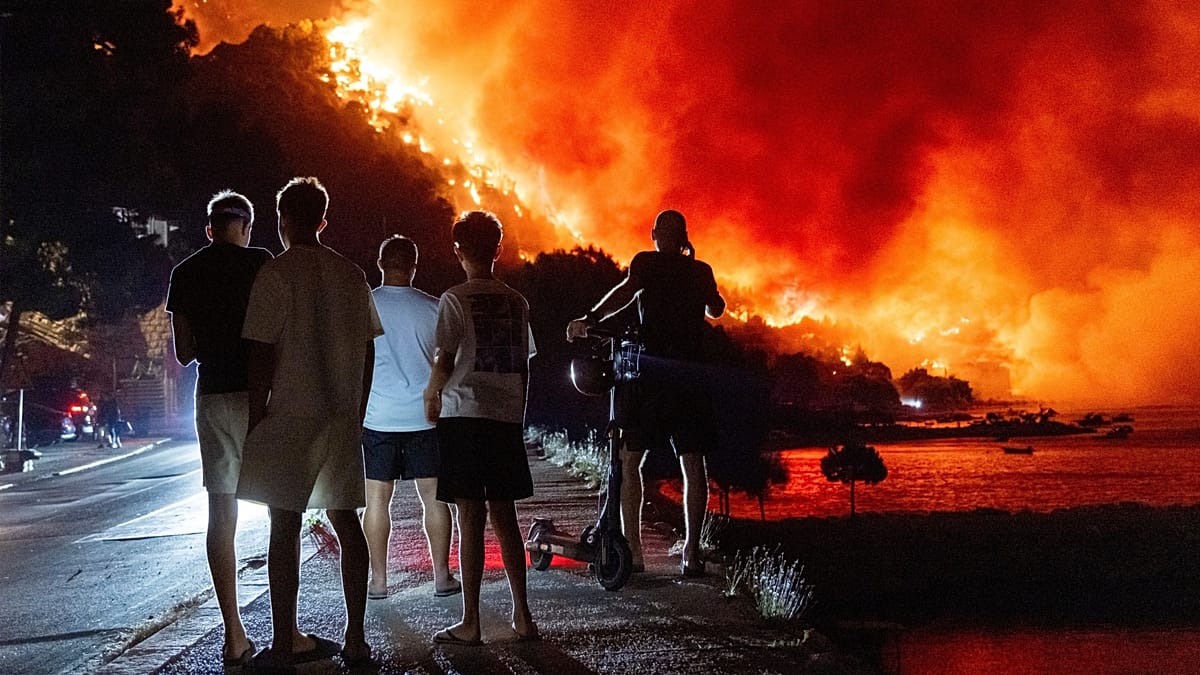
A wildfire on Croatia’s coast has left at least 10 people in intensive care and dozens more injured after fire crews battled overnight with “one of the worst” blazes in the country’s history, according to officials.
ADVERTISEMENT

ADVERTISEMENT
Around 2,000 had been evacuated from nearby villages as the fire ripped through the surrounding hills, damaging homes and destroying cars in the early hours of Friday.
As access reopened mid-morning, the AFP news agency saw the blackened remains of several burnt out cars along roads near Omiš, some ringed by silver puddles of metal that had melted under the intense heat of the fires.
Several buildings in the area had also been damaged by the blaze, with some structures nearby completely destroyed.
During a visit to the area Prime Minister Andrej Plenković stressed the dangers of the fire and praised the efforts of the firefighters.
“This fire spread at lightning speed,” he told reporters. “What the firefighters managed to save is truly a miracle.”
Plenković pointed out that this was a “very densely populated” region, with a township of 15,000, currently bolstered by 12,000 tourists.
Hospital officials said 40 people had been admitted to Split hospital so far, including a German and Polish tourist.
Nearly 300 firefighters were deployed overnight but were often outpaced by the blaze, according to the country’s fire chief Slavko Tucaković, who described it as “one of the worst in Croatia’s history.”
“It was frightening even to watch. Many houses, cafes, restaurants, cars, and boats that were on dry land were damaged,” he told national radio.
Tourists flee
Firefighters battled through the night, with local media broadcasting images of crews facing walls of flames.
Hundreds of tourists were among those evacuated to a shelter set up by the Red Cross, Ana Stejskal, the organisation’s director in the town of Omiš, told national broadcaster HRT.
Several other shelters have been opened in nearby coastal towns of Split and Makarska, the Croatian Fire and Rescue Service said in a statement.
“People have a bed, a shower, a toilet and food, but it’s difficult to predict how long this situation will last,” said TOmišlav Gojo, director of the Red Cross in Split.
After four Canadair water bombers were deployed at dawn, authorities said the situation was calmer.
But as conditions eased in Omiš, the firefighting aircraft had already been sent to another blaze on the Pelješac Peninsula, about 70 kilometres south, where homes were under threat.
Blazes were also burning in other parts of the Balkans as a heatwave brings soaring temperatures and worsens drought conditions.
Emergency crews in Montenegro have been battling fires along the coast for several days, while fires were reported near Albania’s capital on Thursday.
Temperature records, already broken this summer, were again beaten earlier this week when nearby Split, about 30 kilometres north of Omiš, hit 39.7C.
Additional sources • AFP