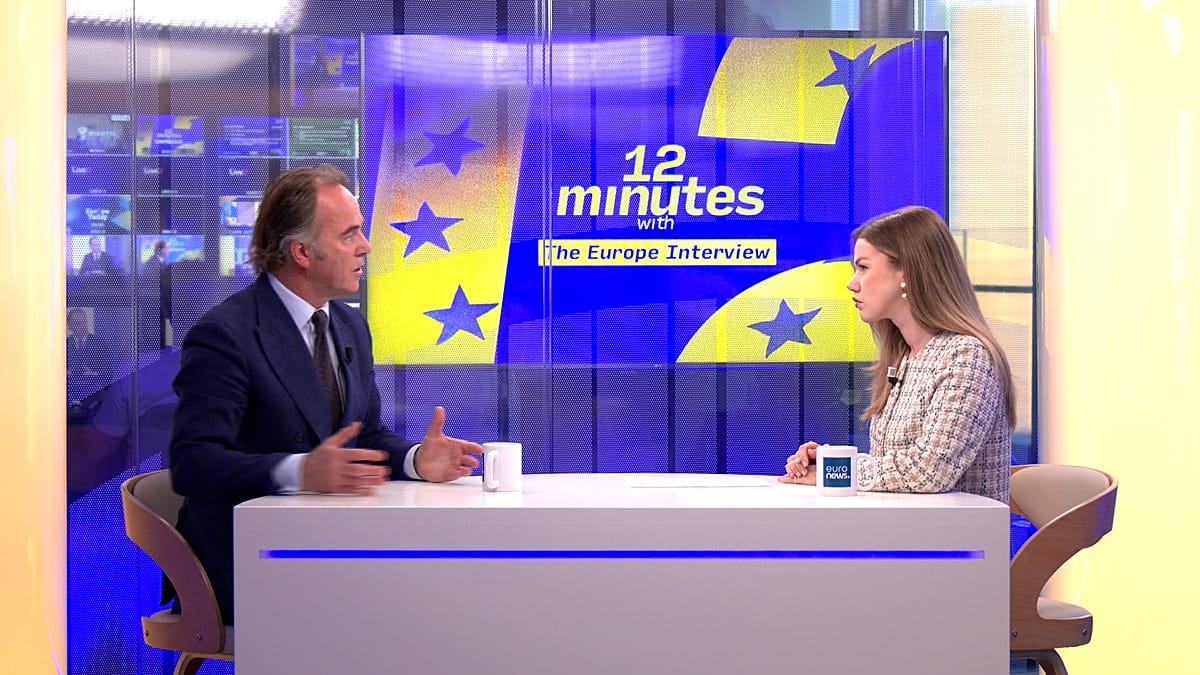



The European Union should leverage development aid and visa policies to force countries to cooperate with its stance on migration, Belgium’s Minister for Migration and Asylum, Anneleen Van Bossuyt, has told Euronews’ interview programme 12 Minutes With.
Belgium is already implementing this tit-for-tat approach. When in discussion with third countries for future partnerships, it makes aid and support conditional on assistance with migrant returns.
“We have decided that we will have a whole-of-government approach,” Van Bossuyt said. “So what we mean by that is that we will relate development aid to the way in which the countries of origin take back their nationals.”
Van Bossuyt, who took on her role in February last year and is tasked with implementing what Prime Minister Bart De Wever has described as the “strictest possible migration policy” in Belgium’s history, went further by saying that visa policies can also be made conditional on cooperation on migration.
This means rules on visas, including costs, processing, or access, can be leveraged to pressure countries into accepting the return of their nationals from the EU.
The country justifies stricter return policies by the fact that many people whose request for asylum has been denied ignore orders to leave. More than 110,000 people are thought to be living in the county without residence permits, according to research by the Vrije Universiteit Brussel.
“I can say that it’s not only a Belgian challenge, it’s a European challenge because we see that also at the European level, only one in five people who have to return to their home country actually do so,” Van Bossuyt said.
Belgium urges EU to use its leverage
Van Bossuyt said that she is convinced this approach would be more efficient if enforced on an EU level.
“If we were to do that at the European level, we have much more leverage to use (…) towards the countries of origin,” she said. “And that’s why we really need this European cooperation.”
She added that there is political appetite for such measures among her European counterparts. “We see that spirits are changing also at the European level,” she said.
In July 2025, the European Commission unveiled plans to tie its development spending more directly to the bloc’s domestic priorities, including the systematic integration of “migratory considerations”, under its long-term budget for 2028-2034.
That budget, known as the Multiannual Financial Framework (MFF), is currently in negotiations but is expected to contain a clause that will allow halting all financial support, bar humanitarian aid, to non-EU states that do not cooperate with migrant returns.
The EU will be focused on the MFF during the negotiations over the next few months. The MFF proposal is now with the European Parliament and the Council, a Commission spokesperson told Euronews.
Undermining development goals?
This proposal reflects a political line being floated in Brussels for some years now, and marks a significant move away from the current no-strings-attached approach to development aid.
However, critics have warned this approach could undermine development goals, as well as the credibility of the EU as a partner.
“This short-termist policy reflects the EU’s growing fixation on increasing returns at any cost and will undermine the effectiveness of EU development objectives,” Olivia Sundberg, EU Advocate on Migration and Asylum, at Amnesty International, told Euronews.
She added that conditioning development funds to migration management “demonstrates the EU’s lack of commitment to international solidarity and responsibility-sharing” — which Sundberg argues will not be lost on non-European states — at a time when Europe should be building partnerships.
She pointed to Italy’s relations with Libya as an example of the damage this can cause. “This shows how cooperation and development can be used as means to advance a repressive and dangerous migration control policy.”
More generally, restricting development aid has been denounced by Van Bossuyt’s government coalition partner and Belgian Foreign Affairs Minister Maxime Prévot.
“It is precisely this type of funding that improves people’s lives in their countries of origin, thereby reducing migration. They deny the added value of development aid,” he said in an interview at the start of this year.