


A suspected drone sighting brought disruption to Munich airport on Saturday morning, with around 26 flights reportedly diverted and further delays affecting departures. It’s the latest in a growing number of drone incidents at German airports.
ADVERTISEMENT

ADVERTISEMENT
Figures from Germany’s air navigation service, Deutsche Flugsicherung (DFS), show that 37 drone sightings were recorded in the first three months of this year alone. Yet one question often goes unanswered: who was flying them?
In most cases, investigators are unable to determine whether a drone was being operated by a hobbyist, an irresponsible pilot or someone with more hostile intentions.
Without recovering the aircraft or identifying its operator, establishing where it came from is often impossible.
The answer? A drone ‘hunter’
One German company believes it has found a way to solve the problem. Working alongside US radar manufacturer Echodyne, Argus Interception has developed a system designed to hunt down rogue drones and catch them in mid-air.
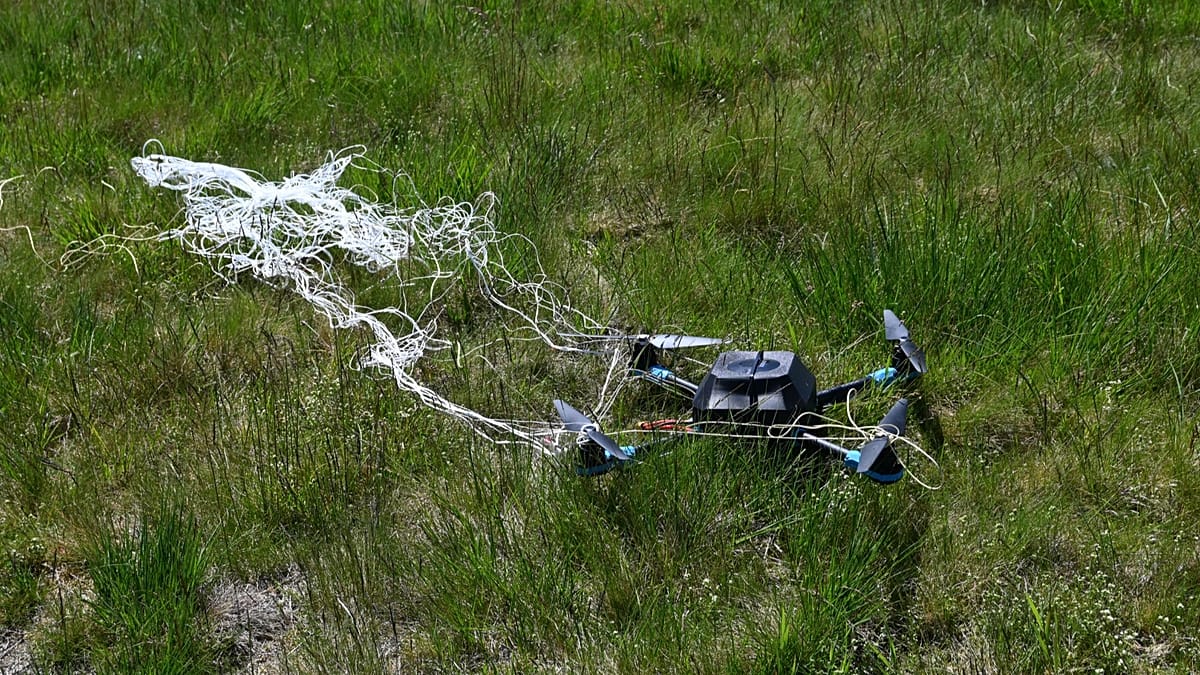
Rather than shooting a target down, the company’s A1-Falke interceptor fires a net intended to bring the aircraft safely to the ground. The idea is not only to avoid debris falling onto people or property below, but also to recover the drone intact so it can later be examined by investigators.
To improve the chances of a successful interception, the drone carries two net payloads, allowing operators a second attempt if the first misses.
At an exclusive demonstration attended by Euronews and a small group of journalists near Hamburg, the companies put the system to the test. A target drone was launched across a training ground before the A1-Falke was sent in pursuit. Moments later came a loud bang. Seconds after that, the target was caught in the interceptor’s net.
Sven Steingräber, co-founder of Argus Interception, says the system was designed for situations where shooting a drone down is not an option, such as near airports, critical infrastructure or in densely populated urban areas.
“We set out to address a capability gap,” he said. The aim, he argues, is to respond to drone incursions proportionately while avoiding collateral damage. “Our net system allows us to capture the drone, transport it away and place it exactly where we want it,” Steingräber added. “That way, we can avoid harm to bystanders as well as damage to property.”
In built-up, urban areas, he argued, that distinction matters.
How does the system work?
In simple terms, Echodyne provides the eyes, while Argus provides the interceptor.
The two companies play different roles within the same system. While Echodyne’s radars monitor the airspace and detect suspicious aircraft, Argus’ A1-Falke is responsible for the interception itself.
“You saw a couple of different radar systems on the ground,” Echodyne chief executive Eben Frankenberg told Euronews. The larger system, known as EchoShield, is responsible for “detecting an initial drone flying into the area” before “tracking it with very high fidelity and sending that data to the command and control centre.”
A smaller radar, EchoGuard, performs the same role, but at shorter ranges. Once a target has been identified, its position is passed to the interceptor. The A1-Falke then takes over. Mounted on the drone itself is a radar called EchoFlight, which performs what Frankenberg describes as “air-to-air tracking.”
“So once the interceptor drone is in the air, then it’s going to go find the intruder drone and then start tracking it,” he said. “And so the interceptor drone can then follow it,” Frankenberg said.
The A1-Falke is then sent in pursuit. Designed to catch rather than destroy its target, the drone fires a net intended to entangle the aircraft and bring it safely to the ground.
To increase the chances of a successful interception, it carries two net payloads, allowing operators a second attempt if the first misses. The drone itself is piloted from the ground. While artificial intelligence assists with the operation, the final decisions remain in human hands.
A growing security concern
Steingräber argued that many people still underestimate the potential threat posed by drones flying over sensitive sites. “Modern wars often don’t begin with the first shot being fired, but with the gathering of information,” he told Euronews. Many people, he said, are unaware that intelligence collected by a drone today could have significant consequences at a later stage.
“Such drone flights over critical infrastructure can have major consequences,” Steingräber said. “Operational procedures are filmed, supply routes are mapped and critical points are assessed for an adversary, allowing them to strike more effectively because they already have the information.”
Reports of drones flying over critical infrastructure, airports and military sites in Germany have become more frequent since Russia’s full-scale invasion of Ukraine. Until recently, responsibility for dealing with such incidents rested largely with the police. The German army was generally limited to responding to drone activity over its own facilities.
That changed last year when Germany amended its Aviation Security Act. While primary responsibility still lies with the police, the armed forces can now provide support if requested by state authorities and if the available civilian resources are deemed insufficient.
Some in the industry argue that the current framework leaves operators of critical infrastructure with few tools to respond to suspicious drone activity. They are calling for facilities such as airports, energy sites and other sensitive locations to be given greater scope to use counter-drone systems themselves.
One example is the net-based interceptor demonstrated to Euronews near Hamburg, which is designed to capture a drone rather than destroy it. As it carries no live ammunition and is not classified as a weapon, operators could deploy the drone themselves, bring an intruding aircraft down and have it examined afterwards.