
Ahead of the European Council summit, where EU leaders will decide on Ukraine financing, a new YouGov survey shows that major European countries tend to support using frozen Russian funds to provide financial support for the war-torn country.
The majority of British, Polish, German, and Spanish respondents support using frozen Russian funds in European bank accounts to fund additional aid for Ukraine.
However, Italy proves to be the exception, as Italians are closely divided on the issue, with 39% supporting and 38% opposing it.
Experts claim Italy’s division reflects “a deeper fracture in its political landscape”, particularly regarding a “pro-Ukraine” faction in Prime Minister Giorgia Meloni’s government when it comes to security, versus a part of the ruling coalition under Matteo Salvini that is typically more sympathetic to Russia and anti-EU.
“This division exposes Italy’s ambivalent position within the EU, caught between wanting to be a major player at the European table while maintaining domestic political narratives that are often Eurosceptic,” Alberto Alemanno, Jean Monnet Professor of European Union law and policy at HEC Paris, told Europe in Motion.
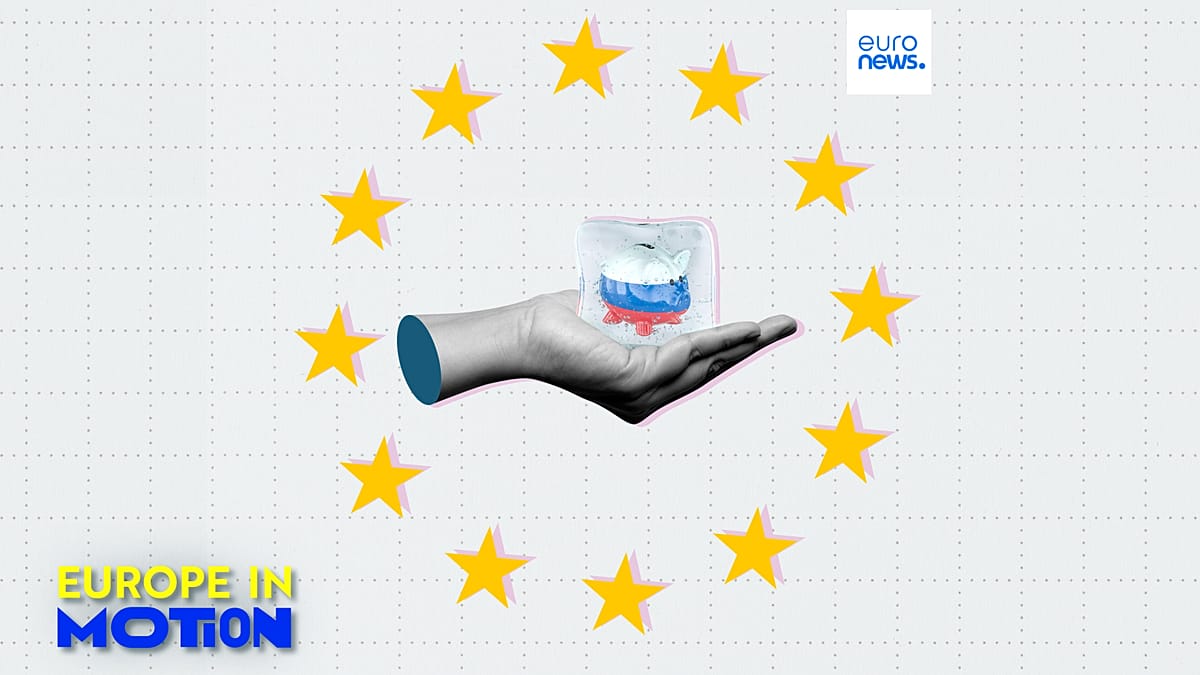
Since many of Europe’s major economies are cash-strapped and mired in debt, EU countries want to finance Ukraine’s defence using €210 billion in Russian Central Bank assets that have been immobilised under EU sanctions since February 2022.
The European Commission has pushed for Belgium to agree to an unprecedented reparations loan for Ukraine, which has the government worried because €185 billion of the assets are held at Euroclear, a securities depository in Brussels.
Belgium seeks guarantees from other EU countries that they would help cover any financial losses if Russia wins a lawsuit against Belgium over the new plan, especially seeing as the Russian Central Bank has already taken Euroclear to court.
The Commission has tried to allay the Belgian concerns by offering a set of guarantees and safeguards to nullify any arbitration attempt. To prevent a sudden liquidity crisis, the EU has indefinitely immobilised the Russian assets.
However, Italy, Bulgaria, the Czech Republic, and Malta joined Belgium on Friday with a joint declaration that called on the Commission to explore “alternative solutions” with “predictable parameters” and “significantly less risks”.
Italy has also frozen around €2.3 billion in Russian oligarchs’ assets since the invasion of Ukraine in 2022, according to data provided by Italian authorities.
“Many Italians perceive their economy as particularly vulnerable to energy disruptions and retaliatory measures, making them more risk-averse than Northern European countries with different economic structures and energy mix,” Alemanno said. “There’s also concern about the risks of setting a precedent of weaponising financial instruments in ways that could undermine European economic interests and legal norms.”
Does the unwavering support continue?
Despite financing challenges, most of these European countries continue to support providing monetary assistance to Ukraine as Russia’s invasion rages on.
Citizens surveyed in the UK, Germany, France, Poland, and Spain still believe it’s right to financially back Ukraine, with support ranging from 73% to 50%.
Meanwhile, Italians are once again divided in their opinions, with 44% supporting and 34% opposing it.
“This translates into support for abstract principles of sovereignty while questioning the concrete costs of sustained financial commitment, especially when Italian citizens — as any other EU citizen — face their own economic costs,” Alemanno told Europe in Motion.
There is also a division within each country over whether the level of support given to Ukraine is too little, too much, or about right.
Germany is among the five EU countries with a higher share of respondents believing there’s too much support, at 34%, while 36% in Poland claim it’s the right amount.
When it comes to NATO, Russia wants to block Ukraine from ever joining the alliance, while Europe won’t rule it out.
Among the EU countries surveyed, Spaniards are the most in favour of Ukraine joining, while others are supportive by more narrow margins, with between 42% and 47% backing Ukrainian membership.