


The opinions expressed in this article are those of the author and do not represent in any way the editorial position of Euronews.
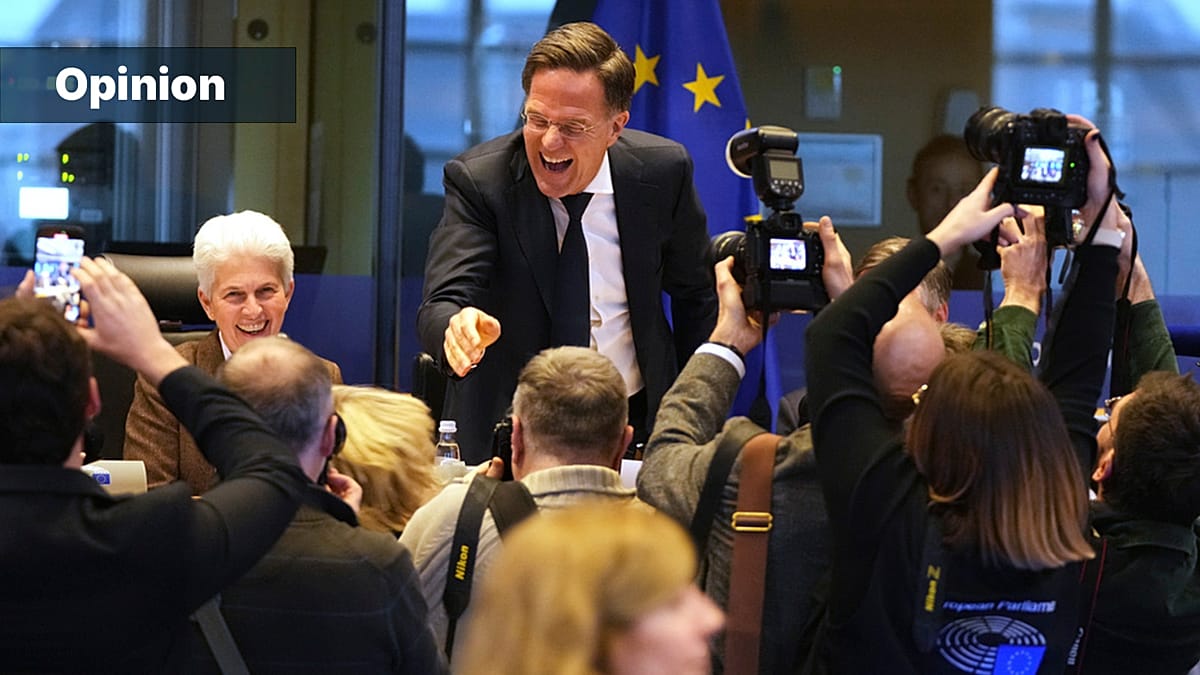
Mark Rutte has (almost) pulled off the remarkable feat of uniting the European Parliament.
Of course, it slightly detracts from the artistic impression that the Parliament is united around something negative: being irritated by Rutte’s statements during a hearing Monday regarding NATO’s ability to deter without the United States.
What he stated — without rhetorical padding — was that Europe, here and now, cannot deter Russia on its own. The United States remains indispensable.
The reaction was predictable. A mixture of irritation, wounded pride, and moral posturing followed. But this is precisely the wrong response. When the diagnosis is correct, indignation is not a substitute for treatment.
Let us start with the basic point, stripped of emotion. As of today, the European pillar of NATO cannot function as a fully autonomous deterrent force without the United States.
This is not a matter of political will or ethical maturity. It is a matter of hard capabilities.
US is the backbone of NATO
First, Europe lacks a genuinely independent strategic command structure capable of planning and executing large-scale, high-intensity operations without US participation.
NATO’s integrated command system is, in practice, deeply American in its architecture.
This is not an insult; it is a historical fact. The alliance was designed that way during the Cold War, when American leadership was both accepted and desired. One can regret this legacy, but one cannot wish it away.
Secondly — and even more decisively — Europe lacks the digital and informational infrastructure that distinguishes NATO from a loose aggregation of national armed forces.
Modern deterrence is not primarily about the number of soldiers or tanks. It is about intelligence fusion, real-time surveillance, satellite coverage, secure communications, targeting data, cyber resilience, and the ability to integrate all of this across domains and national borders.
In virtually all these areas, the United States provides the backbone.
Without US assets, Europe would not merely be weaker. It would be structurally blind and operationally fragmented. Deterrence without credible situational awareness is not deterrence; it is hope dressed up as strategy.
None of this implies that Europe should accept permanent dependence on the United States. On the contrary. If there is a legitimate criticism to be made, it is not that Rutte spoke too bluntly — but that Europe has spent too long confusing aspiration with reality.
It is entirely reasonable to argue that Europe should aim to become capable of defending itself without American involvement. Indeed, given recent developments in US domestic politics and foreign policy, it would be irresponsible not to consider that scenario seriously.
Strategic autonomy is no longer a theoretical debate; it is an insurance policy discussion. Or in other words: General de Gaulle was right all the time.
But insurance policies are expensive, and they take time to put in place.
Here, Europe needs two correct perspectives: an economic one and a temporal one.
Generational project afoot
Economically, genuine military autonomy would require sustained investment at a scale that many European governments – and publics – have not yet internalised.
This is not about marginal increases or creative accounting. It is about building parallel structures where none currently exist: command systems, intelligence capabilities, satellite constellations, logistics chains, stockpiles and a defence industrial base capable of producing at speed and scale.
That bill will be counted in hundreds of billions, not as a one-off, but as a permanent commitment.
Temporally, this is not a five-year project. It is, best case, a 10-year project. But more realistically: a generational one.
Even with political consensus — something Europe rarely enjoys — building credible autonomous deterrence would take a decade or more. During that time, Europe cannot afford strategic self-deception. Pretending to have capabilities that do not yet exist does not strengthen deterrence; it weakens it by eroding credibility.
This is where Rutte’s intervention should be understood not as provocation, but as clarification. He described the present tense. Critics responded as if he were prescribing the future.
There is also a deeper discomfort at play. Many European politicians have grown accustomed to speaking the language of norms, values, and intentions, even in domains where power, capacity, and willingness to absorb costs remain decisive.
Pats on the back are not enough
Defence policy is not an arena in which moral self-affirmation substitutes for material preparedness.
To say that Europe cannot deter Russia alone today is not to deny Europe’s potential. It is to acknowledge the distance between where Europe is and where it might wish to be. That distance can be bridged — but only if it is measured honestly.
Shooting the messenger may provide temporary emotional relief. It does nothing to improve Europe’s strategic position.
If Europe wants to stand on its own, it must first learn to look at itself without illusion. Mark Rutte did precisely that. For once, Europe should respond not with offence, but with focus.
That is why my final appeal to my colleagues in the European Parliament is this: do not look at the world as it ought to be. Look at it as it is — with cool, Bismarck-like eyes.
Europe will not become stronger by wishing for autonomy. It will become stronger by understanding what autonomy actually costs, how long it takes, and why pretending otherwise is the surest way not to get there.
Henrik Dahl (EPP) is a Member of the European Parliament from Denmark.


