
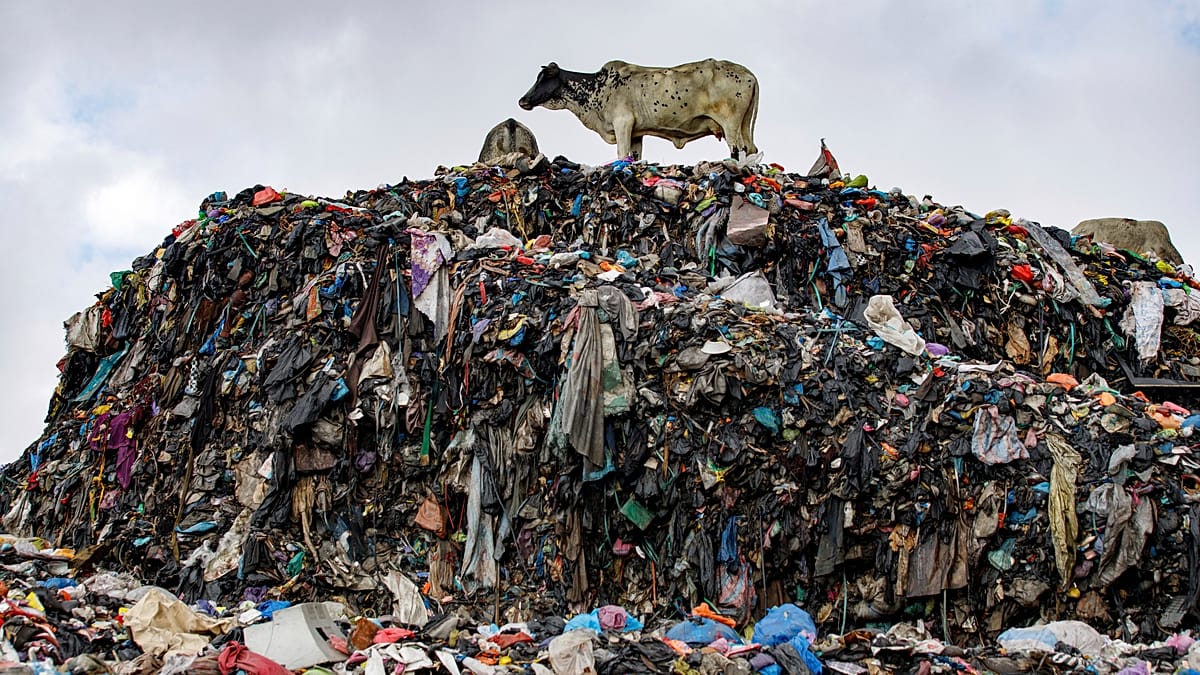
European anti-fraud investigators have helped uncover a large-scale scheme that illegally exported 4,200 tonnes of textile waste from Italy to Turkey, exposing what authorities describe as a profitable operation designed to evade environmental laws and recycling costs.
ADVERTISEMENT

ADVERTISEMENT
The investigation, led by the European Anti-Fraud Office (OLAF) in cooperation with Italy’s Carabinieri and Turkish customs authorities, focused on textile waste containing high levels of acrylic fibres.
Because these synthetic materials persist in the environment for up to 200 years and require more sophisticated recycling processes, they are subject to strict and costly disposal rules.
Investigators found that shipments had allegedly been mislabelled to avoid those requirements.
“Schemes such as this one that offer ways to illegally avoid the cost of recycling certain kinds of textile waste or complying with environmental rules are an opportunity for organised networks to make illegal gains,” said OLAF’s director general Petr Klement.
Klement described the case as evidence of the growing importance of international cooperation in combating environmental crime and protecting both the economy and the environment.
Using trade-flow analysis, customs data and assessments of recycling capacity, OLAF identified suspicious consignments and alerted Turkish authorities. Inspections upon arrival revealed approximately 4,200 tonnes of textile waste that had been illegally shipped from Italy.
Clothing is increasingly treated as disposable, placing growing pressure on European collection, sorting and recycling systems. Much of the discarded clothing eventually ends up in landfills or incinerators, both in Europe and in countries of the Global South that receive second-hand textile exports.
The investigation deepens
The investigation deepened during a joint inspection in Turkey involving OLAF officials, Italian environmental specialists and Turkish authorities.
In addition to the original 4,200-tonne haul, inspectors discovered nearly 2,100 tonnes of textile waste stored in a warehouse linked to a recycling facility that allegedly failed to comply with Turkish environmental laws and another stockpile that had arrived separately.
But the piles of illegal textile waste investigators found didn’t end there.
“A further 768 tonnes of textile waste originating from Italy and connected to the same fraudulent scheme were found stored in the Turkish port of Mersin, also incorrectly labelled and ready to be illegally dumped,” reads OLAF’s statement.
The operation has produced significant enforcement action in Italy.
This week, the Carabinieri raided a business complex in Brescia linked to the suspected exports, according to OLAF. Authorities seized company facilities, a fleet of trucks allegedly used in the operation and approximately €12 million in financial assets.
Textile waste in the EU
The EU textile and clothing sector generated €170 billion in turnover in 2023 and employs around 1.3 million people, yet textile waste remains difficult and expensive to recycle.
In 2019, Europe generated roughly 12.6 million tonnes of textile waste, but only about one-fifth was separately collected for reuse or recycling.
In response, the European Commission introduced new textile-waste management rules in 2025 aimed at preventing waste from being falsely labelled as reusable goods and exported abroad.
The legislation strengthens oversight of textile shipments and enhances OLAF’s role in supporting investigations into waste trafficking.
In a recent effort to pressure the Commission into further action, a coalition of five EU member states led by France launched a coordinated crackdown on ultra-fast fashion.
In a document seen by Euronews, the group of countries warned that the rapidly expanding business model threatens environmental goals, overwhelms waste systems and fuels unsustainable consumer behavior.
“Strengthen oversight and control of online platforms, reinforce market surveillance and close enforcement gaps under the Circular Economy Act and the Market Surveillance Regulation,” the five governments urged, reflecting concerns over the influx of ultra-fast fashion that arrives in Europe from Chinese platforms like Shein and Temu.
Other requests to the Commission include “additional performance requirements” under the EU textile waste rules, supporting the transition to a closed-loop recycling system and the reinforcement of extended producer responsibility schemes.
The five countries argue that these practices drive overconsumption and generate enormous volumes of textile waste.
“We are relatively ahead in this area and we are pleased to be able to share our experience and how Europe can move forward together on this topic as well,” said the French ecological transition minister Monique Barbut on the sidelines of a gathering of environment ministers on 25 June.