




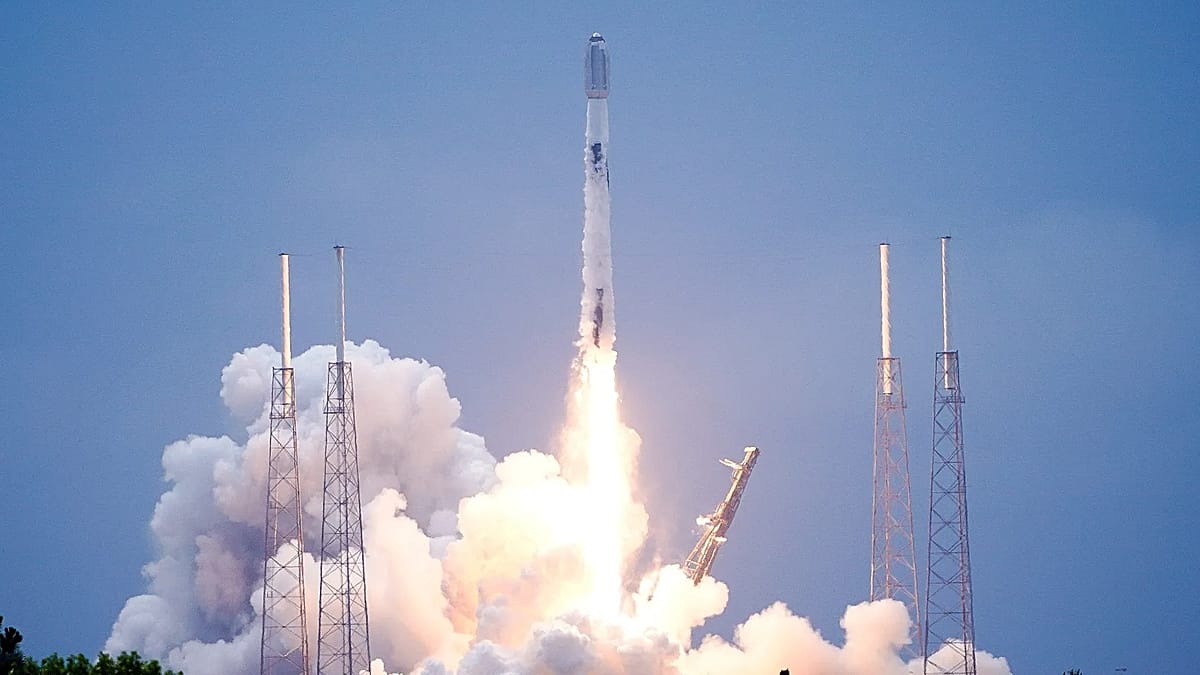
The European Commission will adopt a decision this week that would privilege European satellite operators in a move designed to curb the European expansion of Starlink, the flagship service of Elon Musk’s SpaceX.
ADVERTISEMENT

ADVERTISEMENT
Starlink currently dominates the global satellite internet market with over 10,000 low-orbit satellites. Its closest competitor is Amazon’s Project Kuiper, which recently launched its first commercial satellite constellation.
The strategic importance of satellite-based communications became clear after the full-scale Russian invasion of Ukraine, when Starlink provided a lifeline to Ukrainian troops after physical communications infrastructure was knocked out of service.
More recently, Ukraine reportedly regained about 400 square kilometres of territory in a counter-offensive earlier this year after managing to disable thousands of illicit Russian Starlink terminals.
Yet despite the systems’ role in denying Russia major gains in Ukraine, Europeans have grown wary of the strategic dependence on US operators controlling such a critical communications system.
In response, the EU attempted to launch its own satellite-based secure connectivity system, IRIS² – and Brussels now appears to be going a step further with a decision on radio spectrum allocation at the European level that would prevent Starlink and Kuiper from further expanding their services in Europe.
“Satellite connectivity is a key piece of our technological sovereignty, our security, and our defence, as also highlighted by IRIS²,” Thomas Regnier, the Commission’s spokesperson for tech sovereignty, told Euronews.
“In the changing geopolitical situation, EU-wide satellite connectivity becomes synonymous with resilience, security, and capability.”
Pro-European decision
The Commission is due to adopt its decision on Wednesday on the selection of operators for pan-European systems providing mobile satellite services for the 2 GHz radio spectrum frequency, the only band harmonised at the EU level.
Since 2009, this bandwidth has been allocated to two European operators, Viasat and EchoStar.
These frequencies are currently used for a limited range of use cases, notably when a smartphone has no mobile network connection but can still be used to call the emergency services.
Following technological developments, the Commission is now considering expanding the use of these frequencies for so-called direct-to-device communications, allowing smartphones and other devices to connect directly to satellites in space.
However, direct-to-device communications would allow the likes of SpaceX and Amazon to directly compete with European mobile operators, providing space-based connectivity that makes terrestrial infrastructure obsolete.
The upcoming decision is thus set to favour the European satellite operators, with whom European telecom operators prefer to interact as they are not seen as a direct threat to their business model.
The decision is expected the week before the Commission is due to present its Tech Sovereignty Package, an initiative aimed at freeing the EU from strategic dependence on foreign technology providers.
The Trump question
The question is whether the move will anger the US government, which, since Donald Trump returned to the White House last year, has been particularly assertive in protecting the interests of American companies abroad, including in Europe.
At the Mobile World Congress in March, the chairman of the US Federal Communications Commission, Brendan Carr, warned the EU against favouring European providers in satellite spectrum allocations.
“Europe has national champion satellite providers that do substantial business in the US. And I think we have all benefited from a fair and even-handed approach. And whether we get to continue to do that, frankly, is in the hands of European regulators right now,” Carr said.
“If Europe insists on going down a path of satellite sovereignty that excludes providers that are not based in the continent, then the US will have to be taking that into account with respect to the reciprocal treatment that we provide.”
At the same time, the Commission believes the worst-case scenario has already been avoided: last week, EU policymakers managed to settle their differences and reach a political agreement on the controversial EU-US trade deal.
Commercial vs defence interests
The 2 GHz radio band also pits commercial interests against military applications, with the defence establishment perpetually seeking to reserve bandwidth for its own use.
Within the Commission, this tension is playing out in the form of a clash between EU digital chief Henna Virkkunen, who is closer to the interests of telecom operators, and Defence Commissioner Andrius Kubilius.
In an interview with the Financial Times last week, Kubilius pushed for IRIS² to obtain a slice of satellite frequencies, a position not necessarily shared by the rest of the Commission.
Spectrum is a scarce resource, and its allocation has always been a balancing act between competing interests.
As the EU presses ahead with developing its domestic technology solutions, striking the right balance – avoiding Washington’s wrath and leaving enough room for defence applications – will be a particularly delicate act.