
Serbia’s decision to repeal controversial judiciary reforms has reignited debate inside the European Union over how to balance strategic engagement with democratic standards, exposing divisions over whether Belgrade has done enough to revive its accession bid.
ADVERTISEMENT

ADVERTISEMENT
The European Commission on Monday presented member states with an information note outlining why it believes Serbia’s recent reforms justify opening Cluster 3 of its accession negotiations, which Belgrade has sought to unlock after years of stalemate.
The note, dated 3 July and seen by Euronews, says the Commission believes Serbia has remedied the “backsliding” identified earlier this year and taken steps to strengthen the capacity of the country’s Prosecutor’s Office for Organised Crime.
It acknowledges, however, that “further work is still required in the judicial and prosecutorial system”.
But interviews with more than a dozen diplomats, EU officials and experts suggest Serbia’s latest rollback has done little to bridge divisions among member states, whose unanimous backing is required before the accession process can move forward.
While some argue Belgrade should be recognised for implementing recommendations from the Venice Commission, others say repealing the reforms does little to reverse years of democratic backsliding and persistent concerns over judicial independence, corruption and the rule of law. The Venice Commission is the Council of Europe’s advisory body on constitutional matters.
For many in Brussels, the debate extends beyond a single negotiating cluster.
Serbia remains the Western Balkans’ largest economy and a strategically important partner, leading some officials to argue that continued engagement offers the best chance of encouraging further reforms.
Others counter that rewarding incremental progress before more fundamental changes are delivered risks undermining the credibility of the EU’s enlargement process.
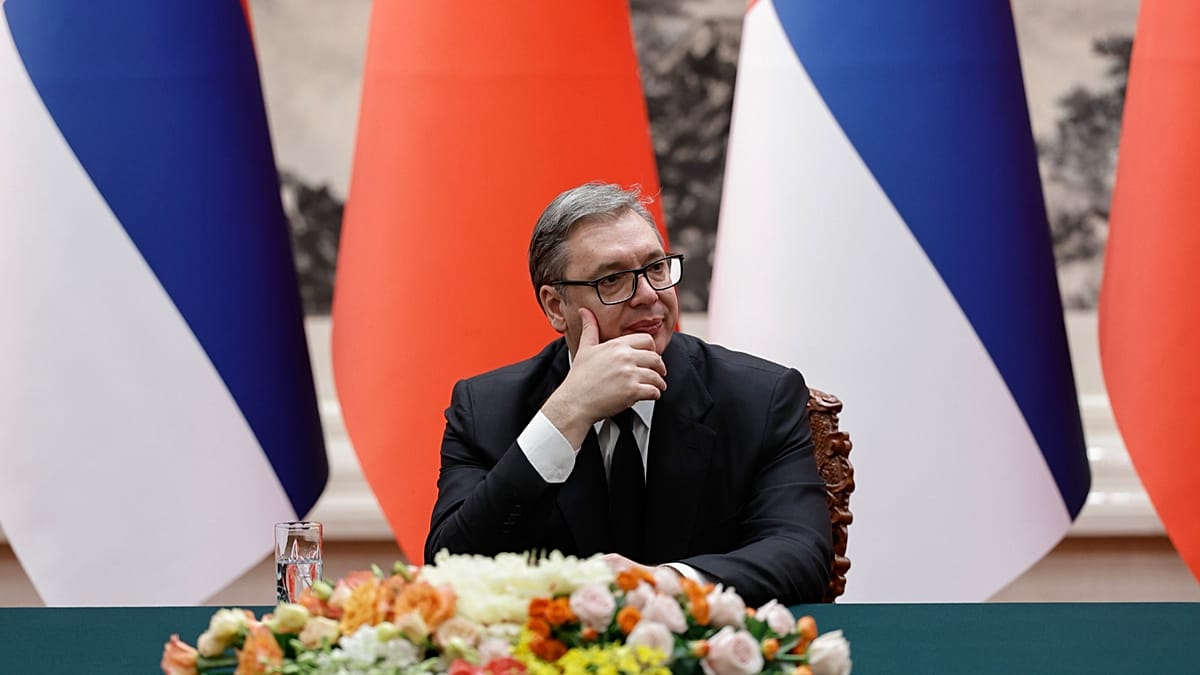
The debate has taken on added significance following President Aleksandar Vučić’s announcement that he intends to resign after eight years in office and call elections within the next three to four months.
While supporters have portrayed the move as the start of a new political chapter, critics argue it is a tactical manoeuvre that could allow him to retain power by seeking the premiership.
The Commission stressed, however, that any decision ultimately rests with EU governments. “The decision to move forward with Serbia’s accession process remains in the hands of the Council,” the spokesperson added.
It is expected the matter will be raised at a meeting among ambassadors in Brussels on Wednesday.
A strategic balancing act
The latest debate was triggered after Belgrade repealed a package of controversial judiciary laws, enacted in February and collectively referred to as the Mrdić laws. It followed sharp criticism from the Venice Commission.
The reversal was welcomed by European Enlargement Commissioner Marta Kos, who described it as an “important step in the right direction” and said discussions were continuing on Serbia’s wider reform agenda.
European Commission President Ursula von der Leyen has also said Serbia could advance further in its accession negotiations if it delivers on reforms, while European Council President António Costa recently suggested alignment with the Venice Commission’s recommendations could help move the process forward.
Behind those public statements lies a more nuanced debate.
Several EU officials argue that maintaining dialogue with Belgrade is strategically important, despite Serbia’s democratic shortcomings and its refusal to align with EU sanctions against Russia.
From the Commission’s perspective, disengagement risks weakening the EU’s influence in the Western Balkans and alienating a country regarded as central to regional stability.
That approach, however, is far from universally shared.
In response to questions from Euronews, a Commission spokesperson confirmed that the executive had shared an information note with member states explaining why it believes Serbia’s recent steps could justify opening Cluster 3.
For some diplomats, recognising Serbia’s latest reforms would reinforce the principle that candidate countries are rewarded when they implement recommendations made by Brussels and the Venice Commission.
One EU diplomat argued that failing to acknowledge tangible progress risks turning Serbia into “the next North Macedonia” — a country that secured EU candidate status in 2005 but has repeatedly seen its accession ambitions frustrated despite undertaking reforms.
Others are unconvinced.
Several diplomats told Euronews that while repealing the judiciary laws was welcome, it does not resolve broader concerns surrounding the rule of law, democratic institutions and judicial independence.
One diplomat said the repeal merely brought Serbia “back to square one”, while another argued that reforms under Cluster 1 — covering the fundamentals of the accession process, including the rule of law — remain the real test of whether Belgrade is ready to make meaningful progress.
The debate illustrates the central dilemma now facing Brussels: whether incremental reforms should be rewarded as a way of keeping Serbia anchored to the European Union, or whether doing so risks sending the wrong signal about the standards expected of candidate countries.
Rule of law
Several diplomats said discussions around Cluster 3 cannot be separated from concerns over Cluster 1 — the chapter covering the fundamentals of the accession process, including the rule of law, judicial independence and democratic institutions.
Several diplomats pointed to a confidential Commission assessment circulated among member states in early 2025, describing it as one of the most critical evaluations of Serbia’s progress in recent years.
One diplomat characterised it as the “worst” enlargement assessment they had seen, while another described it simply as “damning”.
Their argument is straightforward: Serbia cannot credibly move forward on economic chapters if it continues to struggle with the fundamentals that underpin the accession process.
“The repeal of the laws is welcome,” one diplomat said. “But it doesn’t mean Serbia is suddenly ready to move ahead. It simply brings the country back to where it was before.”
Others, however, see the latest developments differently.
Two diplomats argued that Belgrade’s decision to reverse the judiciary reforms demonstrated that the government was willing to respond to recommendations from Brussels and the Venice Commission — precisely the kind of behaviour the enlargement process is designed to encourage.
That disagreement reflects a broader question confronting the EU: whether candidate countries should be rewarded for incremental progress even when deeper structural concerns remain unresolved.
A leaked version of the Commission’s assessment, seen by Euronews, highlights persistent shortcomings in judicial independence following the adoption of the January legislation.
It states that Serbia should implement the Venice Commission’s recommendations by repealing or substantially amending the legislation “without delay” — a step Belgrade has since taken.
But the document also identifies a broader pattern of concerns that extend well beyond the judiciary.
It points to shortcomings in democratic governance and references the wave of anti-government protests that followed the collapse of a railway station canopy in Novi Sad in November 2024, which killed 16 people.
The report notes that the safety of demonstrators was not always guaranteed and cites several violent incidents during the protests. It also raises concerns over the pace of investigations into the disaster, saying corruption inquiries had been hampered by a lack of police cooperation.
“The collapse and the lack of progress in the investigations continue to fuel a perceived lack of accountability and transparency in government infrastructure and construction projects,” the document states.
The findings broadly mirror the Commission’s 2025 enlargement report, which concluded Serbia had made only “limited progress” in key areas, including the rule of law, anti-corruption efforts and reducing state interference in the economy.
Yet even among member states there is no single view of how those findings should shape the accession process.
One diplomat from a major EU country said they had observed “positive developments” in Serbia in recent weeks, while another indicated they would assess positively any recommendation from the Commission to move forward with Cluster 3.
Others remain considerably more cautious, arguing that Serbia has yet to demonstrate sustained progress on the reforms that lie at the heart of the accession process.
Resignation raises fresh questions
Vučić’s announcement that he intends to step down has added another layer of uncertainty to an already delicate debate in Brussels.
The 56-year-old, who has dominated Serbian politics for more than a decade, said he would resign after serving two presidential terms. He has yet to decide whether he will seek the premiership, but has insisted any decision will be made transparently.
For EU officials, the announcement is significant, but not necessarily transformative.
“The proper functioning of democratic institutions is at the core of Serbia’s EU accession process,” a Commission spokesperson told Euronews, adding that Brussels would closely monitor any future elections to ensure they are free and fair.
Experts, however, caution against interpreting Vučić’s announcement as evidence of a broader democratic opening.
Antigona Imeri, a Western Balkans expert at the Centre for European Policy Studies, argued the resignation should instead be viewed as a tactical political manoeuvre.
“It should set off alarm bells,” she said, arguing the move could ultimately consolidate rather than diminish Vučić’s influence.
One European diplomat broadly agreed with that assessment, saying there was little expectation in Brussels that Serbia’s political trajectory would fundamentally change simply because Vučić vacates the presidency.
Berta López Domènech, a policy analyst at the European Policy Centre, believes the announcement reflects constitutional reality as much as political strategy.
Having reached the two-term presidential limit, Vučić may instead seek the office of prime minister, allowing him to retain political control while presenting himself as responding to public demands following months of anti-government protests.
“He presents himself as someone who listens to the people,” she said. “But he can no longer run for president. Becoming prime minister would allow him to keep his grip on power.”
López Domènech argues that the apparent contradiction extends beyond Serbia’s domestic politics.
“When you look at the rhetoric he’s still using domestically, it’s still belligerent towards the EU and friendly towards Russia,” she said. “The overall position hasn’t changed.”
For Slovenian MEP Vladimir Prebilič, who sits on the European Parliament’s delegation for relations with Serbia, the announcement alone offers few guarantees that democratic standards will improve.
“There is no concrete timeline, no dissolution of parliament and, most importantly, no guarantees for free and fair elections,” he said.
“The cosmetic change in the current political constellation won’t change anything when it comes to Serbia’s EU path, which has been effectively frozen since 2021.”
Instead, he argued, Brussels should focus less on political announcements and more on the conditions under which future elections are held.
“What Serbia instead needs from Europe is a clear and unequivocal signal that free and fair elections are needed now, and to stand unconditionally alongside Serbian citizens and the democratic movement.”
A familiar dilemma
Serbia’s democratic trajectory is only one part of the equation confronting EU capitals.
The country’s refusal to align with EU sanctions against Russia, its close political relationship with Moscow and its expanding ties with China continue to complicate accession talks.
Croatian MEP Tonino Picula, the European Parliament’s rapporteur for Serbia, recently warned that while countries such as Montenegro and Albania have accelerated reforms, Serbia has experienced a “steady erosion of political rights and civil liberties” alongside a weakening of democratic institutions.
He also pointed to Belgrade’s limited alignment with the EU’s foreign and security policy as an increasingly important concern for member states.
Vučić has maintained close ties with Russian President Vladimir Putin throughout Russia’s full-scale invasion of Ukraine, including attending the Victory Day parade in Moscow earlier this year.
EU foreign policy chief Kaja Kallas has publicly criticised such engagement, questioning why European leaders would choose to stand alongside Putin while Russia continues its war against Ukraine.
For Serbian officials, however, Brussels has not always applied the same standards to every candidate country.
Former prime minister Ana Brnabić recently told Euronews that Serbia faced “double standards”, pointing to electoral reform recommendations made by the Office for Democratic Institutions and Human Rights (ODIHR).
“If you look at other candidate countries which also have ODIHR recommendations on improving electoral conditions, they are not required to implement even one of them, and they have already opened all their clusters,” she said.
“We are not giving up. We will keep fighting, we will work even harder, but it is important that we present not only plans but also results.”