


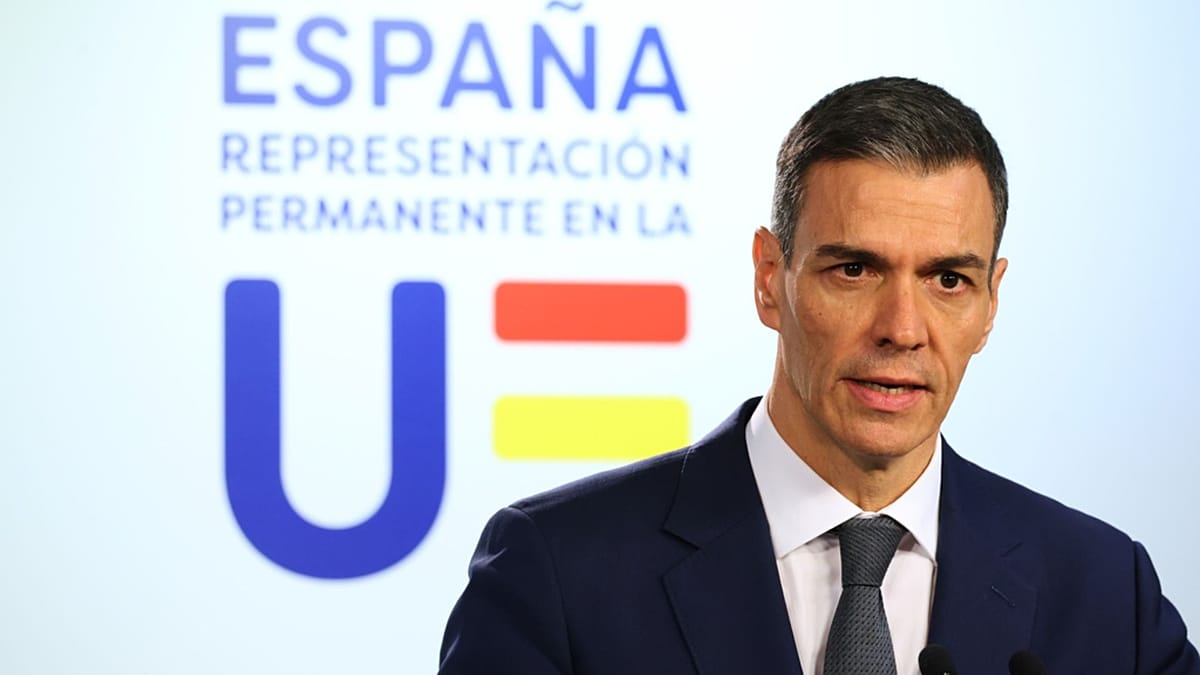
The Spanish government’s controversial decision to approve a decree that will regularise 500,000 undocumented migrants and asylum seekers has sparked debate across Europe.
ADVERTISEMENT

ADVERTISEMENT
Alongside more measured criticism and analysis, a wave of misleading claims has surfaced.
Some widely shared posts on X, amassing millions of views and thousands of shares, claim that these newly regularised migrants will be given the automatic right to vote.
Others say that they will be put on a fast track to citizenship, allowing them to vote and, in turn, creating a “loyal voting bloc” for Prime Minister Pedro Sánchez and his left-wing government.
When you look at Spain’s immigration, naturalisation and voting rules, there is little truth to these claims.
What does the decree entail and is it new?
The decree, expected to come into force in April, applies to at least 500,000 undocumented migrants and asylum seekers currently living in Spain.
Applicants for regularisation have to prove they have no criminal record and have lived in Spain for at least five months or sought asylum by the end of December 2025.
It’s not the first time Spain has regularised multiple migrants: the Spanish Commission for Refugee Aid (CEAR) said this is the seventh similar process since 1986.
The decree provides beneficiaries with a one-year residence permit and the right to work in Spain.
Sánchez’s government has said that the move will strengthen Spain’s labour market. Spain’s minister of inclusion, social security and migration, Elma Saiz, called it a “migratory model based on human rights, integration, co-existence and which is compatible with economic growth and social cohesion”.
The measure has equally sparked ire from the conservative People’s Party (PP) and the far-right Vox. The leader of the PP accused Sánchez of attempting to deflect attention away from the government’s response to multiple deadly train crashes over the past month.
Who can vote in Spain?
Spain’s voting rules are clearly defined.
According to the Spanish interior ministry, only Spanish citizens of legal age (currently 18 years old) are entitled to vote in national elections and elections in Spain’s autonomous communities. In European elections, EU citizens resident in Spain may also vote.
In local municipal elections, voting rights are more limited. Non-EU nationals may only vote if Spain has a reciprocal voting agreement with their country of citizenship. This applies currently to nationals of 13 countries, including Iceland, Norway and the UK, provided they also meet residency requirements (which can differ depending on the country).
Contrary to online claims, simply holding legal residence in Spain does not grant the right to vote in national elections.
Does regularisation lead to quick citizenship?
Another claim circulating on the viral posts suggests that regularised migrants can gain Spanish citizenship in as little as two years. But this is misleading.
Under Spanish law, only citizens of specific countries, namely Portugal, the Philippines, Andorra, Equatorial Guinea and most Latin American countries, as well as those of Sephardic origin, can apply for Spanish citizenship after two years of legal and continuous residence.
For the vast majority of people from other countries, though, it takes much longer: most immigrants to Spain need to live there legally for 10 years to be able to apply for citizenship, but this is shortened to five years for refugees and can be shortened even further to one year if the individual was born in Spain or has been married to a Spanish citizen.
Regardless of the timeframe, the residency period is just the start of the process. The decree itself grants one year of legal residency, meaning it would not be sufficient for the majority of people to gain citizenship in that time frame.
Applicants must still pass Spanish language and other tests, as well as wait for processing, which can take several years.
In conclusion, Spain’s new regularisation push grants migrants legal residence, not citizenship, and it does not confer voting rights in elections.
These rights are legally distinct in Spain and remain unchanged with this new decree.


