

ADVERTISEMENT
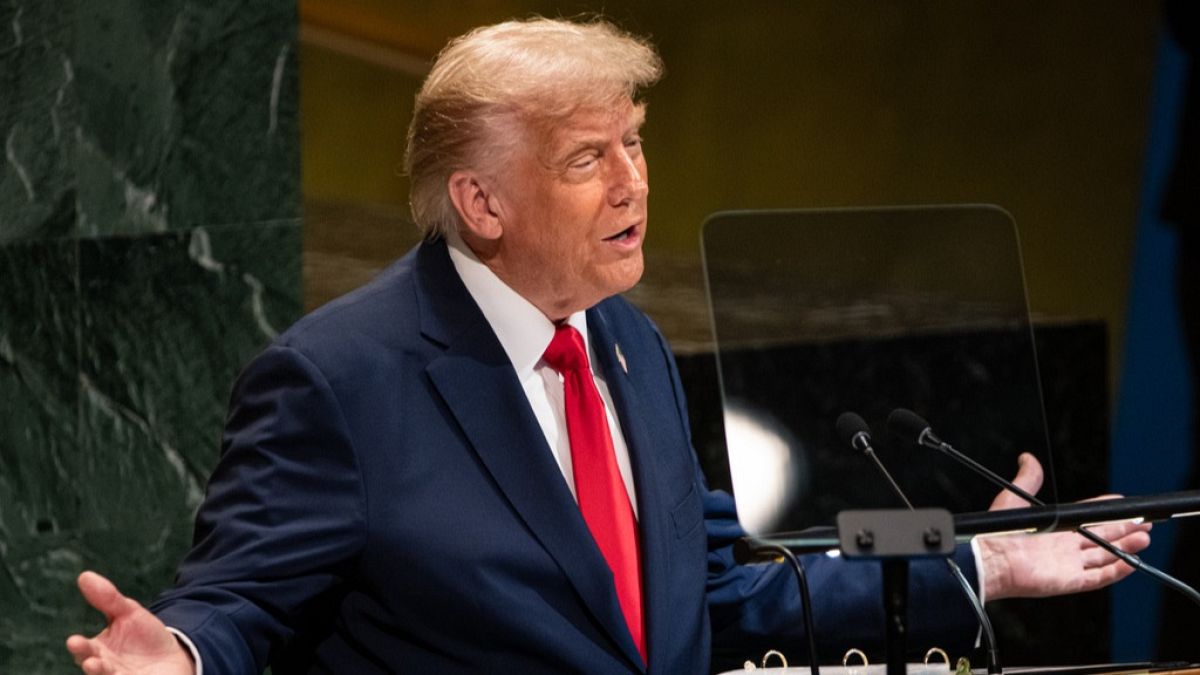
United States President Donald Trump made a string of misleading and false claims during his address to the United Nations General Assembly (UNGA) on 23 September 2025, including many aimed at the European Union and European countries in general.
To determine where the facts lie, Euroverify has taken a look at Trump’s assertions.
On European immigration
Addressing the UNGA, Trump attacked the whole continent of Europe for what he called “the unmitigated immigration disaster.”
“It’s time to end the failed experiment of open borders. You have to end it now. I can tell you, I’m really good at this stuff. Your countries are going to hell,” the president said.
According to Eurostat data, the share of non-EU citizens in all 27 member states totalled 6.4% of the overall EU population in 2024, while 9.9% of the population was born outside the bloc.
Compare that with the US, whose foreign-born or immigrant population stood at 15.8% of the total in January 2025.
Trump aimed at illegal migration in particular, but statistics show that this is actually decreasing in the EU.
Frontex, the bloc’s border agency, reported 239,000 irregular border crossings in 2024, down by 25% compared to the year before. The numbers continued to fall during the first seven months of 2025.
The EU is also implementing a common Pact on Migration and Asylum, designed to tighten its borders and asylum procedures.
It’s also disingenuous to paint legal migration in a wholly negative light when statistics repeatedly show that it can help destination countries drive development and innovation, fill gaps in the labour market, and address the challenges created by ageing populations, in addition to cultural and economic enrichment.
‘London wants to go to Sharia law’
In a similar vein to his attacks on immigration in Europe, Trump made the bold—and false—claim that the city of London wants to “go to sharia law.”
These comments from Trump build on long-standing conspiracy theories that allege that London’s first Muslim mayor, Sadiq Khan, wants to convert the city to Islamic fundamentalism.
Sharia means the correct “path” or “way” in Arabic, and is the legal system of Islam.
Sharia law is subject to interpretation, and Sharia councils do exist in the UK, ruling on issues such as marriage and divorce.
Sharia law has been deemed controversial as it can conflict with modern secular law. However, the decisions Sharia councils take are not legally binding under UK law.
Meanwhile, many Muslim-majority countries around the world incorporate Sharia law into their national legal systems.
London’s Mayor, Sadiq Khan, responded to Trump’s claims by stating, “people are wondering what it is about this Muslim mayor who leads a liberal, multi-cultural, progressive and successful city, that means I appear to be living rent-free inside Donald Trump’s head.”
Khan also said Trump had proven he was “racist, sexist, misogynistic and Islamophobic.”
False claims about Khan and his plans to promote—and prioritise—Islam in London repeatedly surface online.
For instance, a false story claiming that the London mayor planned to build 40,000 new homes designated solely to Muslims, to be near mosques and halal shops, gained traction across social media in September.
In reality, Khan did pledge to build 40,000 new council homes in an interview with Muslim broadcaster the Islam Channel, but he did not state that they would be for Muslims only.
Another fabricated quote was attributed to Khan in 2020, which stated that London was trialling Sharia law in three boroughs.
How many Ukrainian soldiers are killed per week?
Trump claimed that Russia and Ukraine are “killing anywhere from 5,000 to 7,000 young soldiers, mostly soldiers on both sides, every single week,” as Moscow’s war of aggression rages on.
Although Trump has repeatedly peddled the claim that 5,000 soldiers are killed per week, it is difficult to establish the exact number of soldiers who have been killed on both sides since the advent of the war. This is largely due to a lack of reliable data and sources for the data quoted by the US President.
According to experts, Trump’s 5,000 to 7,000 benchmark is higher than the actual number of soldier deaths, with multiple fact-checking outlets estimating the real number of Russian and Ukrainian military casualties to stand around 1,850 per week.
This figure is calculated based on Ukrainian military deaths, according to estimates that stated there had been 80,000 casualties by September 2024, as well as estimates of 250,000 Russian military deaths.
Although Euroverify was not able to independently verify how many Russian and Ukrainian soldiers have been killed since Russia launched its full-scale invasion of Ukraine in February 2022, we have collated the available data to build a picture of what we know.
According to the available data, more Russian soldiers than Ukrainians have been killed since Russia’s full-scale invasion of Ukraine.
In April 2025, the BBC’s Russian service and independent Russian outlet Mediazona identified the names of 100,000 dead Russian soldiers who had been killed since February 2022.
When BBC Russia and Mediazona incorporated unidentified killed soldiers into this tally, the number of dead Russian soldiers rose to between 158,000 and 229,000 between February 2022 and April 2025.
Meanwhile, in June, the Centre for Strategic and International Studies estimated that as many as 250,000 Russian soldiers had been killed in Ukraine.
As for Ukraine, President Volodymyr Zelenskyy stated that over 46,000 Ukrainian soldiers had been killed in action in February 2025, adding that 390,000 soldiers had been wounded in action since the advent of the war.
However, in September 2024, the Wall Street Journal estimated that around 80,000 soldiers had been killed since the start of the war, which has since been refuted by Zelenskyy.
Trump on climate change
The US president slammed efforts to combat global warming, particularly those in Europe, calling climate change “the greatest con job ever perpetrated on the world.”
“Europe loses more than 175,000 people to heat death every year because the costs are so expensive you can’t turn on an air conditioner,” Trump said. “What is that all about? That’s not Europe. That’s not the Europe that I love and know. All in the name of pretending to stop the global warming hoax.”
A recent study published in the medical journal Nature Medicine said that more than 62,700 people died in Europe from heat-related causes in 2024, and that more than 181,000 people died from complications related to the heat in the summer months between 2022 and 2024.
The mortality rate rose by 23% between June and September 2024 compared to the same period a year earlier, according to the study.
A recent report by the European Environment Agency (EEA) stated that Europe is warming faster than the global average, with the global mean temperature rise standing as high as 1.28°C, and Europe’s temperature rise reaching up to 2.26°C.
This creates a dilemma for European governments, which are urgently seeking ways to keep the populace cool without contributing to the global warming that is exacerbating heat-related deaths, such as through the excessive use of air conditioning.
As things stand, access to air conditioning in Europe is among the lowest in the world, according to the World Resources Institute. Only one in five (19%) households in Europe had air-conditioning units in 2022, which is far behind the likes of North America (76%), the Asia-Pacific (47%), and even well below the world average of 37%.
Europe historically needed little air conditioning due to mild climates and heat-retaining buildings, but rising temperatures have made summers increasingly unbearable, according to recent reports.
With Europe now warming twice as fast as the global average, the demand for air conditioning is a new and urgent reality.
It’s also been refuted time and time again by the scientific community that global warming is not a hoax, that it is caused by humanity and that it poses a significant risk to the world.