
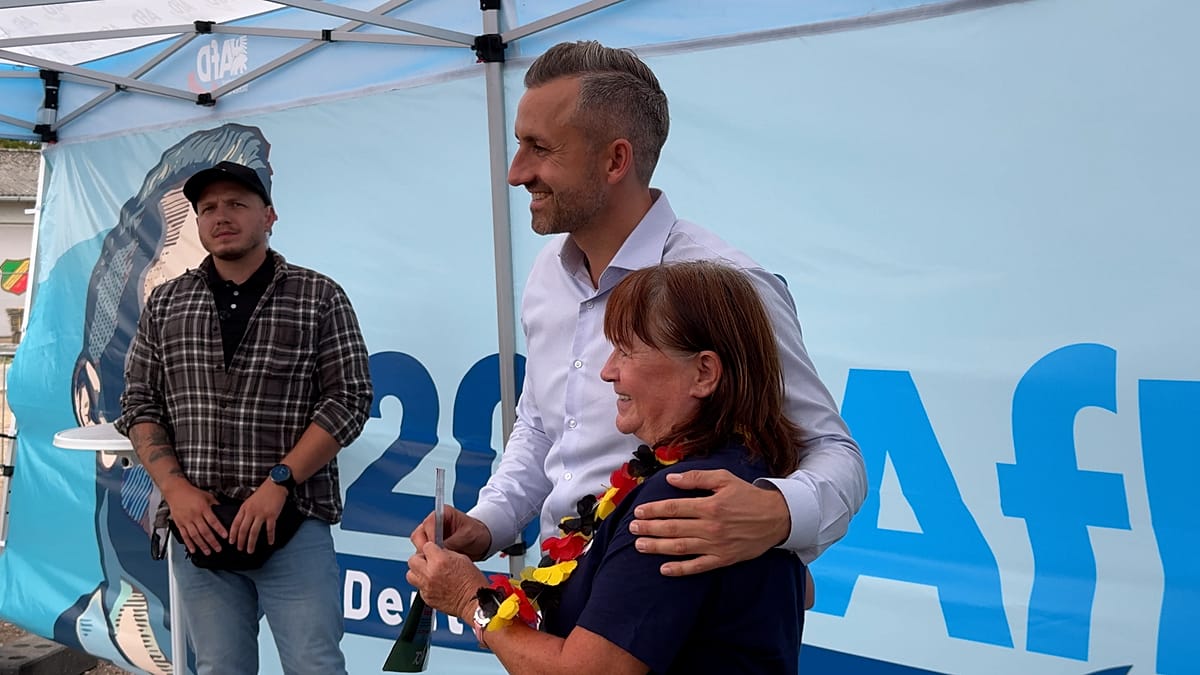
Supporters queue in lines stretching dozens of metres for a photo with him: AfD lead candidate Ulrich Siegmund. The 35-year-old is standing for the party in Sunday’s state election in Saxony-Anhalt.
ADVERTISEMENT

ADVERTISEMENT
The state’s Office for the Protection of the Constitution — a department of the Germany’s interior ministry — has classified the Saxony-Anhalt AfD as a confirmed far-right extremist organisation. Siegmund is the young rising star of the AfD in eastern Germany.
“I finally want to make policy for our own country again,” Siegmund tells Euronews. He wants to overhaul migration policy, freeing up money he says is “currently being handed out around the world, for people who are here illegally, who commit crimes here.” Policy, he says, should serve “our own interest, for our own country.”
Within his first 100 days in office, Siegmund plans to introduce a “work obligation for asylum seekers”, he says. Fire service driving licences and the display of flags at schools are also right at the top of his list. “Of course this is not turning the really big wheel, but these are the first concrete steps where you can see the first progress in all areas of this society.” What has been destroyed will take a few years to rebuild, the AfD politician goes on to say.
Here at the “family festival”, as the AfD calls it, near the Magdeburg city centre, thousands cheer and celebrate their “Ulli”. His likeness is emblazoned on countless T-shirts and placards. Time and again chants of “We are the people” cut through the crowd. Some AfD supporters also chant “We are the Wende”. In between, musicians take to the stage or techno beats blare from the speakers.
The party has rolled out the heavy artillery – its best-known politicians fire up the crowd, including Thuringian AfD politician Stephan Brandner and co-chair Tino Chrupalla. Whenever the speakers mention the CDU, SPD or other parties, the crowd boos and whistles. Some shout “Shame”.
Visitors are hoping for a 180-degree turnaround in state politics in Saxony-Anhalt, led by Siegmund. “I support the AfD and I love Ulrich. Once you’ve done all sorts of things, rape and stabbings, then you can’t live here, then you have to go and he makes sure of that. That’s already good,” Gerda tells Euronews. The pensioner has travelled specially from Berlin. She finally wanted to attend an AfD event in person. She has already watched several on YouTube. Gerda is actually called something else. She does not want to give her real name, like many at the event. The fear of possible consequences is too great.
Even a heavy downpour does not stop his fans from waiting for Siegmund’s appearance. For them, everything is at stake: for the first time, the AfD could govern at state level – as part of a coalition or possibly even on its own.
CDU politician: working with the AfD would spell the end of the Union
Current polls put the AfD at around 41 percent, according to Forschungsgruppe Wahlen on behalf of ZDF. The CDU trails far behind in second place with 23 percent, the Left party is third with 11.5 percent. In the last election in 2021, the AfD won 20.8 percent. Back then the CDU won by a clear margin (37.1%).
This time the AfD hopes to be able to win the election outright. But that might still not be enough for the state government. The party may get too few votes to govern alone. It rejects any coalition with the CDU. The CDU also rejects a coalition. It has adopted an incompatibility resolution.
Dennis Radtke, the head of the CDU’s workers’ wing (CDA), warns that his party would be doomed if it formed a coalition with the AfD in Saxony-Anhalt. “The moment we start working with this party, bringing it into positions of responsibility, the CDU is finished,” Radtke said on ZDF’s “Maybrit Illner” programme.
Only the BSW can imagine tolerating an AfD-led government, meaning supporting an AfD single-party government with its votes. But the BSW is currently on four percent in the polls and could thus fail to clear the five-percent threshold. The SPD and the Greens, too, have in recent weeks been shaky contenders hovering just below the threshold. They have now climbed to 8.5 percent and six percent respectively.
Lead Left party candidate optimistic
Given the current polling figures, Saxony-Anhalt may face a complicated coalition-building puzzle after the vote. A coalition of AfD and CDU appears to be ruled out. A CDU–Left party alliance as the basis for a majority government with the SPD and Greens also looks unrealistic for now, because the Union’s incompatibility resolution also applies to the Left party.
Just a few days ago, Chancellor Friedrich Merz (CDU) said: “Both with the AfD and with the Left party there are such fundamental differences with the Union that cooperation is out of the question,” Merz told the “Magdeburger Volksstimme” and the “Mitteldeutsche Zeitung”.
The mood in the state parliament has changed significantly in recent years, explains Eva von Angern, lead Left party politician, speaking to Euronews. She has been a member of the Saxony-Anhalt state parliament since 2002. “The climate is very hostile to women. Hate and incitement are what define a parliamentary sitting.” This has now also arrived in society and on social media.
Despite the current forecast, she is looking “optimistically” towards election day, the Left politician says. She is “firmly convinced” that the AfD will not manage to form a single-party AfD government in Saxony-Anhalt. “People have understood. They want to fight for diversity in Saxony-Anhalt.”