


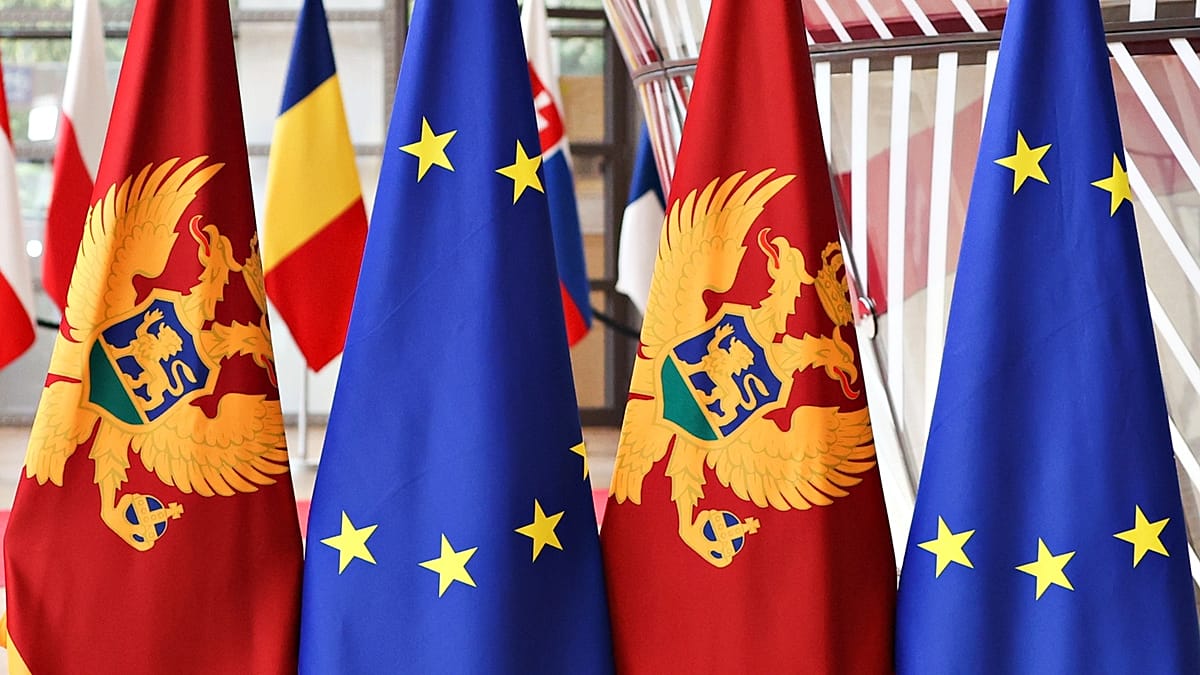
The European Union should be equipped with additional tools to respond more swiftly to new member states that violate fundamental rights and democratic principles, five countries have said as EU enlargement gains renewed urgency.
ADVERTISEMENT

ADVERTISEMENT
A joint proposal by Germany, France, the Netherlands, Belgium and Luxembourg, seen by Euronews, recommends that the accession treaties of the bloc’s future members be beefed up with various safeguard clauses to crack down on legal breaches and impose swift penalties, such as suspension of funds and voting rights.
Newcomers should also have their veto power restricted for an undefined period to prevent sudden blockages in high-priority decisions, the document says. Foreign policy is one of the areas where the EU requires unanimity at all times.
Enlargement, a diplomat said, “should not go to the detriment of our capacity to act”.
The initiative is largely a response to the EU’s bruising experience with Viktor Orbán. The former Hungarian prime minister, who was ousted in April after 16 uninterrupted years in office, repeatedly antagonised his peers with his back-to-back vetoes.
His reforms to weaken checks and balances led to numerous lawsuits and billions in frozen EU funds. Earlier this year, his controversial veto on a €90 billion loan for Ukraine prompted furious accusations of disloyalty and blackmail.
In fact, the paper proposes a brand-new safeguard dedicated to the principle of sincere cooperation, the same principle Orbán was accused of violating by backtracking on the agreement reached by leaders on the €90 billion package.
“Building on the lessons learned from past enlargement rounds, we need a fresh perspective on accession treaties. A copy-paste of previous accession treaties will not suffice,” the five countries say.
“All options should be on the table.”
Brussels is in the early stages of drafting the accession treaty of Montenegro, the frontrunner on the waiting list.
The document is deliberately timed to influence the ongoing discussions and ensure that the Montenegro treaty sets the blueprint for the remaining candidates, including Ukraine, Moldova, Albania, North Macedonia and Serbia.
While no candidate is explicitly singled out, some references in the paper — such as “enhanced” transitional periods for the Common Agricultural Policy (CAP) and cohesion policy — appear to reflect concerns in many capitals regarding Ukraine’s application.
Further transitions should be considered to mitigate “disturbances” that free movement of workers might cause in the labour market, living standards and housing, it says.
‘Non-regression’
But the central element in the three-page document is the rule of law.
In recent years, the EU has struggled to rein in democratic backsliding in several countries that joined the bloc in 2004, most notably Hungary, Poland and Slovakia.
The crisis has exposed the limited leverage Brussels retains once the accession process—already defined by exceptionally high admission standards—is completed.
The paper aims to create leverage in the years immediately after accession by codifying a “non-regression clause” as a “binding norm” for new member states. Should regression happen, the EU would be empowered to take “protective measures” beyond the tools it has today, namely the infringement procedure and the freezing of funds.
The “protective measures” are left open for capitals to spell out.
Additionally, the document proposes to simplify Article 7 of the EU treaties to deal with serious breaches of fundamental values.
Known as the “nuclear option”, Article 7 consists of two main procedural steps : activation by a 4/5th majority of member states and suspension of voting rights by unanimity (except the accused country). In past cases involving Hungary and Poland, the unanimity requirement for the second step has proven impossible to meet.
The document says the suspension of voting rights should be possible with just a 4/5th majority to enable faster action if a new member backslides.
Notably, the promoters behind the ideas – Germany, France, the Netherlands, Belgium and Luxembourg – are five of the six founding EU members. (Italy did not join.)
Two of them, France and the Netherlands, have been widely identified as “enlargement sceptics” in Brussels, even though they are both staunch allies of Ukraine.
The addition of safeguard clauses and transitional periods in future accession treaties can help assuage citizens wary of expanding the bloc, the coalition argues.
“We must seize this opportunity and design necessary improvements to ensure that enlargement will strengthen the EU and enhance the security of its neighbourhood,” the document says in the introduction.
“This will be key to uphold and increase political and public support for enlargement, which is, in turn, instrumental in view of the required ratification of accession treaties in all member states.”
The proposal comes amid an intensifying debate over how to adapt the decades-long accession process to the new geopolitical context and move it from a bureaucratic concept to a tangible perspective.