

Paris and Berlin have never agreed on how far the EU should go in building up its own defence industry versus keeping the market open to outside partners. Now, as Europe’s defence needs to grow more, that disagreement is coming to a head.
ADVERTISEMENT

ADVERTISEMENT
With Washington gradually pulling back from Europe, Russian pressure mounting on the eastern flank and China’s geopolitical ambitions growing, the EU has rarely faced a more urgent moment to build up its own defence capabilities. But France and Germany cannot agree on how to do it.
Ever since Donald Trump returned to the Oval Office in January 2025, Europe’s defence spending has surged, spurred by an administration that rarely misses a chance to accuse its allies of free-riding on American military power.
The fifth year of Russia’s war against Ukraine, combined with Washington’s announced troop withdrawal from Europe, has further fuelled concerns in EU capitals about the need to scale up defence readiness, both to support Kyiv and to boost deterrence.
But while there has never been more money on the table for European defence, there is still no shared vision at EU level on how that capability should be built: through purely domestic industry, or in partnership with allies.
“It’s really a disagreement within the pro-European camp on what the best strategy is to build a strong industry in Europe, and especially, as far as defence is concerned, to be independent from all the great powers of the world,” MEP Jean-Marc Germain (France/S&D) told Euronews.
Opposite visions
After Friedrich Merz became German Chancellor last year, there initially seemed to be growing alignment between Paris and Berlin on how to tackle their shared security challenges.
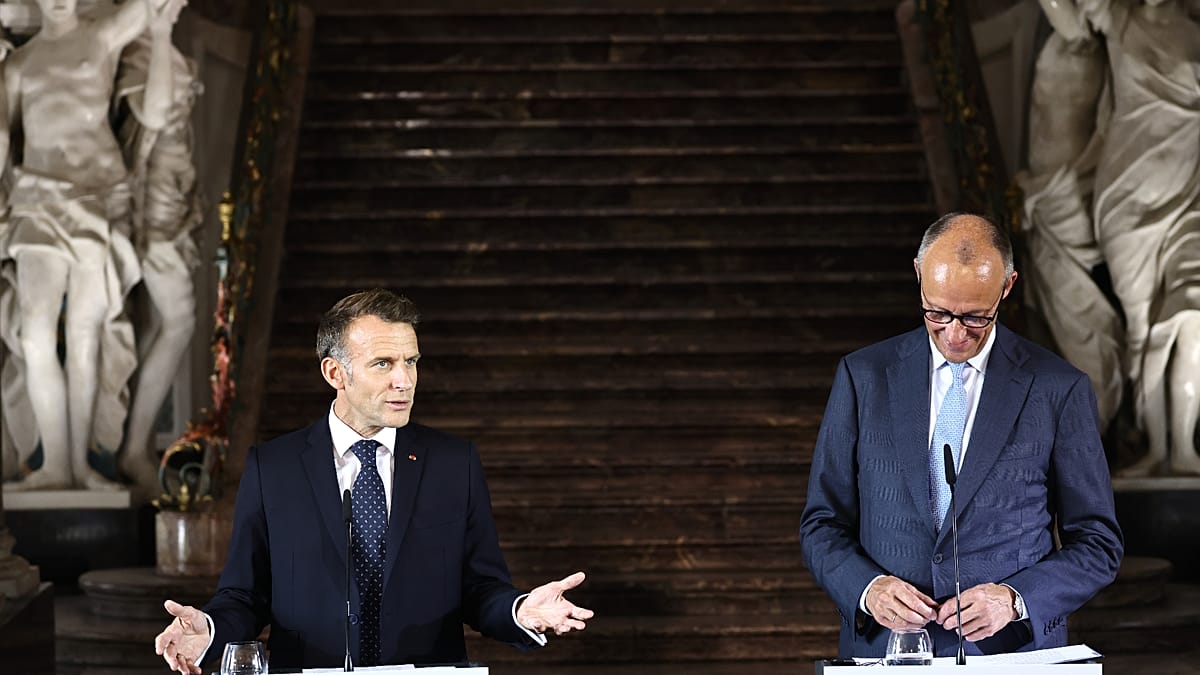
“We have decided to work together to ensure European preference in essential and critical industrial production sectors, including in our public procurement. Until recently, this was a European taboo,” President Emmanuel Macron said at a joint press conference in August 2025.
But despite that early commitment to a European preference in public procurement, with defence contracts as the primary testing ground, deep-rooted strategic divergences soon resurfaced.
Since the Second World War, Paris has championed the idea of strategic autonomy: that Europe should act as an independent power, distinct from both superpowers, building a sovereign nuclear arsenal and a matching military-industrial complex.
By contrast, post-war Germany has traditionally kept its economy open, treated its trade surplus as close to inviolable, and kept defence spending relatively low, relying on NATO for its security.
Since the start of the second Trump administration, however, Berlin has abandoned its historical fiscal frugality, exempting defence and security spending from its constitutional debt brake and setting a target of 3.5% of GDP for defence spending by 2029.
Yet Germany’s repositioning in the military sphere has not brought it closer to its closest European partner — instead, it has exposed a deep-rooted tension between the two countries’ mentalities.
“We work very closely with the American defence industry, and we intend to continue doing so. There are simply systems that we don’t yet have, or that we don’t currently have. But we urgently need them in the next five to ten years,” Germany’s Federal Defence Minister Boris Pistorius said at a press conference in July.
As the traditional driving force behind European integration, the EU rarely advances without France and Germany moving in tandem. Yet that partnership has seldom faced such visible strains as in the ongoing negotiations over the bloc’s next long-term budget.
European preference
The European Commission’s initial proposal earmarked €131bn for defence, security and space under the new European Competitiveness Fund, a fivefold increase on the previous budget period.
France wants that money to support a genuinely European defence-industrial base, while Germany wants to preserve its freedom to work with companies from NATO partners such as Norway, Canada and the UK.
Elements of European preference have already been written into EU defence policy. Under the Security Action for Europe (SAFE), the European Defence Industry Programme and the Ukraine Support Loan, at least 65% of procured defence products must be produced in Europe.
But these programmes also include exceptions for cases where European production cannot meet the required timing, volume or cost, exemptions France has been pushing to phase out, including for items such as ballistic interceptors and drone components.
Ultimately, the EU is trying to balance two objectives at once: meeting the immediate demands of boosting Europe’s deterrence and supporting Ukraine’s war effort, while ramping up domestic production to cut off strategic dependencies in the long run.
“France and Germany come from very different corners,” an EU diplomat told Euronews, adding that they “don’t always see eye to eye, but this tension is good because it helps to move the discussion forward.”
But while Brussels tries to reconcile short-term pragmatism with long-term strategy, the fallout in Franco-German relations is already being felt, undermining joint projects and fuelling national fragmentation across the EU.
Faltering collaboration
Earlier this year, Berlin announced a €10bn satellite-based communication system for its military, directly competing with the EU’s IRIS² secure connectivity network and prompting concerns about duplication.
In June, France and Germany formally abandoned plans to build a next-generation fighter jet under the Future Combat Air System (FCAS), a €100bn programme, after industrial disputes proved unsolvable.
The collapse of FCAS has also called into question Franco-German collaboration on tanks under the Main Ground Combat System (MGCS), with Berlin reportedly looking for more national autonomy and alternative options.
Meanwhile, the German government has been pushing Washington to allow the licensed production of advanced American weapons systems in Germany, in particular Patriot interceptors and Tomahawk cruise missiles.
For Paris, these are all signs that Berlin is pursuing a ‘Germany first’ approach: localising defence production at home with large-scale licensing deals with American companies; making massive national investments while pushing for cuts to the next EU budget.
Berlin, by contrast, considers France the outlier in this debate, isolated in pushing for very strict European preference rules that would advantage French companies, while most of the EU’s defence industry openly collaborates with NATO partners.
“It has to be taken seriously because it’s a real blockage,” MEP Germain said. “The positions are not only far apart, but they rely on completely different strategies for European competitiveness and defence.”