
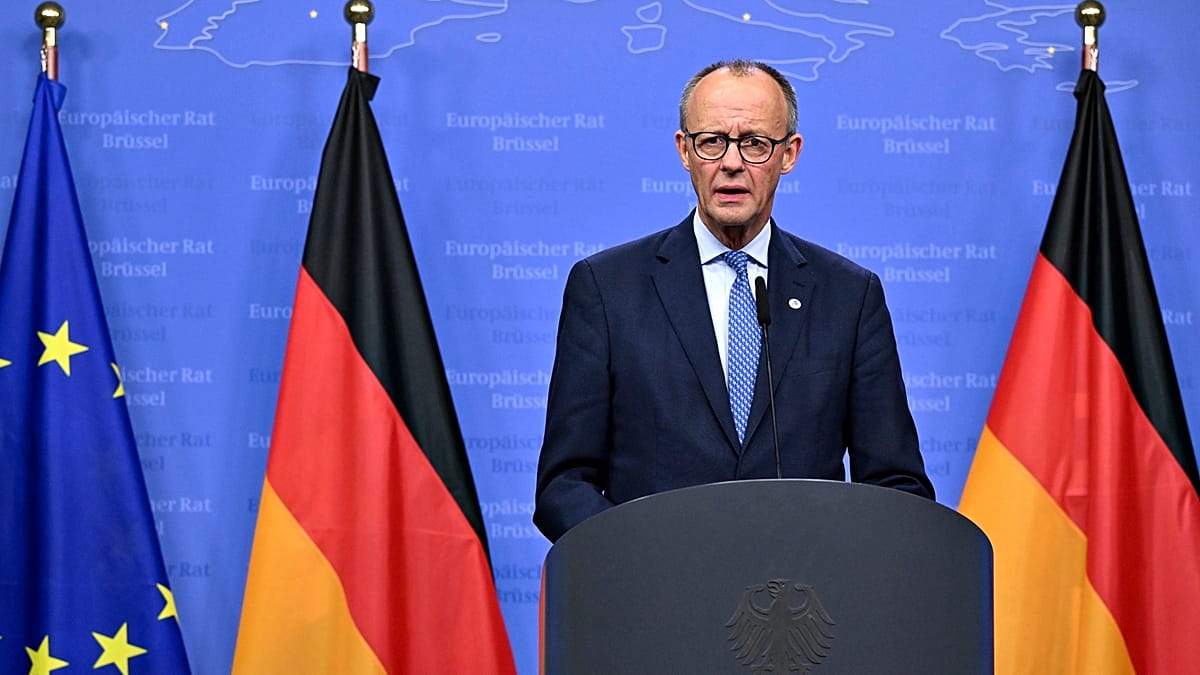
Friedrich Merz, the federal chancellor of Germany, will travel to Brussels on Friday to meet with Belgian Prime Minister Bart De Wever and European Commission President Ursula von der Leyen in a bid to unblock the reparations loan to Ukraine.
The three will gather on Friday evening for a private dinner at the Berlaymont building, a Commission spokesperson confirmed to Euronews.
A spokesperson for Merz also confirmed the trip, noting the last-minute change of plans had prompted the cancellation of his trip to Norway.
The sudden move represents Merz’s most forceful intervention to make the bold proposal a reality and highlights the exceptional stakes of the debate, with EU leaders set to meet in two weeks to make a final decision.
Under the unprecedented scheme, the Commission would channel the immobilised assets of the Russian Central Bank into a zero-interest line of credit for Ukraine.
Kyiv would be asked to repay the loan only after Moscow agreed to compensate for the damages caused by its war of aggression – a virtually unthinkable scenario.
The bulk of the assets, about €185 billion, are held at Euroclear, a central securities depository in Brussels. There are €25 billion in other locations across the bloc.
This has made Belgium the most formidable opposition to the initiative.
Last week, De Wever penned a scathing letter to von der Leyen, lambasting the reparations loan as “fundamentally wrong” and ridden with “multifold dangers” that could lead to multi-billion-euro losses for both Belgium and Euroclear.
“Why would we thus venture into uncharted legal and financial waters with all possible consequences, if this can be avoided?” De Wever wrote.
“I will never commit Belgium to sustain on its own the risks and exposures that would arise from the option of (a) reparations loan.”
De Wever also described the untested project as an obstacle to the White House’s ongoing push to strike a deal between Ukraine and Russia.
“Hastily moving forward on the proposed reparations loan scheme would have, as collateral damage, that we, as the EU, are effectively preventing reaching an eventual peace deal,” the Belgian premier wrote.
Political clash
De Wever’s view directly clashes with that of Merz, who has been one of the most vocal advocates in favour of tapping the immobilised Russian assets.
In an op-ed published on Wednesday, Merz insisted that all financial risks stemming from the reparations loan be “shared collectively”, with each member state handling an “equal share of the risk relative to its economic capacity”.
“We must first agree on this principle politically, and then implement it through legally binding provisions. It would be unacceptable for any single country to bear a disproportionate burden,” Merz said.
“I fully understand, in particular, the concerns of the Belgian government, given that the majority of the frozen assets are held there and that Brussels cannot rely solely on political assurances. These concerns must be addressed in the forthcoming discussions on the legal texts. Those discussions must begin immediately and conclude swiftly.”
Merz also pushed back against Russia and the United States for trying to use the immobilised assets for their own commercial benefit in the original 28-point peace plan, which has since then been considerably amended.
“If we are serious about this, we cannot leave it to non-European states to decide what happens to the financial resources of an aggressor state that have been lawfully frozen within the jurisdiction of our own rule-of-law and in our own currency,” he said.
His intervention happened as von der Leyen unveiled the legal texts necessary to establish the reparations loan and begin payments to Ukraine in the second quarter of 2026, when foreign assistance is scheduled to run dry.
Von der Leyen offered sweeping guarantees to protect both Belgium and Euroclear.
The guarantees consist of bilateral contributions by member states, a backstop by the EU budget, safeguards against legal retaliation and a new prohibition on transferring sovereign assets back to Russia, which would eliminate the threat of a veto.
“We have created a very strong solidarity mechanism where in the very end the Union can intervene, because we want to make very sure to all our member states, but specifically also to Belgium, that we will share the burden in a fair way, as it is the European way,” von der Leyen said.
Shortly after her presentation, the Belgian foreign minister lashed out at von der Leyen for failing to address his country’s concerns in a “satisfactory manner”.
“We keep on struggling to understand why that obstinacy against the legitimate concerns of a member state,” the minister said.
The clock is ticking fast for the bloc: EU leaders are meant to gather on 18 December for a make-or-break summit to decide how to meet Ukraine’s financial and military needs.
If the Belgian concerns persist and the reparations loan is discarded, the EU will have to resort to the financial markets and raise €90 billion in joint debt.