
The European Union’s member states are entering into a decisive phase in the finalisation of the EU-Mercosur trade deal – but whatever obstacles and setbacks they are able to navigate, there is another area of jeopardy.
Three crucial votes to be held in the European Parliament could derail, or significantly change the agreement with the trading bloc of South American countries. More than two decades in the making, the agreement was struck one year ago, but it requires the greenlight from both EU countries and EU lawmakers to enter into force.
The first parliamentary vote is set for the December plenary session. It concerns a bilateral safeguard clause for agricultural products that is slated to be added to the deal.
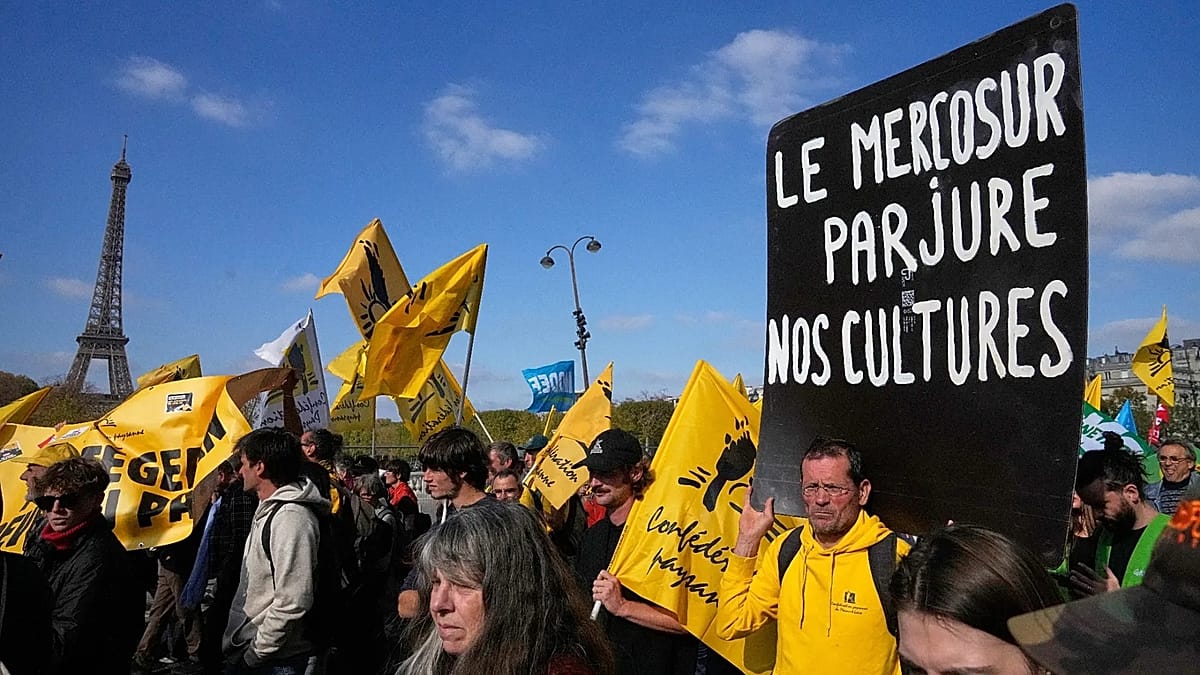
In October, the Commission proposed a number of safeguards to strengthen protections for EU farmers, who could be affected by cheaper South American products flowing into the European market. The proposed “reciprocity clause” would allow for the temporary withdrawal of tariff preferences granted to products coming from Mercosur countries to offset the worst of these effects.
According to a version of the clause approved by the Parliament’s committee on international trade (INTA), the safeguard should also include “the introduction of a reciprocity obligation regarding products and production standards”, which means that South American farmers exporting to the EU would have to respect the same obligations as European ones.
“Respecting reciprocity helps ensure that our farmers do not face environmental, sanitary, or animal-welfare dumping. Each time a product fails to meet our standards, we should trigger a market safeguard clause”, Belgian MEP Benoit Cassart, one of the proponents of the clause, told Euronews.
“This means that Mercosur countries must establish supply chains that comply with the standards in force in the EU, to gain access to our market”, he said.
Tensions with farmers
This request will be put to a vote, together with the entire safeguard package, on Tuesday 16 December in the Strasbourg Parliament.
If approved, the safeguards will have to be agreed with the EU member states: a special procedure could fast-track negotiations, allowing Ursula von der Leyen to fly to Brazil to sign the deal before the end of the year.
However, the measure is highly controversial. It would entail a significant change to the deal’s conditions, which the South American parties might yet dispute, and its practical workability is hotly disputed.
“It would not be possible under the WTO law, contrary to the safeguard (proposed by the Commission) and also technically unworkable,” a Parliament official told Euronews.
It is still possible that amendments from one or more of the Parliament’s political groups might call for the reciprocity clause to be removed, as the INTA committee’s decision to include it was passed by a margin of only one vote.
The European People’s Party, the Socialists and Democrats, and the majority of the Renew Europe group all voted against it in the committee, meaning half of the Parliament is against it.
According to another Parliament official, the vote is indeed going to be tight – but while the reciprocity clause might yet pass, lawmakers know it will not be accepted by the EU member states, which are represented by the Council. And in fact, that may be the very reason it passes.
“It is very complicated for MEPs who represent rural areas,” the official said, explaining that legislators realised that rejecting it “would be seen as a provocation by farmers”.
“They could become targets in their constituencies. So some will vote in favour, knowing it may be struck down later during the negotiation with the Council”.
The vote will be watched with great interest by EU ministers gathered in Brussels.
“If rules on the use of crop protection products and antibiotics are imposed on our producers, in order to protect the environment and labour rights, we cannot allow products that are completely at odds with these standards enter the market”, Italian Minister for Agriculture Francesco Lollobrigida said in Brussels on Friday.
Italy’s position on the deal, which has not yet been stated by the government, is crucial. Euronews understands that Belgium plans to abstain in the final vote, meaning Italy’s backing is needed to reach the qualified majority needed for approval.
Not the end of the road
Even if the deal is finally approved in time for von der Leyen and Costa’s planned trip across the Atlantic, the EU-Mercosur deal will hang in the balance for a while yet.
The text that the EU and Mercosur leaders will sign is in fact a “provisional agreement”, which will have to be ratified by the European Parliament. That process could be stalled by two more parliamentary votes, both of which will be held in the first months of 2026.
First, the Parliament will consider a challenge to the deal in the EU Court of Justice, following a request signed by 145 lawmakers from leftist political groups. They argue that the Commission violated rules by splitting the agreement into two parts, a move that was widely seen as a tactical manoeuvre to bypass the approval of the member states’ national parliaments.
“We will ask a legal opinion from the ECJ on the compatibility of the deal with the EU treaties,” Greens/EFA MEP Saskia Bricmont, one of the challenge’s proponents, told Euronews.
The vote will be held in February or March, according to Euronews sources, but Parliament’s largest groups are expected to vote against it.
The vote on the deal’s final ratification, however, will probably be much tighter. Last October, 269 MEPs rejected a paragraph praising the conclusion of the Mercosur agreement that was inserted into a non-legislative resolution; 259 voted in favour.
The majority of the lawmakers should be on board in order for the deal to be approved. But according to several Parliamentary sources, many MEPs could ultimately break ranks with their political groups and vote according to their national governments’ positions instead.