Without long-term solutions to secure fertiliser supplies, the European Union will see food scarcity, the European Commissioner for Agriculture and Food, Christophe Hansen, has told Euronews.
ADVERTISEMENT

ADVERTISEMENT
His comments come as the ongoing conflict in the Middle East has sent fertiliser prices soaring. In response, the European Commission — fearful that high fertiliser prices could reduce crop yields and lower food production — introduced the Fertiliser Action Plan, bringing support in the form of financial aid.
But Hansen says that beyond short-term relief, the EU must tackle structural weaknesses in its fertiliser supply chain.
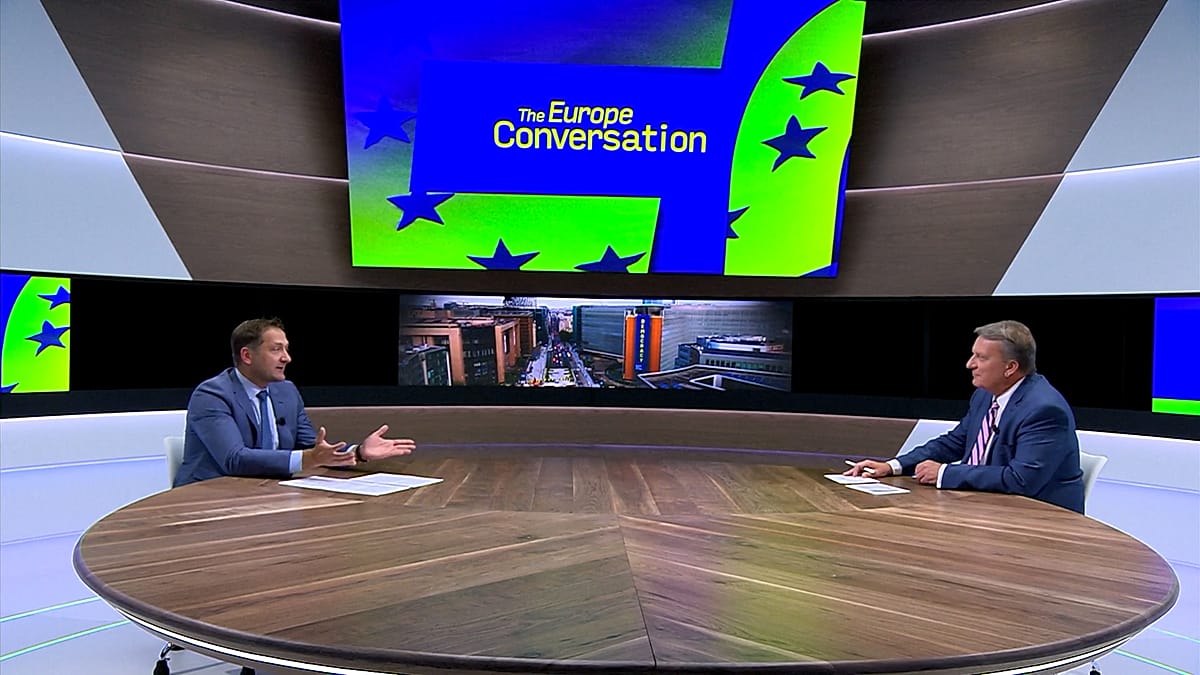
“We need to do our homework as well and address the issues to make fertilisers not only available but also affordable, because, otherwise, there will be food shortages in the European Union,” the Commissioner said on Euronews’ interview programme The Europe Conversation.
Many farmers across Europe are considering not producing crops, Hansen said, “because it has become too expensive and they cannot pass on the costs so easily, as they are competing.”
The fertiliser plan was presented in May and, while Hansen is set to reveal the exact amount of money being made available this Friday, he told Euronews that “more than half a billion euros will be proposed to budgetary authorities to help farmers immediately.”
Of this €500 million, €200 million is taken from the crisis reserve of the Common Agricultural Policy (CAP), the EU’s system of agricultural subsidies and programmes. This will be reinforced by €300 million in additional support.
He added that this is “money that can be topped up by the member states” by 200%, potentially bringing the budget up to €1.5 billion.
Hansen, whose brother and father are farmers, underlined that the latest geopolitical tensions are adding to an already severe fertiliser crisis that has been building for years, reinforcing the need for Europe to develop long-term resilience.
“The fertiliser crisis had already started well before the Middle East crisis,” Hansen said, noting that fertiliser prices rose by 60% between 2020 and 2024 as a result of the energy crisis caused by Russia’s full-scale invasion of Ukraine.
“We have now seen two consecutive [crises], and this will come back if we do not ensure a more stable and more reliable production cycle and availability.”
Home-grown solutions and reliable partnerships
Hansen explained that the current issue of fertiliser shortages and skyrocketing costs is driven by Europe’s dependence on imported energy and fertiliser supplies. Fertiliser production, especially nitrogen fertiliser, depends overwhelmingly on natural gas.
“The main ingredient in chemical fertilisers is energy, and Europe remains heavily dependent on energy imported from outside the European Union.”
Meanwhile, between 40% and 45% of fertilisers used by member states are imported from third countries, leaving farmers exposed to global market disruptions and geopolitical shocks.
This reliance on imports has consequences far beyond the agricultural sector.
“[Food] is something we need, you and me, two to three times a day. We need proper food in order to be in good shape and to be healthy. And that is something that should not be at the mercy of imports or unstable partners that eventually produce at only a slightly lower cost than we do.”
Hansen said that securing fertiliser supplies and ending the EU’s dependence on other countries will require stronger domestic production.
The Commission plans to promote greater use of organic fertilisers, improve nutrient recycling and encourage precision farming techniques to reduce dependence on imported materials.
“There is a lot to gain through efficiency and better nutrient use,” he said.
However, reliable international partnerships are also needed, as some raw materials used in fertiliser production are not available within Europe.
“This is not only a European problem; it is a global problem, which is why international partnerships are of utmost importance,” he said, pointing to Monday’s meeting with G7 agriculture ministers, which concentrated on soaring fertiliser costs.
He noted that these measures might carry costs in the first place, but argued that in the medium and long term, “this will be less expensive than being over-dependent.”
European vulnerability
His remarks come as policymakers across Europe assess the broader dependence on foreign imports and the bloc’s ongoing vulnerability to global supply chokepoints and price shocks, laid bare by the consequences of the Iran conflict.
“We see these dependencies in many other sectors, when it comes to semiconductors, when it comes to medical products and so on. That makes us vulnerable, something we really need to tackle in order not to be able to be blackmailed,” the Commissioner said.
“That is something that currently happens with food. There is food diplomacy, there is fertiliser diplomacy or warfare, call it what you want, but this is happening right now, and we need to step up.”