



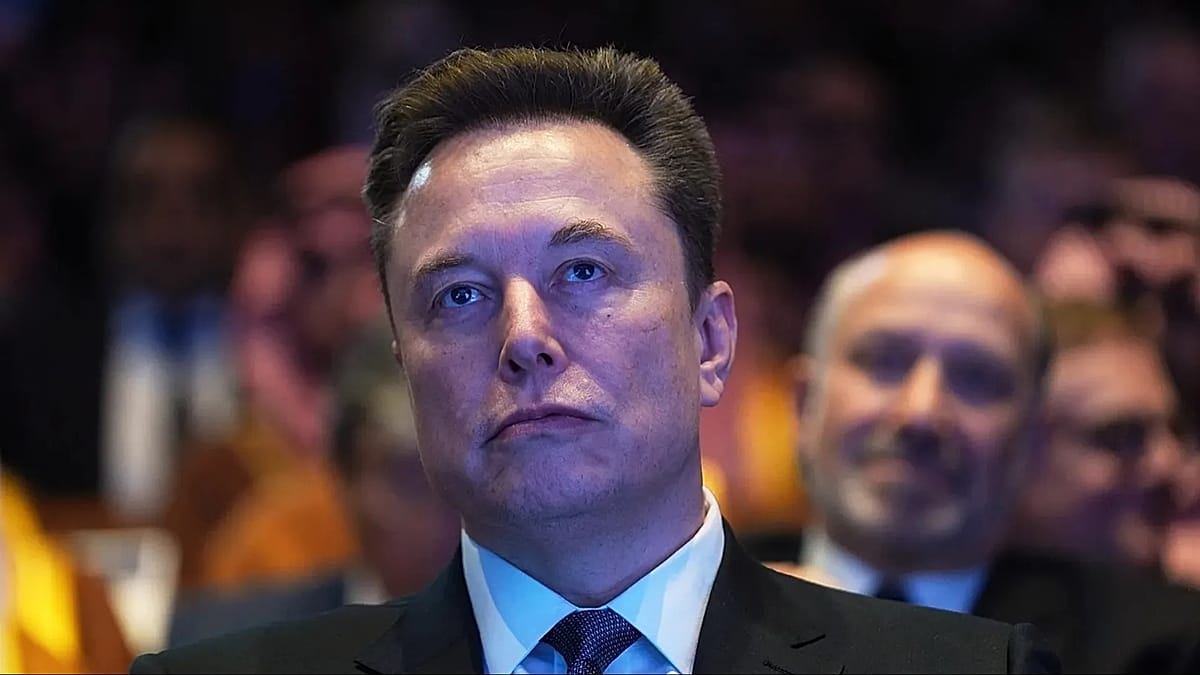
Tech billionaire and X owner Elon Musk launched a tirade of comments against the European Union last weekend, calling for it to be dismantled as well as comparing it to the “Fourth Reich”.
The background to his comments was a €120 million fine imposed on X by the European Commission on 5 December, for allegedly violating its transparency obligations under the EU’s Digital Services Act.
He was joined in his opposition by several top members of the Trump administration, including the president himself, who said Europe was “heading in a very bad direction”.
Many of Musk’s remarks about the EU are not new. He has in the past criticised the European Union for being “undemocratic”, reshared posts highlighting crimes committed by migrants in European member states and bolstered far-right parties in Europe that hold Eurosceptic views.
The Cube, Euronews’ fact-checking team, has looked into some of his recent posts.
Musk condemns Christmas market attack, but gets facts wrong
On 6 December, British far-right activist Tommy Robinson shared video footage of what he described as a car crash targeting Christmas market preparations in the French overseas territory of Guadeloupe.
According to Robinson, 10 people were killed in the incident, as he accused “legacy media” of staying silent. Under his post, speculation rapidly abounded, with X users commenting on the supposed Muslim identity of the driver, implying that the crash was part of an Islamist terror plot.
Musk, who has regularly used his platform to relay Islamophobic comments, previously claiming that Europe is being overrun with migrants, re-shared the post with the caption “again”.
However, Robinson’s claims are false: although a number of individuals, including children, were injured close to Christmas light preparations, there were no fatalities. As for the perpetrator of the attack, he was “under the influence of alcohol” and cannabis, according to local authorities.
On 8 December — two days after his initial post — Robinson clarified his statements, asserting “10 people were not killed, which means I reported incorrectly at the time”.
It’s not the first time Musk has reshared Robinson’s posts. In recent months, the two men have developed increasingly close and public ties, particularly over their often conspiratorial criticism of the UK government, with Robinson thanking Musk for funding his defence costs after he was cleared of terror-related charges in November.
Has X become Europe’s most popular news app overnight?
One claim posted and repeatedly reshared by Musk in the aftermath of the European Commission’s fine was that X saw a massive surge in downloads over the weekend and became the number one news app in Europe.
“X is seeing record-breaking downloads in many countries in Europe,” Musk claimed on Sunday before proclaiming shortly afterwards that X was “now number 1 in every EU country” over a report that X had become the number one news source in multiple European countries.
But it’s hard to tell from publicly available data whether X has seen a sudden surge in downloads. In some EU countries, X does appear in first place in the specific “news” category for iPhone downloads and top Android apps.
When looking at top overall download charts, X does not appear at the top in Germany, France, Poland, Spain and Italy. These countries show that X is not the most popular free app. In the majority of countries, it is not even listed as being in the top 10.
In Germany, for example, the X app is not listed in the top 12, although Musk’s AI assistant, Grok, is listed as number six. In Spain, X is similarly not listed highly, although Grok is number one.
Third-party websites showing ranking for Android devices on Google Play across Europe show that there hasn’t been a sudden surge in downloads for X.
Similarly to app downloads for Apple, X does not rank highly as Grok, and is not listed in the top 20 rankings, which are dominated by TikTok, WhatsApp, Instagram and ChatGPT.
The Cube has reached out to X for further information, but has not received a response in time for publication.
Musk has long pushed X forward as a trustworthy alternative for news, but research shows audiences in Europe have not necessarily followed.
The Reuters Institute’s 2025 Digital News Report found that although traditional news outlets are indeed losing influence with younger audiences, Europe is still more reliant on traditional news sources than the US.
When audiences are turning to social media, the report found that, globally and including European country charts, X is used less for news than Instagram, TikTok and YouTube.
‘Remigration’ has wide European public support
In his tweets, Musk repeatedly re-shared opinions stating that the concept of “remigration” has broad public support in Europe.
“A new poll from Denmark found that over 70% of people want to deport foreigners who have been convicted of a crime. This confirms that remigration isn’t “far-right”. It’s a completely normal opinion,” Musk reshared, alongside posts that claimed non-European migrants were supporting a genocide of ethnic Europeans.
Whilst The Cube could not locate the exact poll re-shared by Musk, deporting foreigners who have been convicted of a crime is a mainstream policy in Denmark that is supported by its current government.
Most European countries have laws that allow the deportation of foreigners, including those who are EU citizens, if they commit serious crimes. Austriaand Polandalready have legal provisions that allow the expulsion of foreigners who commit crimes, whilst Germany recently tightened laws allowing the expulsion of foreign criminals to countries previously considered “unsafe”, such as Syria and Afghanistan.
Nine European countries have also signed an open letter calling for the European Court of Human Rights to make it easier to deport migrants in Europe for criminal activities.
The deportation of foreigners who commit crimes is, however, decided selectively on a case-by-case basis and is not the same as “remigration” — a broadly defined concept associated with Europe’s far-right parties, particularly the Identitarian movement in Austria and France and later with Germany’s Alternative for Germany (AfD) party.
“Remigration” is generally understood as the aim to reverse a perceived demographic replacement by carrying out forced deportations of people with a migrant background, not only asylum seekers or refugees, but also migrants with long-term residence permits and those who have become naturalised citizens.
In its most radical form, it has been used to advocate for the removal of their descendants born and raised in Europe.
Surveys of European attitudes show that there is public discontent with how governments have managed immigration, as well as a general belief that there are too many migrants.
Support for returning migrants is, however, conditional and limited to removing failed asylum seekers or migrants who have committed crimes, for example. There is much less support for returning migrants who are legal or long-term residents who have not committed crimes, and The Cube could find no credible survey on European attitudes toward the large-scale deportation of all foreigners.
It’s also misleading to suggest that migration in Europe is anywhere close to replacing the so-called “ethnic population”. Eurostat data shows that the share of non-EU citizens in all 27 member states totalled just 6.4% of the overall EU population, whilst only 9.9% of Europe’s population was born outside the bloc.
The European Commission offered X an ‘illegal secret deal’
Musk reshared a post over the weekend repeating a claim he first made a year prior, relating to its €120 million penalty: that the European Commission offered X an “illegal secret deal last year. If X quietly censored speech without telling anyone, they would not fine X.”
Last year, former European Commissioner for Internal Market Thierry Breton responded to Musk that, “there has never been — and will never be — any ‘secret deal’. With anyone. The DSA provides X (and any large platform) with the possibility to offer commitments to settle a case.”
Under the EU’s Digital Services Act (DSA) online platforms can indeed offer voluntary “commitments” to fix alleged breaches, and the Commission can make those commitments binding, therefore closing the case.
In June, the Commission publicly announced it had accepted commitments from online retail service AliExpress after it raised a series of concerns over how the platform flagged illegal products, among others.
The settlement was formal and openly published, supporting Breton’s claim that such procedures are not “secret” or “illegal” deals.
“We did it in line with established regulatory procedures. Up to you to decide whether to offer commitments or not. That is how rule of law procedures work,” Breton said.