
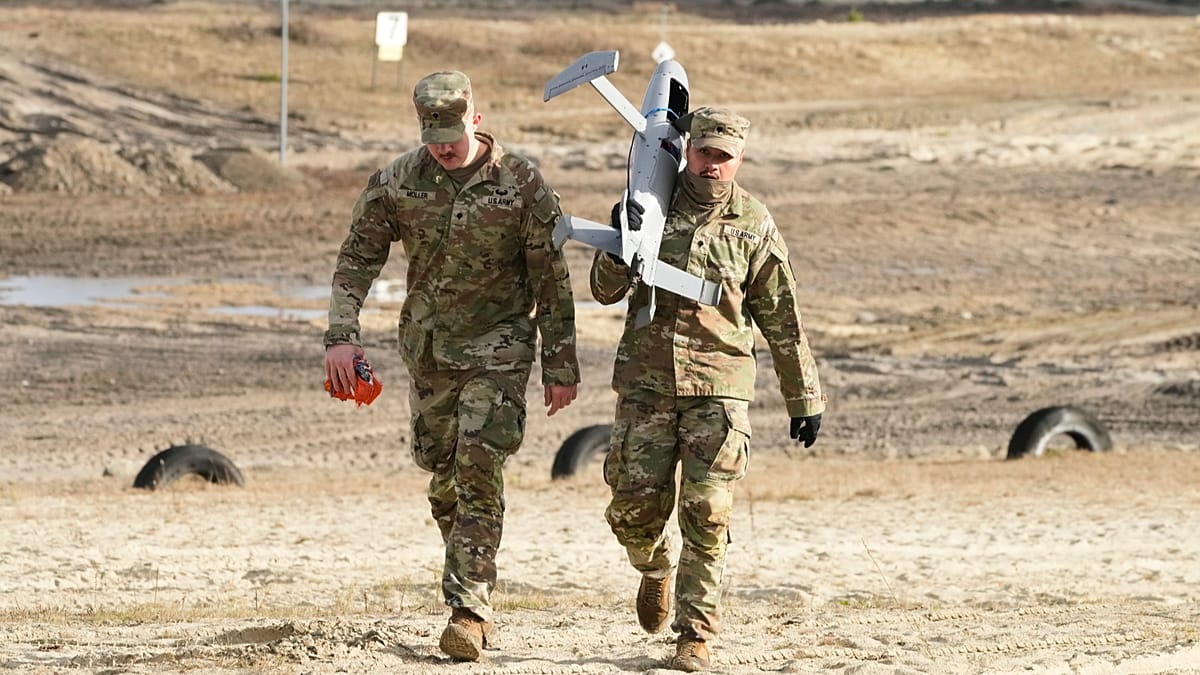
To find a more cost-effective solution and strengthen collaboration, NATO is turning to industry for ways to counter unmanned systems. Earlier this week, the second AIRCOM Industry Day took place at Germany’s Ramstein Air Base, bringing together representatives from European arms manufacturers and the military.
ADVERTISEMENT

ADVERTISEMENT
A drone crashing into a house in Romania, another violating Lithuanian airspace, and Munich Airport suspending operations for several hours following a suspected sighting: unmanned systems, and how to counter them, have become an increasingly acute threat for NATO.
If a drone is detected violating NATO airspace, the operation known as “Eastern Sentry” is triggered, which involves the deployment of several fighter jets to either track the drone or, if necessary, neutralise it. This, however, is deemed a costly intervention: drones are relatively cheap, with some being produced for less than €100,000. A single NATO fighter jet scramble against a drone can cost tens of thousands of euros per hour, though, with a typical two-jet interception costing more than €85,000 before any missiles are fired.
In his opening remarks, Lieutenant General Guillaume Thomas, Deputy Commander of the Allied Air Command, emphasised that drone warfare is confronting NATO with “collective challenges,” pointing out the masse that Russia is using in its war against Ukraine. For him, the solution is to stay ahead of three key curves: cost, production and innovation. Achieving that requires close cooperation between industry and the armed forces.
Working with Ukraine a ‘requirement’
According to senior policy fellow at the European Council on Foreign Relations, Dr. Ulrike Franke, one of the event’s keynote speakers, drones “have brought mass to the battlefield,” which forces the alliance to focus on mass and cost, not using expensive equipment to take down cheap drones and work with Ukrainians. The latter, she called a “requirement” in countering drone threats.
Senior Lieutenant Oleksandr Vorobiov, call sign “Zhan” and deputy chief of air defence of Ukraine’s 3rd Army Corps, said Ukraine’s biggest shortcoming is reliable radar detection. He explained that intermittent radar tracking has prevented the development of fully autonomous interceptor drones, as existing radar systems often lose track of small drones for several seconds.
“The one thing that really stopped us [in Ukraine] from making it fully autonomous. The radars we mostly use in Ukraine were not designed to detect this type of drone. They’re weather radars, jet radars, basically any type of radar except ones designed for these drones. That means the target sometimes disappears from the radar picture. If the drone still can’t see the target and the radar loses track of it for ten seconds, then the drone needs to be operated manually for that time. That’s the biggest gap: reliable detection of these kinds of targets. Maybe Europe has that capability, maybe the US has it, I don’t know,” he told Euronews.
Connecting military needs with industrial innovation
The aim of this year’s industry day “is about innovation in technologies overall,” Lieutenant Colonel Steffen Bott, the event’s project manager told Euronews. He emphasised that during these industry days, the military’s role “remains unchanged.”
“Neither we as the military nor NATO itself enter into contractual relationships with defence companies. However, one of the main drivers behind the current focus on counter-UAS is that the military has identified specific operational requirements. To carry out these operations effectively, it has become clear that technologies in the counter-UAS field are evolving extremely quickly. Start-ups, alongside established defence companies, are driving much of this innovation. At the same time, military requirements, particularly in light of the war in Ukraine, are evolving rapidly. Those requirements may not change completely, but they adapt much faster than the procurement and acquisition processes designed to meet them,” he explained.
Reflecting that focus on rapidly evolving counter-drone technologies, around 35 companies exhibited their latest systems at the event, including Matra BAe Dynamics Alenia (MBDA), Alta Ares, Hensoldt and Aselsan, to name a few. The systems and counter measures ranged from radars to interceptor drones and missiles, such as MBDA’s specialised counter-drone missile. A representative told Euronews that the missile was developed to counter mass drone attacks, “such as those we have seen in Ukraine and the Middle East, typically involving Shahed or Geran drones, in a cost-efficient and effective way.”
The missile is being integrated into Rheinmetall’s Skyranger 30 air defence system, the first of which are earmarked for Germany’s brigade in Lithuania, with deliveries expected between 2027 and 2028. Each Skyranger 30 carries nine missiles, allowing a six-vehicle battery to field 54 ready-to-fire interceptors. Smaller Class 1 drones, such as quadcopters, are engaged by the system’s 30 mm cannon, while the “Defend Air-missile is intended for larger threats, including Shahed-type drones, the company representative said.
Learnings from Russia’s full-scale invasion of Ukraine
Walking through the exhibition tent, one thing quickly stood out: the absence of Ukrainian companies. The event was reserved for firms from NATO member countries, Euronews has been told. Still, Ukraine was an ever present topic for both the alliance and the companies, with many of them highlighting the collaboration with Ukraine.
Turkey’s defence giant Aselsan told Euronews that the key learning from Russia’s war against Ukraine is reliability. “The system has to be reliable. When the target comes towards you, you have just a few seconds to decide and act. The system should use artificial intelligence to shorten the decision-making time,” he said.
A representative from the French defence company Alta Ares that develops AI-powered software and systems for intelligence, surveillance and reconnaissance (ISR) and counter-drone (counter-UAS) operations, told Euronews, that they “don’t really see Ukraine as a lab”. The French company has presented two different types of interceptors on NATO Aircom’s industry day: the x-block, designed for short and mid-range interception, so with a maximum range of 15 kilometers and one is for longer range, which can go up to 40 kilometers from launching site.
“Our two co-founders were in Ukraine at the beginning of the war. And they worked closely with Ukrainian units in order to understand the needs, to understand clearly how the battlefield is evolving. They wanted to give them solutions adapted to their needs, so they worked on AI solutions in order to be integrated on the drones,” the representative explained.
With more than 30 competitors exhibiting their products, competition is never far away. “If you adpot the Ukrainian way of thinking, we are only partners because we potentially need solutions like this in Europe,” he told Euronews. “There’s not enough on offer. There will be too much demand,” he added, pointing out that Alta Ares has recently signed an Memorandum of Understanding (MOU) with the German drone company Quantum Systems.
Senior Lieutenant Oleksandr Vorobiov agreed saying it’s “good they are there,” as without, there’s a lack of knowledge about the modern battlefield. Vorobiov added that he can’t say if these efforts are enough, but the mindset, that European companies go to Ukraine and are present on the battlefield is good, albeit a little late.