


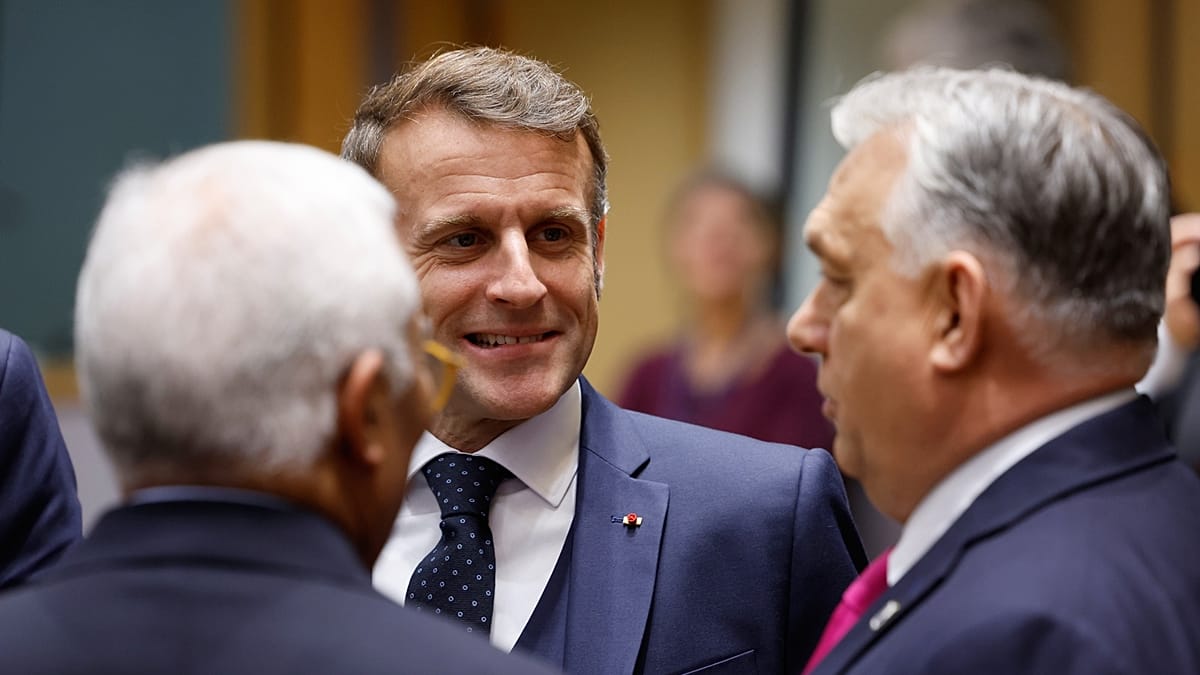
The 27 leaders of the European Union are heading into a stormy summit on Thursday, with Hungary’s veto of a €90 billion loan for Ukraine, the widening war in the Middle East and persistently high energy prices set to dominate the talks.
ADVERTISEMENT

ADVERTISEMENT
The single market, trade, defence, security, migration and the state of the multilateral system will also be on the table, along with a brief – almost blink-and-you-miss-it – discussion on the next seven-year budget.
From the moment leaders arrive, all eyes will be on Hungarian Prime Minister Viktor Orbán, whose decision to block the support loan for Ukraine at the very last stage of the legislative process has caused widespread outrage and anger.
Back in December, when heads of state and government stayed overnight in Brussels to agree on the €90 billion scheme, Orbán secured a complete opt-out from the joint borrowing. Slovakia and the Czech Republic also benefited from the exemption.
The assumption was that, by removing the three dissenting countries from the equation, the remaining 24 member states would go ahead with the much-needed assistance.
But in an unprecedented twist, Orbán vetoed the loan in mid-February in response to the interruption of oil deliveries through the Druzhba pipeline, which he claims is being deliberately shut by Ukrainian President Volodymyr Zelenskyy for “political reasons”.
That Orbán is in the final stretch of a bruising re-election campaign – portraying Kyiv and Brussels as colluding to support opposition leader Péter Magyar – has not gone unnoticed in other capitals, further fuelling the exasperation.
“It’s absolutely unacceptable that a deal agreed by leaders in December is taken hostage with unrelated conditions and that sets a dangerous precedent,” said a senior diplomat, who called the last-minute veto a “turning point” in Orbán’s behaviour.
A breakthrough emerged on Tuesday after Zelenskyy agreed to accept the European Commission’s proposal for an external inspection of the section of the Druzhba pipeline that was damaged in late January by a Russian drone attack.
Still, hopes for a resolution before the Hungarian elections on 12 April are overall low. Zelenskyy, who is scheduled to address the summit through video conference, estimates the complete resumption of oil deliveries could take one and a half months.
“Hungary’s position remains unchanged,” Orbán said after Kyiv confirmed it had agreed to the external inspection. “If there is no oil, there is no money.”
Trump’s call for help
Another major point on Thursday’s agenda will be the widening war in the Middle East and the far-reaching consequences it has triggered worldwide.
Europeans were caught off guard when US President Donald Trump last week asked for their help to reopen the Strait of Hormuz, a vital passage for energy exports that Iran has closed off. Global oil prices remain over $100 per barrel as a result.
The idea of joining a military confrontation launched without European input or United Nations consent was widely rebuffed.
“We are not party to the conflict, and therefore France will never take part in operations to open or liberate the Strait of Hormuz in the current context,” said French President Emmanuel Macron, noting his country would only “assume responsibility for the escort system” once hostilities come to a definitive end.
Feeling snubbed, Trump hit back at allies, saying that the US did not “need or desire” anybody’s help. He also raised the prospect of pulling his country out of NATO without congressional approval – something that he would, in fact, need.
“I think NATO is making a very foolish mistake,” Trump said. “Everyone agrees with us, but they don’t want to help. And we, you know, we as the United States have to remember that because we think it’s pretty shocking.”
EU leaders will on Thursday examine possible solutions to restore freedom of navigation in the Strait of Hormuz, but from a strictly diplomatic perspective. UN Secretary General António Guterres will join the debate in the afternoon.
The prospect of expanding Aspides, an EU military mission that protects ships from attacks in the Red Sea, has already been ruled out. The mission is based on a UN Resolution that speaks about Houthi rebels, not the Iranian regime.
Moreover, the geography of the Strait of Hormuz, a narrow bottleneck in shallow waters, represents a more formidable challenge than the Red Sea, a long, vertical corridor.
Both Trump and his war on Iran are deeply unpopular among European citizens, which makes their governments even more reluctant to commit military assets.
“It’s important to return to diplomacy and the UN Charter,” said a senior EU official.
The ETS backlash
Before the Middle East was plunged into the unknown, EU leaders had intended to make Thursday’s summit into an all-hands-deck, now-or-never session on competitiveness, following up on their informal retreat in February.
Heads of state and government have grown increasingly alarmed about the economic gap between the bloc and its two main competitors, the US and China, which enjoy healthier GDP growth rates and drive the race for cutting-edge technologies.
The 27 leaders agree that energy prices, which have remained stubbornly high since the 2022 disruption, are a major problem but disagree on how to tackle them.
At the core of their ideological dispute is the Emissions Trading System (ETS), which puts a price on carbon emissions from polluting industries.
One camp, which includes Austria, Bulgaria, Croatia, the Czech Republic, Greece, Hungary, Italy, Poland, Romania and Slovakia, argues the ETS is a burden on the economy that unfairly taxes companies and prevents them from lowering electricity bills.
The other camp, with Belgium, Denmark, Finland, Luxembourg, Portugal, Slovenia, Spain, Sweden and the Netherlands, argues the ETS is an indispensable tool to curb CO2 emissions and encourage heavy industries to adopt greener energy sources.
While in February the wind blew in favour of the ETS opponents, it has now shifted in favour of the ETS defenders. In a five-page letter to leaders ahead of the summit, Ursula von der Leyen threw her weight fully behind the long-standing mechanism, while promising to address excessive volatility in the carbon market.
“The ETS is market-based, technology-neutral, and provides long-term investment certainty while rewarding first movers. Based on the ETS system, companies across Europe have made investment decisions for the coming decades,” she wrote.
“We must now ensure that it is also adapted to new realities.”
As an immediate solution to offset high energy bills, Brussels recommends governments either lower taxes or roll out subsidies, both of which affect revenues.
The long-term recipe, however, is far less clear, as leaders remain fiercely divided on the need for structural reforms. Electricity prices vary widely from one member state to another, making it even more difficult to find common ground.


