Published on
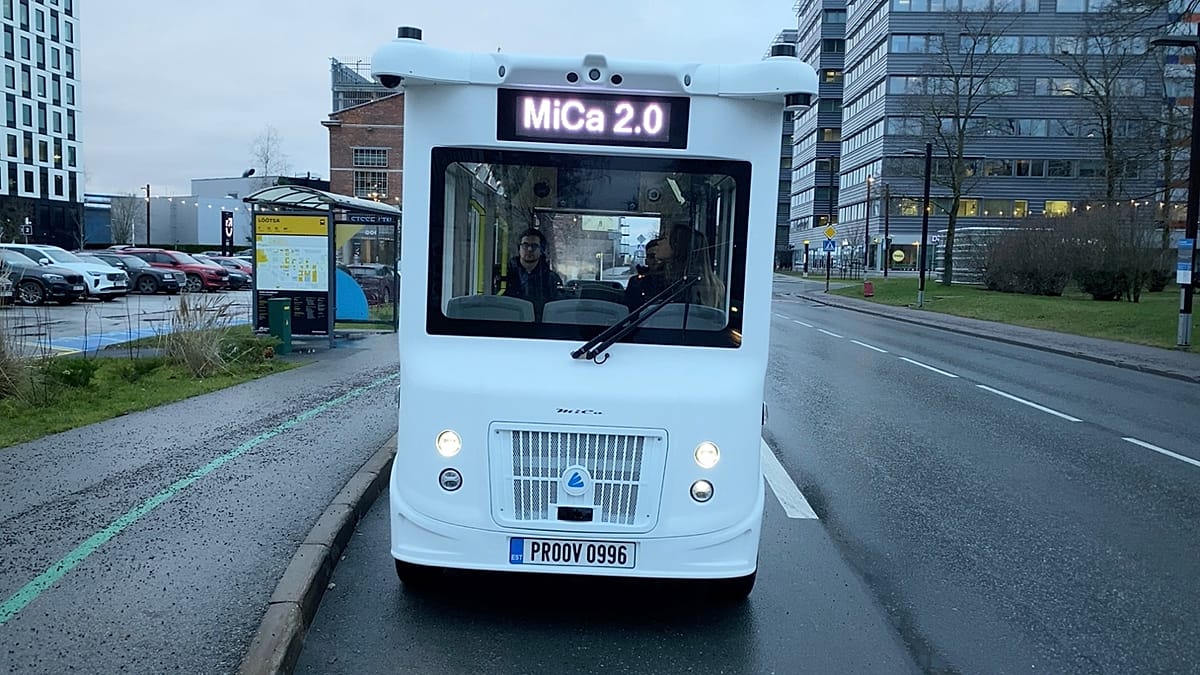
MiCa can seat 8 people and reach up to 25 km/h. It’s been designed to operate autonomously for up to 20 hours per day.
“When the vehicle understands what’s around it, then it’s able to see where the road is, where objects are possibly moving, where the pedestrian crossing is, where the intersection is, and based on that and the next bus stop it’s going to, it’s able to plan a path for its route,” explains Kristjan Vilipõld, Product Manager, at AuVe Tech OÜ.
The company behind the prototypes was founded in 2018 in cooperation with Tallinn University of Technology. Its self-driving vehicles have so far operated in 17 countries, including several in Europe as well as in Japan, the US, Israel, Saudi Arabia and the UAE, both in demo activities and in closed testing urban circuits.
The company, co-funded by the EU, claims it offers a full-scope service that involves autonomous vehicles, their integration into various environments and fleet management. Managers here describe their product as “the world’s most compact and flexible autonomous shuttle, able to suit existing infrastructure.”
“Not only in Europe but globally, there are too many cars in traffic, and we need to find ways to get more people to use public transportation,” says Taavi Rõivas, Chairman of the Supervisory Board at AuVe Tech OÜ. “In this we see that the biggest bottleneck is not necessarily the quality or price of public transportation, but the fact that public transportation doesn’t take you to your doorstep. We provide this last mile.”
MiCa has just been significantly upgraded. Based on machine learning and real-life data analysis, its new capabilities include AI-based dynamic reaction to objects, overtaking vehicle detection or side detection.
The vehicles are fully manufactured in Estonia, one of Europe’s digital hubs. One shuttle can be completed in one week. Managers say their decision not to outsource the production aims to ensure quality, control all the processes and manage manufacturing risks.
“Half of the vehicle is electronics, sensorics and computers. The main challenge is to incorporate the mechanical, electronic and also the software sides,” says Kristian Pints, Production manager at AuVe Tech OÜ.
Investment in Research and Development is paramount as both technology and social expectations are constantly evolving, managers say. Thriving in other markets, the self-driving sector faces huge challenges right now in Europe, they conclude.