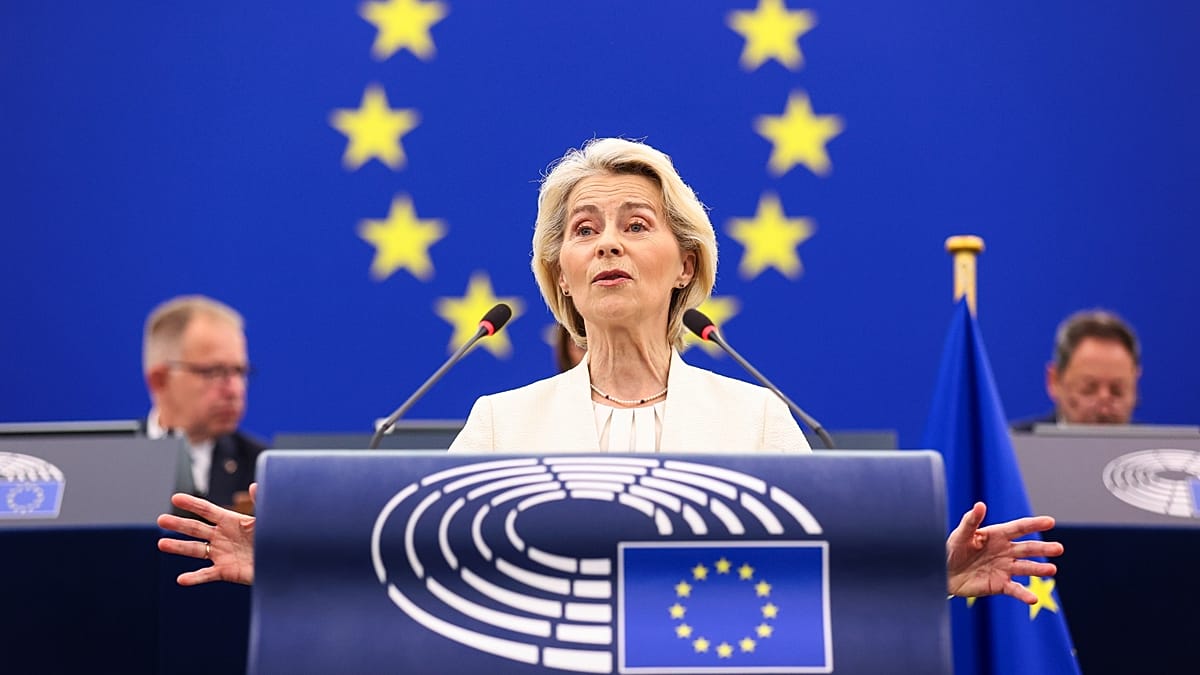
“It was the best of times, it was the worst of times.”
ADVERTISEMENT

ADVERTISEMENT
With this iconic Charles Dickens quote, Ursula von der Leyen began her one-hour-long State of the Union speech in Strasbourg, laying out solutions to cope with the “exceptional” challenges and the “incredible” change that Europe is undergoing.
“In this world, Europe has chosen to forge its own path. And a stronger, independent Europe is now emerging,” she told lawmakers.
“Europe is there for Europeans. And that in the cold fragility of today’s world, only Europe can provide true sovereignty to Europeans.”
Here are the five takeaways from the address.
‘Associate membership’ for Canada
This was the day’s jaw-dropping moment.
The European Commission president offered to create a tailor-made status of “associate membership” to bring Canada ever closer to the bloc.
“We share one ocean, one set of values, one way of seeing the world. And we will now build our shared future as well,” she told Canadian Prime Minister Mark Carney, who flew from Ottawa to Strasbourg to attend the speech as guest of honour.
She hailed the dawn of an “alliance for the future” to deepen EU-Canada cooperation in areas such as economic security, intelligent manufacturing, cutting-edge technology, defence, energy, critical minerals and batteries, as well as the Arctic region.
However, details of what “associate membership” would mean in practice were left unsaid. It remains unclear how it would fit in the current structures of the EU treaties. A previous attempt by the German chancellor to grant “associate membership” to Ukraine swiftly disappeared after backlash from capitals.
Von der Leyen simply said the newfound status would bring EU-Canada relations “to the highest level possible”, prompting loud applause inside the hemicycle.
Ahead of the speech, a poll conducted by Abacus Data showed that 49% of Canadians supported EU membership, while 30% opposed it and 21% were unsure.
These are exceptional numbers for a country that lies on the other side of the Atlantic Ocean and reflect the political damage inflicted by US President Donald Trump’s punitive tariffs and repeated attempts to annex Canada.
Reeling from ‘the summer of truth’
Climate action made a comeback for self-evident reasons.
Von der Leyen framed the summer of 2026 as the “summer of truth”, pointing to wildfires, retreating glaciers, water shortages, crop losses and extreme heat that have wreaked havoc across the continent. She cited 660,000 hectares burned, 12 million tonnes of crops lost and more than 35,000 additional deaths during heatwaves.
“Science is clear. Europe is warming at double the global rate. Of course, the transition is complex. And we will need to adjust and learn along the way,” she said.
The immediate response will be a European Heatwave Plan, which von der Leyen said will address early-warning systems, health preparedness, urban adaptation, cooling and protection for vulnerable groups.
Her Commission is set to present a new climate resilience framework next month, already expected, that will identify 100 of the bloc’s most vulnerable territories, assess their risks and determine the appropriate level of responsibility for managing them.
Insurance was another major vulnerability flagged by von der Leyen.
Only around 25% of catastrophe losses in Europe are currently covered by private insurance, she said, leaving governments to act as the insurer of last resort. Her services will put forward a Climate Insurance Alliance to close that glaring gap.
She also promised a European Water initiative to fix costly leaks and a European firefighting fleet to respond to wildfires.
Flexing the security muscles
As expected, defence featured high in the speech, which came amid a string of hybrid attacks, some of which were attributed to Russia, that have rattled Europe.
“We should be under no illusions about what is happening here: hybrid threats facing Europe are less and less hybrid and less and less threats,” von der Leyen said.
“Cyberattacks and sabotage, arson and drone incursions. They are ramping up every day. So, as the threat level climbs, so must Europe’s preparedness.”
She then proposed a brand-new mechanism fashioned on NATO’s Article 4 that member states would trigger in the event of a hybrid attack. This would launch political consultations to “coordinate” an EU response and “deter further escalation”.
Article 4 in the NATO context means that any country of the 32-strong alliance can call for an urgent meeting to discuss a new threat. It is the precursor to collective defence under Article 5, which stipulates that an attack on one is an attack on all.
Von der Leyen also pitched creating a “European Security Council” to bring together the leaders of Ukraine, the UK, Norway, Canada and other democratic partners.
“This is even more urgent now, given the nature and scale of the risks at play,” she said.
How this Council will go from idea to reality is anyone’s guess at the moment.
There are also manifold supranational groups tasked with ensuring global security that overlap with the European continent, such as NATO, the OSCE and the Coalition of the Willing, so the risk of duplication and overlap is more than considerable.
Digital safety comes first
Technology was top of von der Leyen’s mind.
Speaking about online child safety, she announcedthe EU Kids Act to ban social media access for users under 13 and restrict it for those under 15, completing the personal project that she had launched in last year’s speech.
“We do not have to accept addictive features. We do not have to accept children being drawn into ever more extreme content. We do not have to accept that girls have their photos used for AI-generated sexualised images,” she told lawmakers.
The Commission chief announced the reversal of the burden of proof, meaning it will now be on tech platforms to demonstrate that they have actually made their services safe. The draft law will also force tech companies to make their online services safe by default.
Artificial Intelligence had its own section in the speech, which was delivered a few days after several tech CEOs urged a slowdown in the rapidly evolving technology.
Von der Leyen acknowledged both the benefits and the risks of the AI revolution and stressed the need to monitor the development of the most advanced models and ensure “guardrails” are in place.
“The dangers of self-improving models are becoming ever more apparent,” she said, referring to the Hugging Face incident that shook the tech world.
In this regard, the Commission will organise a discussion with leading AI labs on how public authorities can support industry efforts to “pace the frontier” of this disruptive technology. The exercise will include like-minded partners, like the UK and Canada.
“We want to team up on model evaluation, verification, early-warning, AI security and much more,” she added.
Lessons learned from Ceuta
The memories of the Ceuta border crisis, which shocked Europe, were still vivid as von der Leyen took the stage in Strasbourg.
And she knew it, so she made sure to send a message of support to the Spanish exclave following the mass entry of 82,000 irregular migrants from Morocco in late July. While the vast majority were promptly deported, a few remain in the territory.
“Ceuta’s border is a European border. Because Ceuta is Spain. Ceuta is Europe. And Europe will be there for you,” von der Leyen said.
The Commission chief said irregular migration required “solidarity” from all 27 member states and urged them to “fully” implement the Migration Pact, the multi-law reform approved in the previous mandate that several governments have contested.
But more is needed, she said, as Ceuta demonstrated.
Von der Leyen proposed to introduce an emergency framework to respond to mass influxes of people at the border, especially when these movements are “engineered and weaponised”. (The Spanish government has refused to blame Morocco, despite multiple reports indicating the country was directly or indirectly involved in the crossings.)
The emergency framework “will only be triggered under a strictly defined set of criteria” and “allow for time-limited and strictly defined flexibility in standard procedures,” she explained. This could pave the way for the suspension of the right to asylum, a controversial measure that some capitals have endorsed.
“The message from Europe is clear: we will always comply with our values and fundamental rights, she said. “But we will never compromise on protecting our borders.”