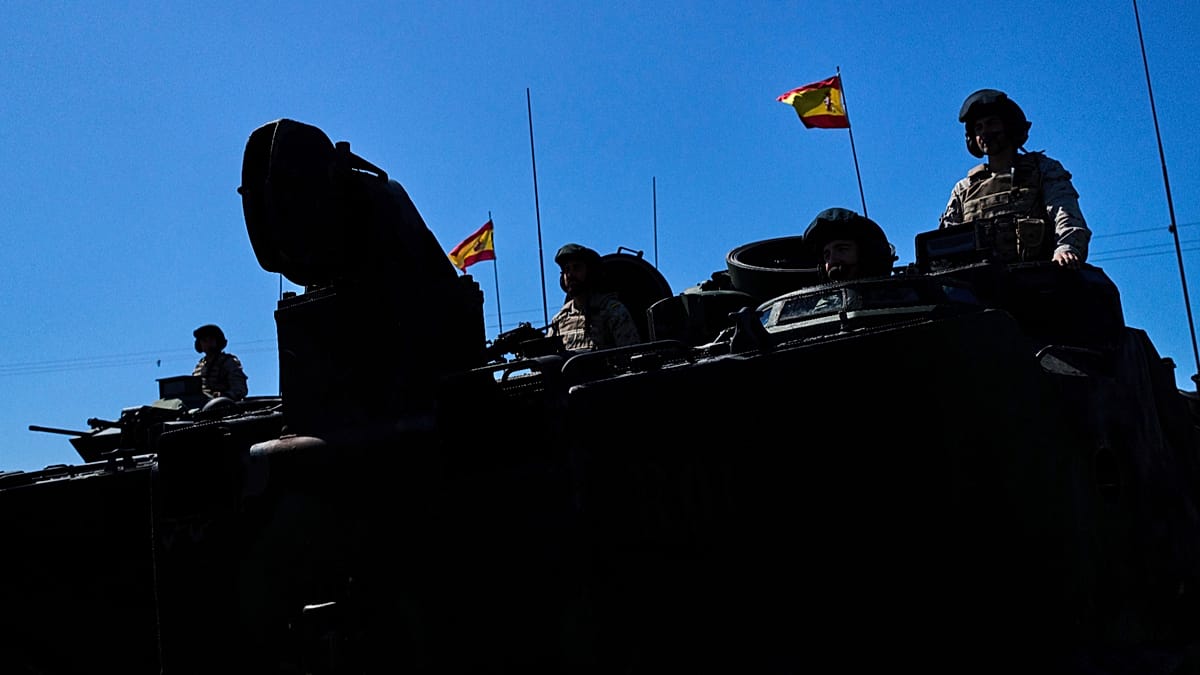
Work to operationalise the European Union’s mutual defence clause should concentrate on circumstances that fall “below the threshold” of NATO’s Article 5, the bloc’s top military official has told Euronews.
ADVERTISEMENT

ADVERTISEMENT
General Seán Clancy, Chair of the EU’s Military Committee, told Euronews over the weekend that his services “stand ready” to help with redefining what European mutual defence means.
On Saturday, European Commission President Ursula von der Leyen used her speech at the Munich Security Conference to call for the EU to become independent in its defence, adding that the time had come for the bloc to bring its mutual defence clause “to life” as part of this effort.
She added that the commitment laid out in the clause, known as Article 42.7 of the Treaties, “only carries weight if it is built on trust and capability”.
Von der Leyen’s comments come with the EU in the midst of a defence overhaul sparked by Russia’s full-scale invasion of Ukraine, with warnings that Moscow could attack another European country before the end of the decade.
But there are also concerns, despite European leaders and ministers publicly stating the contrary, about the US’s continued commitment to European security, NATO and its Article 5 collective defence clause.
‘Below Article 5’
Both NATO’s Article 5 and the EU’s Article 42.7 have been activated only once: the former by the US following the 9/11 attacks, the latter by France after the November 2015 terrorist attacks in Paris.
The EU’s clause states that “if an EU country is the victim of armed aggression on its territory, the other EU countries have an obligation to aid and assist it by all means in their power”.
Asked why the EU needs to further operationalise its mutual defence clause if the 23 member states that are also in the military alliance are convinced of Washington’s long-term commitment to their security, General Clancy said that the roles of the two organisations are very clearly defined.
“NATO is a military alliance in the first instance, the EU is not. The EU is something different completely. And this, I guess, is how we would operationalise this, if I could put it in simple terms, below Article 5,” he told Euronews.
“So in other circumstances, in terms of hybrid war, in terms of the other, I suppose, types of crisis – be they humanitarian, be they a crisis of a more serious nature, be it responsiveness to hybrid threats. What is the EU’s response and how do we operationalise this?”
“I think this is the kind of complementarity, and the focus is complementarity, in order for the EU-NATO understanding and relationship to be strengthened,” he added.
Will the EU be able to defend itself by 2030?
One of the key planks of the EU’s efforts to ramp up its readiness by 2030 is a programme by the EU Commission to incentivise joint defence procurement in order to plug capability gaps in a faster and cheaper manner.
Member states were for instance offered the possibility to tap into a €150 billion Commission-issued loan in order to jointly acquire capabilities among nine identified priority areas, including ammunition, drones, air defence, ground combat and strategic enablers.
General Clancy told Euronews that EU authorities are now “in an implementation phase” and that “all of the nine capability areas are being worked on.”
He conceded however that some sectors are progressing faster than others largely because their industrial bases are more mature. or because lessons from the battlefield in Ukraine have accelerated development. This applies in particular to drones as well as space assets.
The next milestone will be a formal readiness report due in the autumn, intended to provide political leaders – including Commission President Ursula von der Leyen – with greater clarity on where gaps persist and how quickly they can be closed.
Asked whether the EU would be ready to defend itself alone by decade’s end, as is the aim under the Commission’s Defence Readiness 2030 roadmap, General Clancy struck a cautious tone, arguing that the benchmark should be seen as part of a longer-term shift rather than a fixed end state.
“The last four years have taught us that the world is not the same,” he said, pointing to the war in Ukraine as a stark illustration of how conflict is evolving as it combines elements of conventional warfare – such as trenches – alongside disruptive technology-driven equipment.
This makes it impossible, he said, to truly anticipate what a next war in Europe could look like.
What is clear, he argued, is that readiness in Europe must mean preparing for scenarios ranging from “peace, semi-peace, through crisis and into perhaps state conflict”.
“2030 is a target, if you like, and we are accelerating to that, but it’s going to be a continuum,” General Clancy said. Europe, he suggested, will not be able to “sit back” and downgrade defence and security after that date, and will have to sustain current efforts.